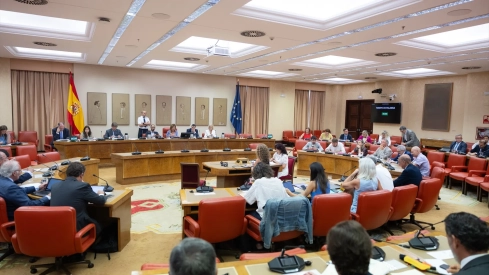
The call for general elections by the President of the Government, Pedro Sánchez, for next November 29 entails the dissolution of the Cortes Generales and will leave certain parliamentary functions in the hands of the Permanent Deputation until the constitution of the new Chambers.
Thus, the body will be especially relevant for the Government in the coming weeks. This Tuesday, the Council of Ministers will again approve the housing decrees that were rejected last Friday in the Congress of Deputies with the votes against of PP, Junts and Vox. Once the Cortes are dissolved, it will be the Permanent Deputation that can assume the power to decide on their validation or repeal.
The Permanent Deputation is the constitutional body that guarantees the continuity of the essential functions of the Chambers when they are not meeting, have finished their mandate or have been dissolved. Its existence prevents an institutional vacuum during periods when the Congress and Senate are not functioning normally.
What the Constitution says
The figure is regulated in article 78 of the Constitution. Each Chamber must have a Permanent Deputation composed of a minimum of 21 members, representing the parliamentary groups in proportion to their numerical weight.
Among its functions is to assume the powers corresponding to the Chambers in the cases provided for in articles 86 and 116 of the Constitution when they have been dissolved or their mandate has expired. In addition, it must “watch over the powers of the Chambers when they are not meeting”.
The Constitution also establishes that, once the mandate has ended or the dissolution has occurred, the Permanent Deputations continue to exercise their functions until the constitution of the new Cortes Generales, scheduled for next December 23.
The role of decrees
One of the most relevant powers in this scenario is that related to decree-laws. Article 86 of the Constitution establishes that these norms, approved by the Government when there is a situation of extraordinary and urgent need, must be submitted to debate and vote in Congress within 30 days following their promulgation.
When the Cortes are dissolved, this function falls to the Permanent Deputation. Therefore, the new housing decrees that the Executive intends to approve this Tuesday may reach this body for its members to decide whether to validate or repeal them. If they are validated, they will remain in force; if they are repealed, they will become ineffective. This possibility is especially relevant after the two previous housing decrees were struck down in Congress with the votes of PP, Junts, and Vox.
A body of 69 deputies
The Permanent Deputation of Congress is made up of 69 deputies and maintains a composition proportional to the representation of the parliamentary groups. Its function is to guarantee the continuity of certain powers of the Chamber while it remains dissolved or out of session.
This change of scenario is especially relevant for the Government because it modifies the parliamentary balance of the vote. According to the current distribution, the Executive can try to gather enough support in the Permanent Deputation to pass at least some of the housing measures. In fact, the Government is studying recovering especially the so-called PSOE decree, while the second text, that of Sumar, would have greater difficulties in gathering the necessary support, after the PNV's refusal.
When the Permanent Deputation acts
The Permanent Deputation can intervene when the Chambers are not meeting in an ordinary session period, when their mandate has expired, and when the Cortes have been dissolved.
In the scenario opened by Sánchez's electoral call, the dissolution of the Cortes will formally activate this mechanism once the corresponding decree is published in the BOE.
From then until the constitution of the new Cortes, the Permanent Deputation will be responsible for exercising the functions attributed to it by the Constitution.
It does not replace Congress in all its functions
The Permanent Deputation does not have the same powers as the Plenary of Congress. Its capacity to act is limited to the functions attributed to it by the Constitution and parliamentary rules. Therefore, it cannot normally carry out the legislative activity of the Chambers nor process ordinary laws, Budgets, or legislative reforms through the usual parliamentary procedure.
Its function is to ensure that certain essential powers continue to be exercised despite the dissolution of the Cortes. Among them is also the role attributed to it by article 116 of the Constitution in relation to states of alarm, exception, and siege.
The calendar after the elections
With the general elections set for November 29, 2026, the Permanent Deputation will continue to exercise its functions until the new Cortes Generales are constituted.
During that period, any royal decree-law approved by the Government must be submitted to the corresponding constitutional procedure within the established period.
In the case of the housing decrees that the Council of Ministers will approve this Tuesday, the Permanent Deputation will, therefore, be the parliamentary body that can decide on their validation or repeal once the Cortes have been dissolved.
