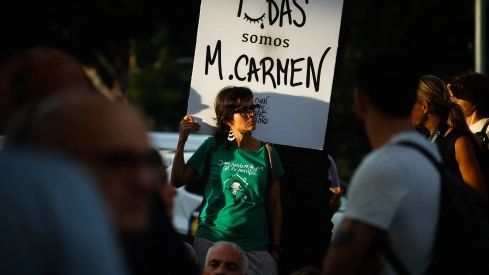
The Government brings this Tuesday to the Council of Ministers the new housing decree after a last-minute negotiation that has not yet allowed all support to be secured. The Executive thus fulfills the commitment assumed by the president, Pedro Sánchez, after the eviction of Maricarmen, the 87-year-old woman expelled last week from the Madrid house where she had lived since 1956.
The latest known version proposes suspending evictions of vulnerable people without housing alternatives until the end of 2028, extending rental contracts that are about to expire, limiting temporary leases, and expanding tax aid for tenants and small landlords.
The document may still incorporate changes during the hours leading up to the meeting. Conversations have extended until the eve with differences within the Government itself and among the parties that will later have to support the norm in Congress. Sumar values the progress, but considers the proposal insufficient on two issues it deems fundamental: the regulation of room rentals and the automatic renewal of contracts.
The Council of Ministers can approve the royal decree-law even if the Executive lacks a closed parliamentary majority. Once published in the Official State Gazette (BOE), it will come into force and a 30-day countdown will begin for its validation in Congress. Deputies will have to vote on the full text and decide whether it remains in force or lapses.
The closest precedent forces Moncloa to intensify negotiations. The previous decree, which allowed certain rentals to be extended for two years and limited the update of rents to 2%, was rejected in April by 177 votes to 166 and five abstentions. Junts was decisive in overturning a norm it considered detrimental to small landlords.
An anti-eviction shield until 2028
The draft suspends until December 31, 2028, eviction procedures affecting households in a situation of economic vulnerability and without alternative housing. Before executing the eviction, the court will have to request that regional and municipal administrations detail available resources and offer an adequate solution.
When no administration guarantees that alternative, the procedure will be paralyzed. The suspension will be reviewed every twelve months and may be maintained for a maximum of three years. The text aims to avoid cases like Maricarmen's, whose eviction went ahead despite her age, her recognized disability, and the precautionary request sent by the United Nations.
The protection incorporates compensation for small owners. The Administration must assume unpaid monthly payments, utilities, and other damages derived from the suspension when the landlord is an individual. One of the versions circulated in recent hours also introduces an exception for those who own two homes or less, the scope of which continues to be part of the negotiation.
The decree also reinstates the extraordinary extension of contracts. Tenants whose leases end before the close of 2028 may request up to two additional years, divided into annual periods, provided they are up to date with payments. During that time, the price and main conditions of the current agreement will be maintained.
The owner may recover the home if they prove that they need it as their habitual residence or that of certain family members. The extension will also not apply when both parties reach another agreement or sign a new contract with a rent reduction of at least 5%.
Some documents distributed among the groups have even proposed three annual periods. The difference between these versions reflects the extent to which the text remains open. The most developed draft maintains the maximum extension of two years, the same duration as the decree rejected in April, although it expands the number of contracts that could be covered.
The text also protects extension requests submitted while that rule was in force. The objective is to prevent tenants who carried out the procedure during those weeks from losing the right due to the subsequent repeal of the decree in Congress.
More limits on temporary rentals and new aid
The Ministry of Housing wants to close one of the main avenues used to circumvent the regulation of habitual rentals. Temporary contracts must respond to a real and verifiable cause, such as a work displacement, studies, or medical treatment. The reason must appear in writing and can be verified.
The duration will be between 31 days and twelve months. If the owner lacks a valid justification, exceeds that period, or chains more than two contracts, the rental will be considered a habitual residence from the date of its signing. This conversion will allow the tenant to benefit from the guarantees provided in the Urban Leases Law.
Updates to temporary rents will be subject to the official index used for habitual contracts. The landlord will also not be able to charge the tenant for community expenses, taxes, real estate management, or the formalization of the contract. The additional guarantee will be limited to one month's rent, and it will be prohibited to require the contracting of a non-payment insurance.
Tourist apartments will have a different treatment. The draft defines this activity as the transfer of a furnished dwelling for a maximum of 30 nights and advertised on tourist channels. Platforms that fail to comply with registration obligations may receive sanctions of between 100,000 euros and one million.
In areas declared stressed, new rents may not exceed the price of the previous contract or the maximum set by the state reference system. Autonomous communities will also have the possibility of lowering the threshold that determines when an owner is considered a large holder from ten to five dwellings.
The fiscal package includes deductions for both parties to the contract. Owners may apply reductions in the Personal Income Tax (IRPF) that will reach up to 100% in certain cases and will depend on the reduction applied to the rent, the location of the property, and the age of the tenant.
Tenants in stressed areas with a taxable base of less than 33,007.20 euros may deduct 10% of the rent of their habitual residence. The Executive also proposes surcharges on the Real Estate Tax (IBI) for empty homes and tourist apartments, in addition to a tax on certain benefits that listed real estate investment companies decide not to distribute.
The 'TU CASA' line will offer, through the Official Credit Institute (ICO), loans of up to 50,000 euros without interest or commissions for those who have the capacity to pay a mortgage, but lack the necessary savings for the down payment. The draft also extends the guarantees for building affordable housing and rehabilitating the existing stock to 2,000 million.
State and Social Security properties that can be used for housing will be transferred to Casa 47. An exemption of up to 100% of capital gains is also established for those who sell a home to a public entity with the commitment to incorporate it into the social and affordable housing stock.
The agreement is still pending on room rentals
The main stumbling block within the Government is the measures that have been left out. The latest version does not regulate room rentals nor does it make contract renewals automatic. Sumar believes that both tools are necessary to guarantee stability and close another of the avenues used to make housing more expensive.
Sources from the party have acknowledged progress in protection against evictions, extensions, and rent freezes, although they maintain that the agreement "is still not close". The negotiation has improved after pressure from the ministers of the minority partner and from the left-wing parties gathered this Monday in front of the Gregorio Marañón Hospital, where Maricarmen remains hospitalized.
Podemos has celebrated that the Government has withdrawn the reform of the Land Law included in previous versions. The party demanded its elimination, considering that it reduced urban planning controls. Its four deputies still do not guarantee a favorable vote and demand that the decree allow the expropriation of homes from investment funds to incorporate them into social housing.
Junts has managed to get the draft to compensate small owners affected by the suspension of an eviction and incorporate new tax advantages. The Catalan party demands a "common minimum denominator" that protects vulnerable families without transferring the cost to individuals, although it has not yet committed its seven votes either.
The Basque Nationalist Party (PNV) asks that extensions be limited to tenants who are up to date with payments and demands respect for regional competencies. Esquerra Republicana de Catalunya (ERC) has focused its demands on temporary and room rentals, the suspension of evictions, surcharges on vacant housing, and the end of tax advantages for real estate companies.
Outside Congress, the Tenants' Union maintains pressure on the Executive. Its spokesperson, Rufina Parra, has warned that mobilization will continue even if the Council of Ministers approves some of their demands. The collective demands automatically renewable contracts, price freezes, and complete protection against evictions without housing alternatives.
The Puerta del Sol encampment, which endures despite the bad weather, thus reaches the morning of the Council of Ministers with its tents still installed and with the so-called 'Maricarmen Decree' as its main demand. "We will not accept a false decree," the Tenants' Union has warned.
Add ElConstitucional.es as a preferred Google source for free.
Stay informed about all the latest breaking news with the best information. Against disinformation, for democracy and social rights.
