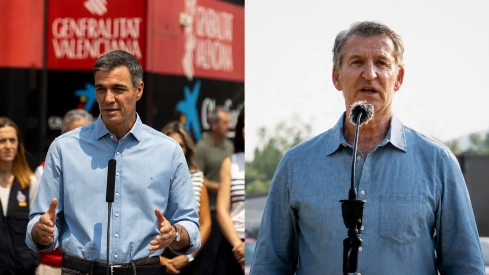
The Government once again places the State pact against the climate emergency at the center of its response to the fires. Pedro Sánchez called this Tuesday on parties, autonomous communities, city councils, scientists, and social organizations to support a common agreement to improve prevention, coordinate resources, and accelerate reconstruction after each catastrophe.
The call comes after one of the most serious weeks experienced in Spain since comparable records exist. More than 172,000 hectares have burned since the beginning of the year, six times the area burned during the same period in 2025. The fires in Madrid, Ávila, Toledo, and Castellón have also forced the evacuation or confinement of more than 100,000 people.
"Climate denialism is the worst fuel," Sánchez affirmed during his political course balance. The president defended that Spain needs to remain united during extinction, but also during the months dedicated to preparing the mountains, adapting infrastructures, and protecting the population from increasingly violent heat waves, droughts, and fires.
The Popular Party has not yet confirmed whether it will support the pact. Génova avoids completely closing the door, although it accuses the Government of proposing an "ideological and sectarian" agreement and demands that any negotiation incorporate funding, clear responsibilities for each administration, and the 50 measures presented by Alberto Núñez Feijóo after the 2025 fires.
The popular position therefore has two levels. The PP has concrete proposals and has been demanding a great national agreement on natural risks for months. At the same time, its main leaders avoid answering whether they will participate in the pact that is already on the table and have hardened their messages against the link between climate change and the severity of the fires.
A pact with 80 measures that is still seeking support
The Government's proposal began to be drafted after the large fires of the summer of 2025. After several months of consultations, La Moncloa presented in December a document with 15 axes and 80 measures, built from more than 3,800 contributions made by 1,300 scientists, administrations, companies, agricultural organizations, unions, and social groups.
One of these axes is entirely dedicated to forest management. The text proposes preventive silvicultural treatments, low-intensity controlled burns, extensive livestock farming, grazing, sustainable use of biomass, more resilient reforestation, and new economic chains linked to wood and forest resources.
The pact also proposes permanent professional teams throughout the year, with greater stability and better conditions for forest firefighters, environmental agents, and brigades. It adds a national catalog of capabilities, information systems compatible between administrations, and a State Agency for Civil Protection and Emergencies to improve coordination.
The plan covers other areas related to climate catastrophes. It includes the adaptation of cities and educational centers to heat waves, new labor protocols, vulnerability maps, measures against floods and droughts, a network of climate shelters, and training and self-protection campaigns aimed at citizens.
The Government has already begun to deploy some actions. The General State Administration has 180 climate shelters, which will remain open every summer, and has announced ten million euros to expand the network and another nine million for green infrastructures and urban renaturalization projects.
The Council of Ministers approved this Tuesday the creation of the Scientific Panel for Action against Climate Change. It will initially be composed of ten researchers specialized in climate, ecology, water, agriculture, health, coasts, engineering, environmental law, sociology, and communication.
The initiative has defined content and objectives, although it still lacks a global budget that would allow knowing how much it will cost to apply its 80 measures. This absence offers the PP one of its main arguments to demand greater financial specificity before sitting down to negotiate.
La Moncloa has not announced a bilateral meeting between Sánchez and Feijóo to address the agreement either. Both leaders have not met since March 2025. The Government intends to take the document to Congress and reopen contacts after the summer, but has not yet set a negotiation calendar with the opposition.
The PP claims its 50 measures
The PP reminds that Feijóo already presented in August 2025 a Comprehensive Plan for Aid, Recovery and Prevention for Rural and Forest Areas. The document contains 50 measures divided between immediate attention to those affected, the recovery of territories and the prevention of new fires.
Among its proposals are new battalions of the Military Emergency Unit, the reinforcement of Seprona staff, a National Forest Fund, tax incentives for silvicultural activity and stable state funding for prevention and extinction devices.
The popular plan also proposes reforming the Forest Law to facilitate forest exploitation and fuel removal, creating a coordination law for the more than 120 fire services existing in Spain and increasing investment in research, artificial intelligence, early detection and soil restoration.
Feijóo again called on July 13 for a grand agreement on prevention, coordination and response to natural risks. His proposal involves delimiting the responsibilities of each administration, identifying all available means and approving multi-year funding to protect the most exposed municipalities.
The popular leader demanded that autonomous communities, city councils, technicians, scientists and rural inhabitants participate in its elaboration. He also asked to listen to ranchers and farmers affected by administrative restrictions that, according to the PP, hinder clearing and the use of forests.
Ester Muñoz has followed this line in recent days. The parliamentary spokesperson accuses the Executive of dedicating only 1% of European funds to prevention and extinction, delaying the modernization of seaplanes and avoiding a meeting with all regional presidents to agree on how to finance actions.
The PP has measures and some coincide with those of the Government. Both documents advocate active forest management, extensive livestock farming, professionalization of teams, improved coordination, technological innovation and more stable funding. The main difference lies in the political framework, the distribution of powers and the weight that each party gives to the climate emergency.
Génova wants its 50 proposals to be the starting point of any conversation. Cuca Gamarra avoided confirming whether the party will attend the table promoted by La Moncloa, while Borja Sémper reproached the PSOE for never having responded to the plan approved by the popular majority of the Senate in September 2025.
Hoaxes enter the fight over fires
The political discussion has ceased to revolve solely around measures. Ayuso and Ester Muñoz have spread false or misleading statements about forest legislation and the effect of climate change in recent days, in some cases coinciding with messages previously disseminated by the far-right Vox and by disinformation accounts on social media.
The president of the Community of Madrid assured that Spain has "a real problem with forest cleaning" and spoke of the "difficulties in cleaning the forests, in working on their own land". Her intervention fueled the narrative that the Forest Law prevents the removal of vegetation or the performance of prevention work.
State legislation does not prohibit cleaning forests. The Forest Law of 2003, approved during a PP Government, obliges the autonomous communities to develop prevention plans that include clearing, pruning, removal of remains, firebreaks and other forest management actions.
Limitations appear during periods of higher risk, when administrations temporarily restrict the use of spark-generating machinery, agricultural burning and other dangerous activities. These prohibitions aim to prevent new outbreaks on days with extreme temperatures, wind and very low humidity.
Owners must maintain their land in adequate conditions and it is up to the autonomous communities to regulate and execute a large part of forest prevention. The State provides means, coordinates resources and can assume direction when an emergency is declared of national interest, as has happened in Madrid, Ávila and Toledo.
Ester Muñoz, for her part, stated that climate change is used as a "mantra" to hide the Government's "poor management". She also maintained that the climate has changed throughout the history of humanity and shifted the debate towards the actions of administrations and the state of the forests.
That the climate has varied throughout history is true. The statement is incomplete when used to relativize current warming, accelerated by human emissions and accompanied by longer heat waves, more intense droughts, and periods with an increasingly extreme risk of fire.
Human action causes most of the outbreaks, whether due to negligence, accidents, or intentional acts. Climate change then acts on the ground and makes it easier for a spark to turn into a large fire. The human origin of a fire and the influence of global warming can occur at the same time.
The European Environment Agency confirms that high temperatures, prolonged droughts, and the accumulation of dry vegetation increase the number of days with high danger. The Government's own documentation and numerous scientific works place the Iberian Peninsula among the European territories most exposed to this worsening.
Forest management also influences. Rural abandonment, the reduction of extensive livestock farming, the lack of biomass utilization, and the accumulation of fuel favor propagation. Presenting the debate as a choice between climate change or forest clearing distorts a problem in which both realities intervene.
From the exchange of reproaches to the pending negotiation
The PSOE accuses the PP of approaching Vox's denialism and recalls that several communities governed by both parties have signed agreements against the European Green Pact or to revise climate laws. Sánchez maintains that these pacts hinder any national consensus based on scientific evidence.
The popular party responds that La Moncloa uses fires to avoid talking about its responsibilities. Ester Muñoz calls for more investment in prevention, a review of aerial means, and a reform of the Forest Law, while Feijóo demands a multi-year budget that guarantees different resources according to the forest extension of each community.
The Government also approved this Tuesday its first battery of aid for those affected. It declared the territories hit since March 31 as areas seriously damaged by a civil protection emergency and activated tax benefits, Social Security exemptions, and mechanisms to repair homes, businesses, and infrastructures.
The new labor shield will allow suspending contracts and requesting an extraordinary benefit for those who cannot work due to an evacuation, loss of their home, access restrictions, or caring for family members. The aid can be maintained for a maximum of four months without consuming accumulated contributions.
Self-employed individuals will be able to access cessation of activity without accrediting a minimum contribution period, and affected companies will have the possibility of requesting exemptions for workers included in an ERTE. The decree also protects against reprisals those who need to avail themselves of these rights.
The immediate response moves forward while the fight over the long-term agreement continues. The Interior Ministry will meet this Wednesday with the autonomous communities to review the evolution of the fires and coordinate resources in anticipation of the new heatwave. After the summer, the Government will take its pact to Congress and the PP will have to decide whether to negotiate on the 80 measures, propose integrating its 50 proposals, or remain outside the agreement.
Add ElConstitucional.es as a preferred Google source for free.
Stay informed about all the latest breaking news with the best information. Against disinformation, for democracy and social rights.
