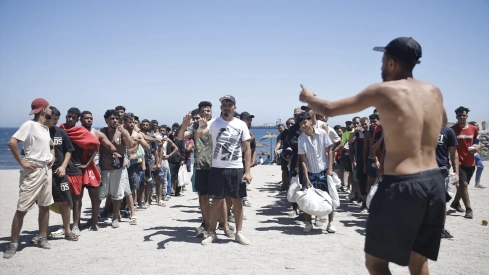
The Government faces this Thursday the most delicate part of the migratory crisis in Ceuta. More than a thousand unaccompanied foreign minors remain in a city with overwhelmed protection centers, housed in makeshift facilities or still scattered through the streets and neighborhoods of Ceuta.
The Executive is already preparing their transfers to other autonomous communities and has enabled an extraordinary allocation of 25 million euros to reinforce immediate assistance. The objective is first to identify each minor, get them off the street, open their file, and individually study their circumstances before deciding their destination.
The response has once again opened a clash with the far-right Vox and with the governments it shares with the Popular Party. Extremadura, Aragon, Castilla y León, and Andalusia announced that they will oppose receiving the minors assigned to them, although the reform of the Immigration Law makes the participation of the communities a legal obligation.
The Government delegate in Ceuta, Miguel Ángel Pérez Triano, warned this Wednesday of the consequences of maintaining that rejection. "Evidently, the law must be complied with," he stated before pointing out that, if any autonomous community refuses to take in the minors, "the Minors' Prosecutor's Office will have to act ex officio".
An Overwhelmed Network
Ceuta had 862 minors attended to at the beginning of this week, but the city government estimates that the real figure already exceeds 1,000 and could approach 1,100. The count continues to grow as protection services locate children and adolescents who remained outside any registry.
The Government Delegation managed a much lower estimate this Wednesday, close to 500 minors. The difference again shows one of the main problems of management. Six days after the massive entry, there is still no closed figure for the people remaining in Ceuta nor for how many are minors.
The lack of a complete registry extends to all migrants. The president of Ceuta, Juan Jesús Vivas, spoke on Monday of between 3,000 and 5,000 people and raised his estimate this Wednesday to 6,000. The central government maintains that about 2,500 remain after the return to Morocco of most of the 72,000 people who entered on July 30 and 31.
The evolution of both estimates follows opposite directions. While the Interior Ministry reduces its calculation as returns progress, Vivas has increased his in just two days. The 3,500-person gap between the two administrations reflects the lack of means to identify those who remain on beaches, mountains, neighborhoods, and around the CETI.
The situation of minors also requires a different procedure than that applied to adults. Their possible return with their families must be analyzed individually, first locating the family members and verifying that reunification is safe and in the child's best interest. This process does not allow for collective return nor does it eliminate the immediate obligation to protect them while they remain in Spain.
The 25 million euro allocation announced by the Government will serve to expand places, reinforce the teams in charge of care, and accelerate the processing of files. The Foreigners Office of the Delegation will also receive more personnel so that administrative documentation does not prolong for months the stay of minors in already collapsed facilities.
The crisis simultaneously keeps a still provisional human toll open. The broadest count raises the number of deceased to 141 people, with 78 bodies recovered in Spanish waters and another 63 in Moroccan territory, according to data compiled by Caminando Fronteras. The central government still manages a lower figure, and search and identification efforts continue on both sides of the border.
PP and Vox before the law
The Popular Party's position changed in just 24 hours. The party's general secretary, Miguel Tellado, avoided differentiating between adults and minors on Tuesday and argued that those who had entered irregularly should return "the way they came." He also presented what happened as a national security crisis and held the Government responsible for guaranteeing departures.
Génova partially corrected that discourse this Wednesday. The Deputy Secretary for Sectoral Coordination, Alma Ezcurra, assured that "the PP communities will always comply with the law and will stand by the people of Ceuta," although she maintained her criticism of Moncloa and demanded to first know the exact number of minors.
The new position of the national leadership clashes with the government agreements signed by the PP and Vox. The pacts of Aragon, Extremadura, and Castilla y León include the commitment to oppose, through all political, legal, and administrative instruments, the distribution of migrants, including minors. The Andalusian agreement also includes an express rejection of new arrivals.
The regional vice-presidencies controlled by Vox have now relied on these documents to close the door. Castilla y León announced a "frontal opposition", Aragon stated that it would use all resources at its disposal, and Extremadura refused to open centers or expand places. In Andalusia, Vice President Manuel Gavira assured that the regional executive would not accept new transfers either.
Political agreements between PP and Vox lack the capacity to override a state law. Communities may file appeals against individual resolutions, discuss distribution criteria, or demand more funding, but they must receive the minors assigned to them as long as no court suspends the procedure.
The far-right maintains a complete rejection. Santiago Abascal responded to the announcement of the 25 million by stating that "not one euro" should be allocated to migrant minors, whom he mixed in the same message with adults in irregular situations, human traffickers, and Morocco. Vox also calls for generalized expulsions and habitually uses the acronym "mena" as a derogatory label against these children and adolescents.
The reform of article 35 of the Immigration Law was approved precisely to prevent territories like Ceuta or the Canary Islands from bearing alone a pressure that far exceeds their capacity. When an extraordinary migratory contingency is declared, the State coordinates relocation using objective criteria, and the destination communities assume guardianship and care.
The procedure sets a maximum period of 15 days from the minor's registration and the opening of their file. The State finances transfers, and reception must be distributed according to population, the capacity of each protection system, previous efforts made, and other territorial circumstances. Solidarity thus ceases to depend on the will of each regional government.
The High Court seeks alerts
The management of minors progresses while the Audiencia Nacional begins to investigate what happened before and during the massive entry. Judge María Tardón this Wednesday asked the Civil Guard for a report to find out if any of its units received prior information that could have warned of what was going to happen on July 30 and 31.
The magistrate also wants to know about the deployment in Ceuta, the rescue operations carried out in Spanish waters, the identity of the survivors, and the available data on the deceased. The request adds to the report previously commissioned from the National Police to determine if the entry was due to a concerted action or directed by some organization or criminal group.
The proceedings originated from a complaint filed by Iustitia Europa. The Audiencia Nacional still has to decide if it has jurisdiction to take on the investigation, but Tardón has begun to gather information before making that decision.
The Civil Guard must now clarify if there was any prior alert, what information reached its units, and how the response was organized during the hours in which tens of thousands of people crossed the border.
Add ElConstitucional.es as a preferred Google source for free.
Stay informed about all the latest breaking news with the best information. Against disinformation, for democracy and social rights.
