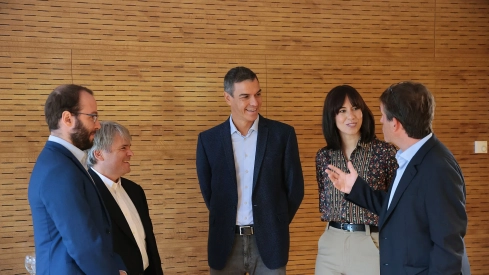
The Government wants to raise the demands of each university degree and block the way for centers that have turned the lack of public places into a business opportunity. The President of the Government, Pedro Sánchez, announced this Friday the processing of a new royal decree that will strengthen the quality of teaching staff and limit distance learning in those careers that require practical and in-person training.
Sánchez presented the initiative during a visit to the Institute of Mathematical Sciences, accompanied by the Minister of Science, Innovation and Universities, Diana Morant. The text will be worked on with the Conference of Rectors of Spanish Universities (CRUE) and with student representatives before its approval.
The president directed his message especially towards centers that have grown in the heat of a demand that the public network cannot absorb. "Universities with a questionable quality offer have appeared that take advantage of this situation to do business," he warned. He then summarized the purpose of the reform with a forceful phrase: "A university cannot be a beach bar or a franchise dispensing degrees."
Control will reach every degree
One of the main changes will affect the teaching staff. At least 50% of the teachers of each degree or master's degree must have a doctorate and 40% will have to work full-time. The current regulation calculates the percentage of doctors over the entire staff of a university, which allows them to be concentrated in some faculties while other degrees fall below.
The Executive intends that the requirements be met degree by degree, both in public and private universities. Full-time hiring also seeks to reduce precariousness and ensure that professors have enough time to teach, research, and attend to students.
The second pillar of the decree will be in-person attendance. The Government plans to require it in studies that need practical training, contact with patients, or the use of specialized facilities, with special attention to health sciences. The definitive list will still need to be finalized during the processing. Medicine, Nursing, and Veterinary Medicine are already taught in person. The new regulation could force a review of certain online or blended learning offerings in Psychology, Pharmacy, Occupational Therapy, or Physical Activity Sciences, provided they are finally included among the affected degrees.
Private growth is especially visible in this field. Between 2015 and 2025, the number of students in health degrees at private centers increased from about 50,000 to over 101,000. In public universities, it barely varied, from 188,400 to 189,300 students. The scarcity of places and locations for practical training has ended up opening an increasingly larger market for tuition-based centers.
The private sector, one university away from equaling the public
Spain already has 99 universities, 50 public and 49 private. The difference narrows even further in distance learning: eight of the nine universities of this type are private. In the 2023-2024 academic year, more than 316,000 people studied in distance learning centers, about 18% of university students.
The advance of the private network has been very rapid. During the last decade, its enrollments grew by 128%, while those of the public sector increased by 3%. In master's degrees, private centers have tripled their student body and already surpass public universities.
Sánchez attributes part of this expansion to the lack of funding and places. In the 2024-2025 academic year, public in-person universities received close to half a million first-choice applications for just over 245,000 spots. This difference raises cut-off scores and pushes thousands of families towards private centers when they can afford the cost.
The situation is especially visible in communities governed for years by the PP. Of the 20 existing universities in Madrid, 14 are private. Castilla y León has five private and four public. Sánchez has accused these regional governments of applying "planned obsolescence of the public sector", deteriorating the offerings until presenting private initiative as the only way out.
Public universities and the CRUE have been demanding stable funding for years to allow for staff renewal, expansion of places, and improvement of infrastructure. The Organic Law of the University System set the goal of reaching a minimum public funding equivalent to 1% of GDP.
The Government defends that direct state funding to universities has grown by 78% since 2018 and recalls that scholarships reached almost 1.3 billion euros in the 2025-2026 academic year, 42% more than eight years prior. It also plans to create more than 20,000 places at the National University of Distance Education by 2029.
The royal decree will now begin its negotiation with rectors and students. During this process, the degrees subject to mandatory in-person attendance, the adaptation periods, and the way to verify that each degree and master's program meets the new requirements must be established.
Add ElConstitucional.es as a preferred Google source for free.
Stay informed about all the latest breaking news with the best information. Against disinformation, for democracy and social rights.
