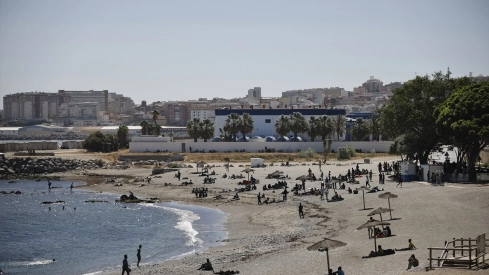
The migratory crisis in Ceuta keeps the confrontation open between the Government and the Popular Party. The Executive reinforced its response this Monday with the implementation of extraordinary humanitarian assistance devices that will allow the immediate habilitation of 1,500 new places for migrants, while the popular party has intensified its parliamentary offensive with a battery of measures and new requests for appearance from three ministers.
The Minister of Inclusion, Social Security and Migration, Elma Saiz, traveled to the autonomous city this Monday to announce the activation of the new resources, which will be temporary and will be distributed in four locations. One will be located in the parking lot of the Loma del Colmenar embankment, ceded by the Autonomous City; another, in the equestrian facilities; and the two remaining will be installed in the old football field of the Cavalry barracks and in the so-called Guano space, both state-owned.
Saiz has defended that coordination between the different administrations is the way to restore normality in Ceuta as soon as possible. “Collaboration between institutions is fundamental to restore normality in Ceuta as soon as possible. That will be the compass that guides my stay these days,” she said during her visit.
The minister has also vindicated the Executive's actions since the beginning of the crisis and has assured that the Government has not stopped working “not for a single second” alongside the autonomous city. In this sense, she has placed Pedro Sánchez at the head of a response that, as she explained, has been developed through face-to-face meetings, telematic encounters and trips by members of the Executive to Ceuta.
Sánchez himself led a coordination meeting by videoconference this Monday with several members of his Government to analyze the situation after the massive entry of people into Ceuta and after a new attempt to enter Spanish territory was prevented last Saturday, August 15. The meeting was held while the president remains at the official residence of La Mareta, in Lanzarote.
The PP demands explanations from three ministers
Faced with the Executive's response, the PP has decided to increase institutional pressure. The party has announced that it will request the appearance of Mónica García, Elma Saiz, and Sira Rego to explain to the Cortes the actions taken in their respective areas regarding the Ceuta crisis.
The offensive adds to the non-legislative motion registered by the popular party, which includes eleven measures to demand urgent action in the autonomous city. Among its main demands are the reinforcement of the protection of territorial integrity and the creation of a single command to coordinate the State's response.
The Deputy Secretary of Institutional Regeneration of the PP, Cuca Gamarra, has accused the Government of not responding to the dimension of the crisis and has directed her criticism at Sánchez. "Sánchez no longer acts as President of the Government. He has become a character, a hologram that appears behind a screen, but who is not capable of leading a country."
Gamarra believes that the Executive knew the risks Ceuta was facing and did not react in time. "They were warned and did nothing. When it happened, they did not react, and 17 days later, sufficient and urgent measures are still not being adopted to guarantee the freedoms and rights of the people of Ceuta," she stated.
The popular leader has also argued that the situation should not be addressed exclusively as a humanitarian emergency, but from the perspective of security and territorial integrity.
Vivas threatens to go to Justice if the crisis is not resolved in a month
Tension has also increased between the Executive and the president of Ceuta, Juan Jesús Vivas. The regional leader has hardened his criticism against the Government's management and has warned that, if the migratory crisis is not resolved within 30 days, he will go to different institutions to demand a response.
Vivas has announced that he will resort, if necessary, to "the Cortes Generales, the Judiciary, the communities, the Federation of Municipalities and Provinces, business organizations, or trade unions." "Whoever is needed, we will not give up," he declared. Subsequently, he clarified his words and stated that he would convey the situation to those institutions willing to receive him.
The president of Ceuta has also accused the Government of having “sugarcoated reality” during the crisis and has denounced what he considers a response marked by “passivity,” “ineptitude,” and “irresponsibility.” In his opinion, this attitude would respond to the objective of “not bothering the neighbor” and preserving “pseudo good relations” with Morocco.
The Government thus faces a new week with the Ceuta crisis as one of the main focuses of political confrontation, with the Executive defending the reinforcement of reception resources and the PP demanding more explanations, new appearances, and a state response that it considers in line with the dimension of the situation.
