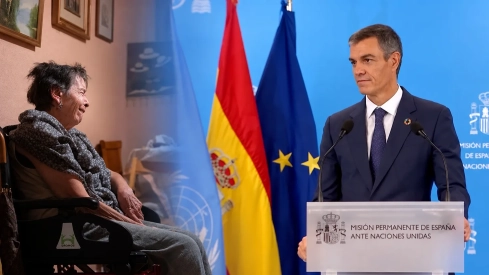
The image of Maricarmen Abascal leaving on a stretcher from the house where she had lived since 1956 has disrupted the Government's calendar. After several months postponing the housing decree due to lack of parliamentary support, the Executive is now working against the clock to approve it in the coming days, with the Council of Ministers on Tuesday, September 29, as the first possible date.
The woman, 87 years old and with a recognized disability of 50%, was evicted this Wednesday from her apartment on Alcalde Sainz de Baranda street, in Madrid. The real estate company Urbagestión rejected the last attempt at postponement and the judicial commission executed the eviction through a huge National Police operation. Maricarmen left the building on a stretcher and was transferred to Gregorio Marañón Hospital before temporarily staying with relatives.
The scene has been a political blow of the first magnitude for a Government that promised to make this legislature the one for housing. Moncloa assumed during the afternoon that the eviction had caused damage difficult to contain with statements and reproaches to other administrations. The order is to accelerate a norm pending since July, intensify negotiations with Sumar and seek the necessary votes among parliamentary partners.
The draft remains open. The PSOE had been defending for weeks that the decree should only go through the Council of Ministers when there were sufficient guarantees to validate it in Congress. Sumar demanded to approve it, put it into effect and use the subsequent thirty days to negotiate support. After the eviction, the parliamentary arithmetic remains just as complicated, but the cost of waiting has grown abruptly.
A norm postponed until the photo arrived
The decree includes the suspension of evictions from vulnerable homes until there is a housing alternative, exceeding the temporary limit that allows the eviction to be reactivated even if the competent administration still cannot find a solution. The owner would receive public compensation during that period, especially when it is a small landlord.
The text also contemplates the extension for two years and with the same rent of contracts expiring in 2026, 2027, and the first half of 2028. Added to this are stricter regulation of seasonal and room rentals, measures against fraud in these modalities, and changes aimed at permanently preserving protected housing.
The gridlock appears in the rest of the package. Junts demands more tax advantages for owners and quick eviction mechanisms, while Podemos rejects tax cuts for rentiers and any modification of the land law that facilitates speculative operations. Among the options studied is separating the anti-eviction shield to facilitate its approval, although Sumar demands maintaining the complete decree.
The minority partner has increased pressure after weeks of exasperation with the PSOE. Ernest Urtasun demands that the norm reach the Council of Ministers on Tuesday "without fail". Pablo Bustinduy maintains that the Government must approve it and force the groups to take a stand in Congress. The Minister of Health, Mónica García, even publicly clashed with Óscar Puente after asking him to stop responding to Ada Colau and focus efforts on advancing housing measures.
The dispute exposes a difference that has been running through the Executive for months. Sumar wants to take the risk of a parliamentary defeat, and the PSOE fears another failed vote. Maricarmen's eviction has turned that tactical discussion into a moral and political problem. During the first quarter of the year, courts carried out around 2,600 evictions related to rent and another 971 derived from mortgage foreclosures. Meanwhile, rents in Madrid have risen more than 80% since 2016, and wages have done so approximately half.
Sánchez points to Madrid and avoids self-criticism
Pedro Sánchez described the eviction from New York as a "social tragedy that we cannot accept". The president assured that the Government would send a new decree to Congress urgently, asked for "a broad perspective" from the groups, and stated that, if the previous protection had been validated, Maricarmen would have been able to remain in her home.
Sánchez directed his attacks against Isabel Díaz Ayuso and José Luis Martínez-Almeida, whom he held responsible for having ignored an emergency that corresponded to the Community and the City Council to attend to. He accused the two administrations of being more concerned with buying and selling with public money "penthouses with 200 meters of terrace" than with protecting a vulnerable woman.
El desahucio de Maricarmen es una tragedia social que no podemos aceptar.
— Pedro Sánchez (@sanchezcastejon) September 23, 2026
El Ayuntamiento y la Comunidad de Madrid, más preocupados por comprar y vender aticazos, han hecho caso omiso a una demanda social que debería haber sido resuelta por quienes tienen esa responsabilidad… pic.twitter.com/GU4NhtiCk0
The criticism has an obvious basis. Ayuso's Government refuses to declare stressed areas, rejects applying the main tools of the state law, and has turned Madrid into a showcase for real estate funds. The City Council assures that it offered Maricarmen an emergency place in a residence, an option that took her away from her home and her environment and which she rejected to stay with relatives. Neither of the two administrations found a solution for years that would allow her to continue living with dignity in her neighborhood.
The 485-square-meter penthouse acquired by the Community of Madrid in Chamberí completed the symbol. While Maricarmen was evicted from the apartment where she had spent seven decades, the regional Administration had a luxury home bought with public money and initially intended for the use of the regional president.
Sánchez's harshness with Ayuso and Almeida coexisted with a clear absence of self-criticism. The Government kept the decree out of the Council of Ministers for months, despite the fact that its approval would have activated the measures immediately and then opened the period to seek support in Congress. Parliamentary prudence explains the delay and leaves its political cost intact. A complete explanation of the police action is also missing. The judicial order had to be executed, but the deployment corresponded to the National Police, dependent on the Ministry of Interior. Journalists and activists reported blows, the use of pepper spray inside the building, and restrictions that prevented them from covering the eviction for hours from the vicinity of the entrance.
First they kick out the press. Then they evict with violence.
— Tenants' Union of Madrid (@InquilinatoMad) September 23, 2026
This is how the PSOE protects investment funds.
Responsible: Francisco Martín Aguirre, Government Delegate of Madrid. pic.twitter.com/z8PB2kC0e2
The Government Delegation assures that it did not give instructions to remove the press and attributes decisions about the perimeter to police commanders. This response is insufficient in the face of images that demand clarification on the proportionality of the operation. Sumar has already demanded an investigation from Fernando Grande-Marlaska.
Ten thousand people clamor in the streets against the eviction amid charges by the National Police
Indignation overflowed Madrid a few hours later. Around 10,000 people, according to the Government Delegation itself, gathered in front of the penthouse acquired by the Community on Paseo del General Martínez Campos. The call had spread spontaneously after the eviction became known.
"Ayuso's penthouse for Maricarmen", "Madrid is not for sale, Madrid is defended" and "Ayuso resignation" were some of the most repeated chants. Thousands of young people raised and shook their keys, one of the usual gestures of the housing movement, before occupying the roadway and advancing towards Paseo de la Castellana.
Around 10,000 people gather in front of the Chamberí penthouse and Sánchez sees Maricarmen's eviction as a "social tragedy" https://t.co/kBIYDm5zf6 pic.twitter.com/VWGCNUYAIC
— Europa Press TV (@europapress_tv) September 23, 2026
The march ended with moments of strong tension. Riot police tried to prevent the advance with charges and the throwing of rubber bullets. Part of the demonstrators managed to reach Castellana and staged a sit-in on the roadway. The protest was peacefully called off shortly after half past nine at night.
SHOTS AND CHARGES BY THE NATIONAL POLICE ON LA CASTELLANA AGAINST THE DEMONSTRATORS FOR MARICARMEN. pic.twitter.com/YhDznbGyDy
— alemvelasco_ (@alemvelasco_) September 23, 2026
The mobilizations extended to a dozen cities, including Barcelona, Valencia, Cadiz, Seville, Oviedo, Toledo, and Avila. Many concentrations were held in front of government delegations and sub-delegations because the protest was also directed against the central Executive.
The Tenants' Union held Ayuso responsible for having handed Madrid over to the funds, but extended its complaint to the PSOE, the Ministry of Housing, and the Government Delegation. Its spokespersons accused the Executive of keeping the decree that would have protected Maricarmen under wraps and rejected that her case is now being used to assign blame. The Regional Federation of Neighborhood Associations spoke of a "profound failure" of the three administrations.
The mobilization has left behind any room for complacent speeches. A vulnerable woman was evicted from her home after eight years of struggle, despite the request for suspension from the United Nations, public mediation, and offers to reach an agreement with the property owner. At the same time, thousands of people ended up charged by the Police when demanding that housing stop being treated as a commodity.
The next Council of Ministers will be held on Tuesday, the 29th. Sumar demands that the decree arrive complete, with the anti-eviction shield and rental extensions. Moncloa continues negotiating and still does not guarantee that it will include it on the agenda.
Add ElConstitucional.es as a preferred Google source for free.
Stay informed about all the latest breaking news with the best information. Against disinformation, for democracy and social rights.
