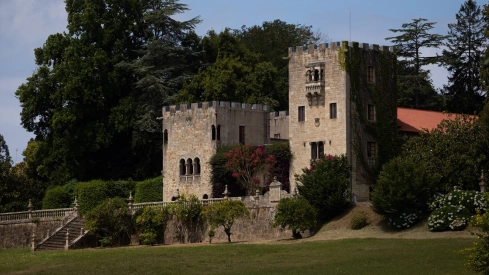
This Friday, the Official State Gazette (BOE) publishes as a Place of Democratic Memory of the pazo de Meirás, a building built at the end of the 19th century in Sada (A Coruña), which was a summer residence of the Spanish dictator, Francisco Franco. The resolution processed in relation to the Democratic Memory Law highlights that Meirás, also known as ‘Torres de Meirás’, constitutes "one of the most significant spaces", to understand the contemporary history of Galicia and Spain.
The official publication recalls that the Franco dictatorship converted this property, which Emilia Pardo Bazán ordered to be built and where she wrote part of her work, "into one of its main symbols of power" of the dictatorship. According to the BOE, that property was an "essential place" for democratic memory during the Civil War. For this reason, it recalls that in March 1938 the ‘Junta Pro-Pazo del Caudillo’ was created to buy this property and hand it over to Franco.
The purchase, formalized on August 3, 1938, was financed through forced contributions from municipalities, civil servants and individuals, and the land was expanded through expropriations carried out on neighboring properties. The property was handed over to Franco in December 1938. Three years later, a deed of sale was simulated to be able to register the Pazo in his name, however, decades later, the courts declared this operation fraudulent, after proving that the Junta had already acquired the property and had donated it to him as head of state.
The property was used by the regime's propaganda to project the dictator's public image and stage popular adherence to Francoism, as an official residence. For this reason, the Pazo, "became one of the most representative spaces for the exercise of power during the dictatorship," concludes the BOE.
The Ministry of Territorial Policy and Democratic Memory, in an informative note, indicates that the declaration establishes that any use of the property must be compatible with the preservation of memory, the defense of human rights, the recognition and moral reparation of victims, in addition to the defense of the principles of justice, truth, and reparation. It also recognizes the relevance of Emilia Pardo Bazán as an essential figure in Spanish literature and a pioneer in advocating for women's rights. And finally, it points out that the State will promote explanatory audiovisual and digital resources in this place, in addition to promoting the installation of memorial interpretive plaques, panels, or distinctive signs and will develop institutional mechanisms to integrate Meirás into international circuits related to experiences of democratic memory construction.
Add ElConstitucional.es as a preferred Google source for free.
Stay informed about all the latest breaking news with the best information. Against disinformation, for democracy and social rights.
