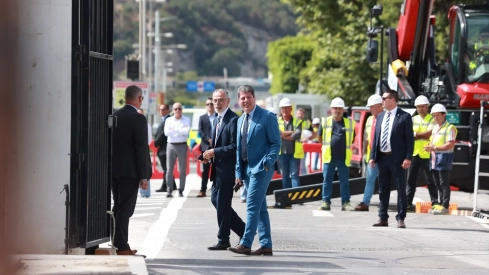
The end of the Gibraltar Fence has left one of the most resounding political statements of the day. The Chief Minister of the Rock, Fabian Picardo, has celebrated the removal of the old border gates with a message directly aimed against the Francoist dictatorship.
"We have removed that fence of Franco, which he liked so much and which he closed, and we should take it to La Almudena and put it on top of Franco, to make sure that neither he nor anyone like him ever rises again," he stated to journalists after the event held in La Línea de la Concepción.
The image chosen by Picardo was as graphic as it was imprecise in one detail. The dictator's remains have been in the Mingorrubio-El Pardo cemetery since 2019, after his exhumation from the Valley of the Fallen, and not in La Almudena. The political meaning of his words, however, was clear. The disappearance of the barrier represents for Gibraltar and for a large part of the Campo the closing of a wound that Francoism kept open for years.
The border with which Franco punished an entire region
The first permanent barrier on the isthmus was installed by the British authorities in 1909. For decades it functioned as a checkpoint between Gibraltar and La Línea, although its greatest political burden came under the dictatorship.
Franco ordered the complete closure of the land border in 1969, after the Gibraltarian population refused to abandon their link with the United Kingdom. The measure was part of the regime's pressure to force a solution on the sovereignty of the Rock, but its consequences fell mainly on the civilian population.
Thousands of Spanish workers lost access to their jobs overnight. Families, friendships, and commercial relationships were separated by a closed border. The closest transit then required long journeys and La Línea suffered a strong economic and social impact.
The partial reopening for pedestrians arrived in December 1982, seven years after the dictator's death. Vehicle and goods traffic took even longer and was normalized in February 1985, coinciding with Spain's integration process into European institutions.
The Fence continued from then on as an everyday border marked by queues, document checks, and political ups and downs between Madrid, London, and the Gibraltarian authorities.
"We took a weight off our shoulders"
Picardo has explained that the provisional entry into force of the new agreement changes from this Wednesday the daily life of those who cross that pass. Land passport controls disappear and Gibraltar is de facto integrated into the European free movement area, with verifications moved to the port and airport.
"We take a weight off our shoulders," summarized the chief minister. That weight included uncertainty about documentation, possible retentions, and the time needed to cross a border used daily by some 15,000 people.
The leader gave as an example those who avoided traveling from Gibraltar to the Campo for fear of encountering long queues upon returning, a situation that also affected Spanish workers who went to the Rock every morning.
Hours earlier, in an interview on ‘Hoy por Hoy’, on Cadena SER, Picardo had expanded on the political meaning of the agreement. "Every step we take today in freedom without having to show our passport is one more step to move the rest of the damned legacy of the dictatorship," he stated.
He also defended that the treaty mainly belongs to the people who live in the region and that the disappearance of the border will modify something deeper than mobility. "The most important thing is that people from here and there will not have to think about how to get there. That will change the mentality, which is the most difficult thing," he explained.
Two territories united by daily life
The mayor of La Línea, Juan Franco, described the first day without controls as a "feeling of freedom." The relationship between both populations, he also recalled on Cadena SER, has functioned for years as that of "two cities in one," with people who reside on one side, work on the other, and maintain family or emotional ties on both sides of the old border.
Picardo took that idea to a more personal level by assuring that his responsibility also consists of facilitating that "boys and girls from one side and the other can continue falling in love."
The provisional entry into force of the agreement between the European Union and the United Kingdom allows from this July 15 to cross by land without the usual controls. The old structures will be progressively removed and the border area will be transformed to adapt it to the new circulation.
The Fence will continue to be part of the history of the dispute over Gibraltar, but it will no longer condition the daily lives of those who live around the Rock. The fence that Francoism turned into an instrument of isolation disappears more than half a century after that closure, while La Línea and Gibraltar begin a coexistence without the physical barrier that separated two deeply connected communities for generations.
