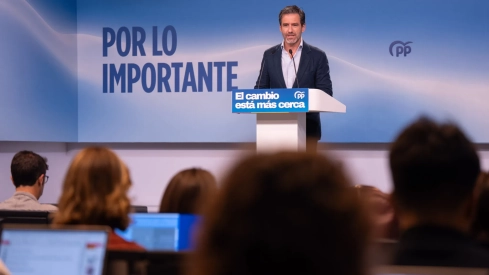
The PP has deployed a message of tranquility this Thursday regarding pensions after its spokesperson in Congress, Ester Muñoz, defended changing the model because "it doesn't work" and "is going to burst." Alberto Núñez Feijóo, Borja Sémper and Muñoz herself have assured that the public system is "non-negotiable" and that a popular government would guarantee the benefits of current retirees and those of workers who retire in the future.
"The PP is not going to sit down with anyone to negotiate questioning the public pension system," said Sémper, national spokesperson for the party, in Las Palmas de Gran Canaria. The leader has asked that this matter stop being used electorally to "instill fear" and has insisted on his commitment to maintain the model. "It is non-negotiable. Period. The current system will not change," he declared.
Ester Muñoz now refers to AIReF
From Almería, Muñoz has defended her words and downplayed the tone used in the podcast, which she described as a colloquial conversation aimed at young people. The spokesperson referred to the 2026 report by the Independent Authority for Fiscal Responsibility (AIReF) to argue that complying with the spending rule does not guarantee sustainability. "It's not something Ester Muñoz says, it's something AIReF says, you just have to read the report," she pointed out.
The study confirms compliance with that rule and, at the same time, warns of risks to public accounts in the long term. It calculates an average expenditure on pensions, discounting the effect of revenue measures, of 13% of GDP between 2022 and 2050, below the legal threshold of 13.3%. Its sustainability analysis contemplates all administrations and warns about the evolution of debt if current policies are maintained, a diagnosis that needs to be distinguished from the announcement of an immediate collapse of the system.
The recipe presented by Muñoz involves more productivity, better wages, and higher contribution revenues. Juan Bravo, deputy secretary of the Treasury for the PP, has also linked the viability of pensions to economic improvement. In that vein, Cayetana Álvarez de Toledo has defended in 'El programa de Ana Rosa' reforming the economic model to ensure future benefits. This Thursday's interventions have not specified changes in contributions, retirement age, or pension calculation.
Sémper and Muñoz have recalled that Zapatero froze pensions and that Sánchez supported that decision as a deputy. The freeze was approved in 2010 to be applied in 2011, with exceptions for minimum, non-contributory, and certain benefits from the old SOVI. Rajoy's 2013 reform, which delinked increases from the CPI and introduced an index with a minimum of 0.25%, insufficient to maintain purchasing power when inflation exceeded that percentage, also forms part of the background.
The CPI, Sánchez, and the position of the far-right Vox
Feijóo has reiterated from Brussels that pensions will be updated according to the consumer price index (CPI). This commitment means maintaining the guarantee included in the 2021 reform, which establishes the revaluation of contributory benefits according to the average inflation of the twelve months prior to December. Muñoz has also expressly defended that pensions continue to rise with prices.
Sánchez assured this Thursday that he will approve the corresponding increase for 2027 even if the Government is then in caretaker status. Furthermore, he has accused PP and Vox of hiding cuts until after 29N. This warning prolongs the confrontation in which the PSOE contrasted its defense of the public system with the changes proposed by the right.
The far-right Vox maintains an open reform. Its parliamentary spokesperson, Pepa Millán, has assured that pensions will be paid "at any cost", but added that "nothing can be ruled out here". Its economic head, José María Figaredo, had proposed moving towards a mixed model, with a public part and another of individual capitalization.
This position introduces a relevant difference in the face of a possible Government agreement between PP and Vox. Sémper rules out negotiating the questioning of the public model, while Santiago Abascal's party keeps its transformation open; for now, they have not presented a joint agreement on pensions.
Immigration and housing in the pre-campaign
Sémper has also promised to modify the necessary laws to promote an "ordered" migratory policy and reinforce Frontex's intervention in the Atlantic corridor and the waters of the Canary Islands. Both he and Muñoz have demanded Sánchez's appearance before the Permanent Deputation due to the presence of Moroccan military vessels in Spanish waters during the Ceuta crisis and have accused the Executive of hiding information.
The spokesperson has defended the return of minors to their families or to the protection services of their country. Repatriation requires examining the circumstances of each minor and respecting their best interest, with the guarantees and reports provided for in immigration legislation; irregular entry, by itself, does not allow dispensing with that procedure.
Regarding housing, Sémper has accused the PSOE of maintaining an "oceanic hypocrisy", when asked about information regarding the properties of his spokesperson's partner, Montse Mínguez. Muñoz, for his part, has focused part of his visit to Almería on water infrastructure, the AVE, and regional financing, and has promised that "Feijóo will not abandon Almería as Sánchez has done in recent years".
