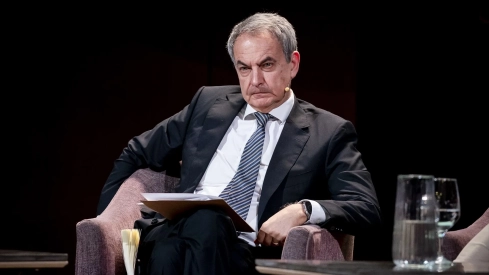
The Popular Party has escalated its offensive against José Luis Rodríguez Zapatero this Wednesday after the former president informed the National Court that the jewels seized from the safe in his office came from a gift from the then King of Saudi Arabia, Abdullah bin Abdulaziz Al-Saud.
"Zapatero must explain if he was also a commission agent when he was Prime Minister," the popular leadership launched. Genoa questions why the pieces remained in the hands of the former socialist leader for almost two decades and demands that he clarify why he never reported the gift received in 2007.
Zapatero has presented his version in writing to Judge José Luis Calama, who is investigating the 'Plus Ultra case'. According to his defense, three sets of jewels consisting of necklaces, bracelets, rings, and earrings were delivered in June of that year, during an official visit by the Saudi monarch to Spain.
The former president maintains that he accepted the gift out of "deference," that he kept it along with other family jewels and gifts from friends, and that he never used it or was aware of its value. He has also asked the magistrate to request official confirmation from Saudi Arabia if he considers the documentation provided insufficient.
The seized jewels have received a provisional expert valuation of more than 1.3 million euros. Zapatero's defense disputes this valuation and specifies that the three sets attributed to the Saudi king account for more than 90% of the value calculated for the pieces found.
The PP believes that this explanation leaves a fundamental question open. Zapatero approved the Code of Good Governance for Executive members and high-ranking officials in 2005, which required rejecting gifts that exceeded usual courtesy and established that institutional gifts of special relevance should be incorporated into the State's patrimony.
"He would have to immediately explain why he never declared that supposed personal gift," Genoa demanded, even suggesting that the jewels could have represented a commission. This accusation is part of the PP's political offensive and still lacks a judicial conclusion to support it.
The popular leadership has also brought the controversy to Pedro Sánchez. "Does he also have a safe in La Moncloa with the jewels given to him by international leaders?" he asked before demanding that the president detail what gifts he has received and what their destination has been.
Sánchez had previously defended that the current regulation on institutional gifts is stricter than that existing in 2007. The PP replies that the Code of Good Governance promoted by Zapatero himself already included specific obligations for gifts of special value at that time.
The PSOE maintains its confidence in Zapatero
The PSOE leadership has closed ranks with the former president and considers that the letter sent to the judge contains a "concrete" explanation about the origin of the jewels. Socialist sources insist that his presumption of innocence must be respected while the investigation continues.
The socialists highlight that Zapatero has identified the alleged donor, has placed the delivery during an official visit held on June 18 and 19, 2007, and has asked the Saudi authorities to formally confirm the gift.
The defense also maintains that the pieces have remained stored since then, without use or intention of obtaining economic benefit. The former president thus tries to disassociate them from any activity carried out after leaving La Moncloa and from the operations investigated around the rescue of Plus Ultra.
The next step is in the hands of Judge José Luis Calama, who will have to assess the documentation provided and decide whether to request, through a rogatory commission, that Saudi Arabia certify the delivery of the jewels. Meanwhile, the PP maintains its pressure on Zapatero and Sánchez, and the PSOE keeps its support for the former president intact.
Add ElConstitucional.es as a preferred Google source for free.
Stay informed about all the latest breaking news with the best information. Against disinformation, for democracy and social rights.
