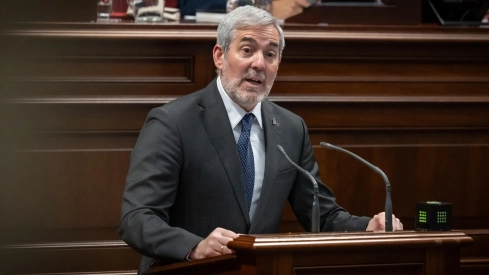
The president of the Canary Islands, Fernando Clavijo, assured this Monday that he expects a response from the President of the Government, Pedro Sánchez, to the letter he sent him to demand the adoption of six urgent measures given the consequences of the arrival of migrants to the archipelago, and has denounced the "disregard" of the Executive towards this phenomenon and towards the Canary Islands itself.
Clavijo made these statements to the media before participating in Bilbao, along with other regional presidents and the Minister for Digital Transformation and Public Function, Óscar López, in a conference organized by NTT Data to present the Future Government Center, a space oriented to analysis, innovation and collaboration in public management.
In the letter, whose content was made public this Sunday, the Canarian president asks the head of the Executive for the extraordinary convocation of the Canary Islands-State Security Board, the approval of a contingency plan for the coming months and greater involvement of the European Union.
In addition, he asks for the activation of the solidarity mechanisms of the European Pact on Migration and Asylum that are applicable, as well as greater operational and financial support, greater involvement of the European Border and Coast Guard Agency (Frontex) within its competencies and an effective distribution of responsibilities among member states.
Increase in maritime arrivals to the archipelago
The requests come in a context of an increase in maritime arrivals to the archipelago, according to the Canarian Government, which recalls that in this month of October, at least, 3,873 people have arrived on the islands, of which 2,835 arrived in El Hierro.
Clavijo has indicated that he does not know if Pedro Sánchez "will be very busy or not" with the electoral pre-campaign agenda, but he stressed that "the ideal and reasonable thing" is for him to respond to a formal request from the Government of the Canary Islands to address this issue, despite the fact that these requests had already been raised previously.
He also criticized the lack of planning and response to three letters that the Canarian Government has sent to the Minister of the Interior, Fernando Grande-Marlaska, to convene the Security Board, an attitude that, in his opinion, demonstrates "neglect and contempt both for the migratory phenomenon and for the Canary Islands itself".
El Hierro, at the center of the migratory crisis
The Canarian president has stated that the situation in El Hierro is increasingly complex, and has warned that "the sad thing is that exactly what we said was going to happen months ago is happening".
He added that migrants are being transferred from El Hierro to other islands and that the Canarian Government "has no information". "I don't think this is reasonable or at least desirable; the ideal is for administrations to collaborate to assist these immigrants and for the population to have information," he remarked.
Clavijo has assured that reports from the National Intelligence Center (CNI) already warned of this migratory surge, and pointed out that it was expected that dinghies and cayucos would arrive again at the end of the year. In his opinion, with the situation in Ceuta and the diversion of attention and controls to the north, the Atlantic route "was more than obvious that it was going to reactivate".
«We do not understand why there is no contact with the Canarian administration, why we do not prepare to receive them and why no means are established to assist them with dignity but also so that it is not the Canary Islands that have to bear all that migratory weight», he stressed.
In that vein, he considered that «Ceuta will remain as a buffer zone in the north, the Canary Islands as a buffer zone in the south, and the State is neither present nor expected».
Torres responds that the Government is acting
For his part, the Minister of Territorial Policy, Ángel Víctor Torres, considered that Fernando Clavijo "is unfair" in accusing the Government of "doing nothing" in the face of the surge in the arrival of cayucos in El Hierro, and recommended him to direct his criticisms at the PP, his partner in the Canary Islands.
"The one who does nothing and puts spokes in the wheels is his government partner, the PP, who voted against the distribution of minors, who contributes absolutely nothing, who is deceiving the Canarians by saying that what needs to be done is to return the immigrants and who is in populism," Torres assured in an interview on RNE.
Torres, who presides over the Interministerial Immigration Commission, thus responded to the letter sent by the President of the Canary Islands to Pedro Sánchez to demand urgent measures in view of the increase in arrivals.
The minister recalled that in the last months of the year immigrant rescues usually increase, because the autumn weather conditions favor navigation towards the Canary Islands, and announced that "the Government of Spain will respond to that letter" from Fernando Clavijo.
He also insisted that the important thing is that "structural" measures have been taken and continue to be taken. "I think he is wrong, because the one who does nothing or, worse, the one who is always putting spokes in the wheels is not the Government of Spain, which helps, collaborates, implements measures, makes decisions and changes the law," he defended.
The former Canarian president also expressed his admiration for the response of the population of El Hierro to this situation and for the work carried out on the island by emergency teams, the humanitarian reception network and security forces.