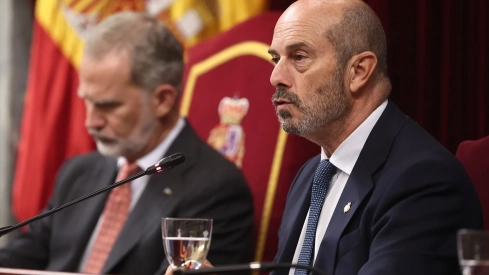
The president of the Senate, Pedro Rollán, has denounced the chronification of the crisis that Ceuta has been experiencing since the massive entry of some 80,000 immigrants recorded at the end of July, and has pointed out that, with one hundred days about to pass since the beginning of that situation, the autonomous city “has barely improved.”
In an interview on Onda Cero, Rollán recalled that he visited Ceuta on August 14 and observed “a very sad image,” while warning then that the crisis could not “become chronic” because it was not “normal.”
In that same context, the president of the Senate has once again defended the Spanishness of Ceuta and Melilla and has regretted that, in his opinion, with this crisis a “historic opportunity” has been lost, because Morocco “wanted to recover and welcome” the assailants of the massive entry at the end of July.
Rollán has also reproached the European PSOE for, as he stated, not supporting measures favorable to the autonomous city in the European Parliament. For the president of the Senate, it is not only a moral obligation, but also a legal one, to “defend” the territorial integrity of Spain. “Our Ceuta and Melilla colleagues have the right to recover their present and do not have to resign themselves to an uncertain and sinister future,” he said.
Felipe VI and Spain's role in Ibero-America
During his speech, Pedro Rollán highlighted the figure of Felipe VI, whom he defined as a “magnificent ambassador” and “the best representative of our country” at the Ibero-American summit held in Madrid. Paraphrasing the King, he stressed that, “in a changing world,” it is “more important than ever to strengthen Spain's alliances and ties” with Ibero-America.
In that vein, he argued that this relationship constitutes a “great strength” in the face of new global leaderships and the “movement of pillars that we considered immovable,” while highlighting the “historical and linguistic” ties, in addition to business ties, that unite Spain with the region.
Defense of the Senate as a counterweight chamber
Finally, the president of the Senate has vindicated the role of the Upper House in a “bicameral” system, in which, he pointed out, it has acted as a “counterweight” to the Executive. Rollán described the legislature as “fruitful” and highlighted the approval of 47 laws with different parliamentary groups.
Likewise, he expressed his support for “advancing” so that the Senate has “greater powers” in the territorial sphere, which he defined as the “fundamental essence” of this chamber.
Contact
We are listening. Get in touch.
