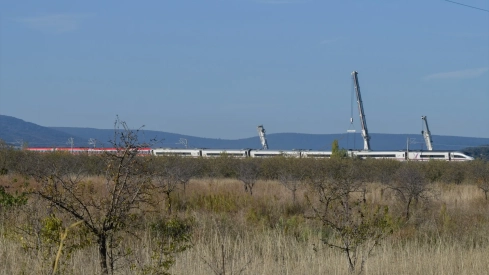
The Railway Accident Investigation Commission (CIAF) has recommended in a 2024 report to adopt technical measures and reinforce protocols, after pointing out that human verification is “susceptible to failure” in cases where it replaces the automated system, a circumstance that, according to the document, occurred in the Urda (Toledo) accident.
The report, to which EFE has had access, analyzes an incident that occurred on June 25, 2024, when AVE 05903, which was operating with the ERTMS Level 1 railway safety system, improperly passed a signal that ordered it to stop in Cuenca-Fernando Zóbel.
A driver's error and a second erroneous authorization
According to the CIAF, the initial error was made by the driver, who confused the appearance of the signal, and then a second failure occurred, as the traffic controller authorized the train to continue. The TRIP system, a safety mode of ERTMS itself, automatically braked the train, but neither the driver nor the traffic controller had identified the improper overrun.
The report uses this case to illustrate the same vulnerability detected in the Urda accident: when automation or signaling fails, safety becomes dependent on human authorization, and if there is no automatic technical restriction, that failure can escalate to a collision.
The CIAF proposes reinforcing signals, protocols and ERTMS Level 2
In the case of Cuenca, the CIAF emphasizes that the authorization to resume the journey was based on human verification, consisting of checking that the block was clear, and considers that this barrier is “susceptible to failure”, because it depends entirely on the human factor.
“This barrier is susceptible to failure, as it depends completely on the human factor, which highlights the need to implement mitigating technical measures,” the report states.
In addition, the CIAF, which had already documented a recurrence of similar overruns, recommends reinforcing the ergonomics of signals, reviewing protocols after a TRIP, and implementing ERTMS Level 2 as an additional safety measure.