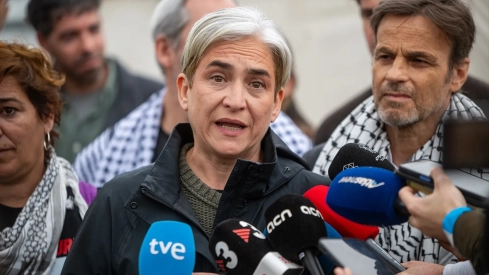
The United States Department of State has justified this Thursday the decision to deny a visa to the former mayor of Barcelona and candidate for the Presidency of the Government for the Frente Amplio, Ada Colau, and has stressed that entry into the North American country "is a privilege, not a right".
A spokesperson for US diplomacy has explained to Europa Press that, under the leadership of the President of the United States, Donald Trump, and Secretary of State, Marco Rubio, the Administration is "putting American interests first in our visa process". In the same vein, he added that "a US visa is a privilege, not a right", and specified that each application is evaluated "on a case-by-case basis after rigorous review and thorough investigation to determine if the individual is eligible under US law".
Washington's response comes after Ada Colau publicly denounced that the US Administration has prevented her from traveling to Puerto Rico, a territory with commonwealth status, where she was scheduled to participate in two weeks in the international municipalist meeting 'Fearless Cities', an event where the mayor of New York, Zohran Mamdani, is also announced.
The former mayor denounces a political veto for her support of Palestine
According to the candidate's inner circle, the prohibition occurred after she was denied the electronic authorization ESTA, which the rest of her entourage did receive, and after she underwent an interview at the United States Embassy in Madrid 15 days ago.
Ada Colau's team maintains that the diplomatic staff's interrogation focused almost entirely on her pro-Palestinian activism and the three days she was detained in Israel after participating in the flotilla bound for Gaza. Finally, the definitive denial was formally based on the alleged "suspicion that she wants to illegally migrate to the country", an argument that her inner circle interprets as an excuse to hide a strictly political motivation.
The "rigorous review" cited by the State Department is also part of the tough stance adopted by the Donald Trump Administration regarding initiatives to support Palestine. Last April, the US Government already harshly condemned the solidarity flotilla in which Ada Colau participated, calling it a "pro-Hamas initiative" organized by an entity sanctioned for terrorism, and warned of possible legal consequences for those who were part of it.
Colau speaks of "authoritarianism" and receives support in her political space
After the veto was confirmed, Ada Colau has accused Donald Trump of exhibiting a new display of "authoritarianism". "It is striking that Trump talks so much about the word freedom, but then he is closing his borders to anyone he simply doesn't like, because in my case there was no legal argument," criticized the Frente Amplio candidate.
The US decision has also provoked reactions of support within her political party. The federal coordinator of Izquierda Unida (IU), Antonio Maíllo, has called the situation a "paradox" and contrasted it with the recent visit to Spain by the Argentine president, Javier Milei. "Milei can enter Spain to talk about cuts, but Colau cannot enter the United States to talk about rights," he stated.
For his part, the Minister of Social Rights, Pablo Bustinduy, has assured that Ada Colau "has to feel honored" by the veto, and has contrasted her position with that of right-wing parties that "act like patriots but bend their backs to Trump and Netanyahu".