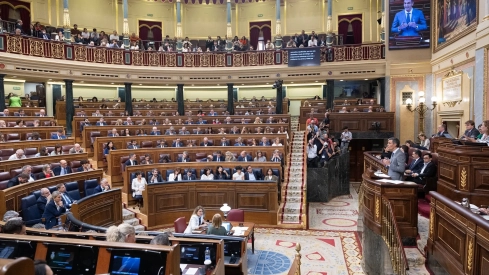
The political parties, federations, coalitions, and groups of electors will be able to register their candidacies for the Congress and the Senate for the next general elections on November 29, starting this Wednesday, October 21, a period that will remain open in the different Provincial Electoral Boards until midnight on Monday, October 26.
According to the electoral calendar, the formations will have six calendar days to present their lists in the constituencies in which they wish to run. Once that registration is closed, the candidacies will be published in the Official State Gazette (BOE) on Wednesday, October 28.
However, this publication will not be definitive, as the electoral boards will have the following two days to communicate any irregularities observed or reported in the candidacies, which can be rectified by the formations within 48 hours of their notification.
Once this review is completed, the boards will have until Monday, November 2, to proclaim the candidacies, which will be published in the BOE the following day, Tuesday, November 3. Afterwards, the formations may appeal this proclamation before the Contentious-Administrative Court between November 4 and 5, with a two-day period for its resolution, and subsequently appeal for protection to the Constitutional Court, which must decide within three days.
Furthermore, during the electoral campaign, appeals may be filed before the Special Chamber of the Supreme Court, whose decisions may also be appealed before the Constitutional Court.
Fewer coalitions registered than in 2023
Parties and federations registered in the Register of Political Parties of the Ministry of Interior, as well as electoral coalitions formed and communicated to the corresponding Electoral Board until this Friday night, may present candidacies.
On this occasion, nine electoral coalitions have been registered before the Central Electoral Board, of which two run exclusively for Congress, three for the Senate, and another four are regional in scope and run for both chambers. In the 2023 elections, twelve coalitions ran: three national, one for the Senate, and eight regional.
The most relevant coalition for 29N in the Lower House is Frente Amplio, led by Ada Colau and Emilio Delgado, which ultimately did not reach an agreement with Podemos, except in Canarias and Comunidad Valenciana. For the Senate, the most prominent alliance is that formed between PSOE and Frente Amplio in most constituencies.
There are also coalitions that, by affecting a single constituency, have been presented to the Provincial Electoral Boards, such as the one promoted by Més and Frente Amplio in Baleares or that of UPN and PP in Navarra.
Endorsements for parties without representation and requirements for groups
In the case of parties, federations, and coalitions that did not obtain representation in either of the two chambers in the last general elections, it will be necessary to collect signatures from at least 0.1% of the electors registered in the census of each constituency for which they intend to run.
This is the case, for example, of Democracia 21, which has formed a coalition with Ciudadanos and UCIN, and which wants to run in the constituencies of Madrid and Barcelona. In the first province, they must present at least 5,500 signatures and in the second, at least 4,400.
Electors' groups may also present lists, although in their case they must have the support of at least 1% of the electors registered in the census of the corresponding constituency. No elector may endorse more than one candidacy with their signature.
Unlike political parties, these groups are constituted exclusively to participate in a specific electoral process, without the need to register in the Register of Political Parties and without the possibility of presenting joint candidacies covering several constituencies.
Mandatory parity and zipper lists
Another of the requirements that candidacies must meet is respect for the principle of electoral parity, which for the first time in a general election requires that lists for Congress be made up of women and men ordered alternately.
Until now, the Electoral Law required that lists include at least 40% of candidates of each sex, with neither being able to exceed 60%, a proportion that also had to be respected in each section of five positions. However, the reform introduced by Organic Law 2/2024, on parity representation, has replaced that system with the so-called gender zipper lists.
This equal composition must be respected in all candidacies, without separating principals and alternates, and will also be mandatory when candidacies for the Senate are grouped into lists. In this way, the composition of both Chambers will be practically equal.
2023 figures, for reference
In the summer 2023 elections, the Provincial Electoral Boards proclaimed a total of 1,090 lists for the Cortes Generales, of which 550 for Congress and 540 for the Senate, 186 fewer than in 2019. In the screening, 66 candidacies from extra-parliamentary formations were excluded due to errors, for not meeting the requirements or, above all, for not attaching the necessary endorsements.
In total, 4,892 candidates competed on July 23, 2023, for the 350 seats in Congress and the 208 in the Senate, a number that this year will be one more after the constitutional change that allowed the creation of a senator for the island of Formentera. That left an average of ten aspirants for each seat in the Lower House and 5.5 for each seat in the Senate Palace.
