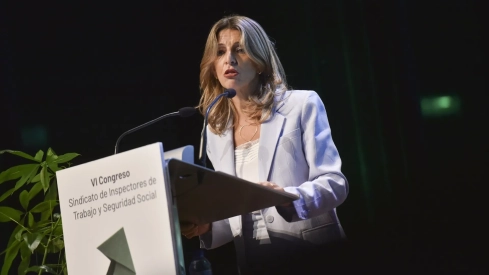
The second vice-president of the Government and Minister of Labor, Yolanda Díaz, accused this Monday the leader of the PP, Alberto Núñez Feijóo, of “radically confronting” Spaniards instead of seeking solutions to the housing problem, after the popular leader announced this Sunday an anti-squatting law to evict illegal occupants in 48 hours, an initiative she described as “nonsense.”
“What Mr. Feijóo is doing is directly attacking the problems that Spaniards have, radically confronting them instead of focusing on what he should do,” said Yolanda Díaz in statements to the media upon her arrival at a meeting of Employment and Social Affairs ministers of the European Union in Brussels, where a recommendation is expected to be approved to combat residential exclusion and homelessness, with measures to prevent evictions and facilitate access to affordable housing.
Criticism of the Popular Party's housing plan
The vice-president's criticisms come a day after the opposition leader tasked the mayor of Badalona, Xavier García Albiol, with leading the drafting of this initiative in Congress, during a pre-campaign event in Barcelona in which he demanded “zero tolerance for squatters” and “zero tolerance for crime and recidivism.”
“Instead of contributing to solving the housing problem in Spain, which all the sons and daughters of our country, no matter who they vote for, have this problem, he places himself, I believe in this case, on the side of nonsense,” reproached the Minister of Labor, who assured that housing has replaced unemployment as the main concern of Spaniards.
Elma Saiz defends a strong social Europe
The vice-president extended her criticisms to other proposals in the PP's program, attributing to Alberto Núñez Feijóo the intention to reduce the minimum wage, stop updating pensions according to the CPI, and grant more powers to mutual societies to grant medical discharges, measures that, in her opinion, represent a setback in workers' rights.
“Feijóo's program is very clear. It is, effectively, to lower the minimum wage, not to revalue pensions in accordance with the CPI, to give more power to private entities, such as mutual societies, so that they are the ones who give medical discharge,” said Yolanda Díaz, who also accused him of wanting to “criminalize” employees who are on sick leave.
Against these approaches, she defended the Executive's labor policy and assured that it will continue to approve social protection measures until the end of the legislature, including a new increase in the interprofessional minimum wage. “Of course, here is the Government of Spain that will raise the minimum wage again, that will continue legislating until the last minute, protecting the working people of our country,” stressed the vice-president, who also highlighted the record employment and the increase in pensions registered in recent years.
Also attending the meeting is the Minister of Inclusion, Social Security and Migration, Elma Saiz, who, in statements to the press, pointed out that she will defend in the debate with the Twenty-Seven that “economic growth is perfectly compatible” with “continuing to advance in social protection and in the extension of rights.”
“Spain arrives with a firm position to continue advancing in that social Europe that provides a joint response to the challenges we face,” she continued, referring to issues such as access to affordable housing, employment, equality and the fight against poverty.
In this regard, the minister insisted on the need for “a strong social Europe” and indicated that, with a view to the ongoing negotiations for the future EU budget post-2027, Spain advocates for “ambitious proposals that respond to the real problems and needs of citizens.”
