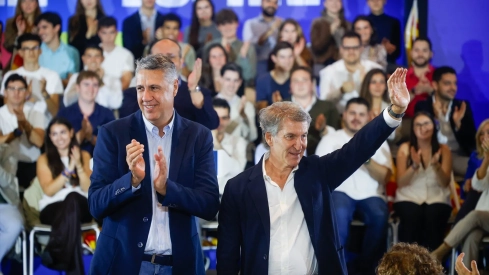
The Partido Popular decided in its last National Congress, held in July 2025, that its deputies cannot simultaneously be mayors of municipalities with more than 20,000 inhabitants. A political decision by its own delegates that responded to a reasonable principle: governing a large city and representing all citizens in Congress requires a dedication that cannot and should not, or should not have, be divided among several institutions.
The PP left -nevertheless and again- a loophole for electoral opportunism. An article of the same Statutes that establish incompatibility allows the National Executive Committee, the populares' "politburo," to authorize exceptions in "extraordinary cases" if the "general interests of the Party" (sic) demand it. Not those of Spain, the needs of the city councils, or the obligations contracted with those who elected their municipal leaders. "The general interests of the Party." The exceptionality requires -for its own sake, it is understood- the express authorization of the organization's leadership, the only one with statutory power to exempt those elected from an obligation that was established as an offering to the electorate and with a general character.
Alberto Núñez Feijóo heads two candidacies for Congress for the general elections on November 29 with two mayors who intend to keep the staff of command of their city councils: Xavier García Albiol, mayor of Badalona, for Barcelona, and Pilar Miranda, mayor of Huelva, for that Andalusian constituency. But if both need to apply the "statutory exception" to continue governing their cities while occupying a seat in the Cortes Generales... one might ask what is extraordinary about their profiles; what merits or services to the party justify deviating from a statutory norm ratified just fifteen months ago.
Albiol needs no introduction. He has spent years building his own image around his self-declared role as a scourge of his most vulnerable neighbors and migrants, or of housing okupación. His record includes statements in which he called Romanian Roma "a plague" and "a scourge," electoral pamphlets that linked this group to criminality, or that shameful campaign under the slogan Cleaning Badalona. His credentials, therefore, are well known. Aberrant or applauded, but very well known. He was tried for incitement to hatred and discrimination, although he was acquitted in 2013. Due respect for that judicial resolution does not oblige us to consider respectable the expressions that originated that procedure. It does not prevent subjecting them to a severe ethical judgment, nor that some of us —from legitimate opinion— sentence them as undoubtedly execrable.
Núñez Feijóo knows who he is promoting. Just a week ago, at a pre-campaign event in Barcelona, he asked Albiol to lead the future "PP anti-occupation law in Congress." "You are going to be the rapporteur. We are going to approve it with you," he announced to those present. The top leader of the Popular Party has thus reserved legislative prominence for a leader with proven solvency in xenophobic messages, with which to snatch leadership in a matter that the —other— far-right has made its banner.
The choice of the extraordinary Albiol occurs —in addition, or because of it— in the midst of electoral and involutionary competition in Catalonia. Vox disputes the PP's traditional electorate head-to-head, and the emergence of Aliança Catalana, the far-right pro-independence party led by Sílvia Orriols, has intensified the struggle for a space where immigration and security occupy a central place. Aliança Catalana will not run on 29N, but, there is no doubt about it, its presence in the political debate has hardened the debate. Feijóo responds by placing one of the popular leaders who has been cultivating this discourse of hatred towards the different for the longest time at the head of his Barcelona candidacy.
Pilar Miranda, Mayor of Huelva
The case of Pilar Miranda is similar but different. The mayor of Huelva, who took office in 2023 after presiding over the Port Authority of her city, does not have Albiol's ideological history, and equating their trajectories would be absurd. They do share the public notoriety that Feijóo has decided to incorporate into his candidacies, even if he has to resort to the "statutory exception" to do so.
Objectively, Pilar Miranda's limited notoriety outside of Huelva stems from episodes ranging from the grotesque to the institutionally worrying. One of the first to gain national repercussion was the controversy over a presumed esoteric ritual of spiritual cleansing in municipal dependencies, including the mayor's own office. The local government denied it, the issue reached the municipal Plenary and occupied cheerful news spaces at the state level. The government team never demanded its right of rectification from the media outlet that revealed the story nor from the journalist who signed it. The same one as this Tribune in ElConstitucional.es.
Then came a municipal initiative that, with the purpose of "promoting sustainability from a gender perspective," proposed teaching women from Huelva how to make products to "clean their homes without polluting." A singular contribution to female emancipation: freeing women from toxic products while keeping them busy with domestic cleaning. The controversy forced the City Council to postpone the activity and gave Miranda another notable appearance in the national media, not without a new mocking controversy.
Her trajectory, however, also includes events about which there can be no irony. The Adamuz train accident, which occurred last January, caused 46 deaths and left a deep wound in Huelva. The mayor assumed a prominent institutional role in demanding explanations and responsibilities, promoted the City Council to appear as a popular prosecution in the judicial investigation —a request rejected by the investigating judge for lack of legitimacy— and participated in the political confrontation with the Minister of Transport, Óscar Puente, with whom she has maintained a confrontation since September 2024, when both starred in a controversy during a Senate session related to the AVE to Huelva.
It is surprising, then, that it was the president of the Huelva PP himself, Manuel Andrés González, who defended another criterion not so long ago. In the last week of September 2024, four prominent PP mayors from Huelva resigned from their mayoralties to keep their parliamentary seats: Manuel García Félix (La Palma del Condado), Carmelo Romero (Palos de la Frontera), Juan Manuel González (Lepe) and David Toscano (Aljaraque). The party then presented the resignations as a way to reinforce the presence of the Huelva populares in institutions such as the Congress and the Senate, and the provincial president of the PP defended that mayors with "clear vocation of service" work from them for the province. Toscano, president of the Provincial Council, left the Aljaraque City Council because he considered it "impossible to be one hundred percent" in the small Huelva town and, at the same time, in the provincial institution. Two years later, the same Manuel Andrés González celebrates that Miranda will add the seat and the Huelva City Council. Exceptional. Extraordinary. Statutory, in short.
Miranda now presents herself, or will do so when the statutory exception of the populares endorses her candidacy for the Lower House, as the voice that will defend the infrastructures of her province in the Congress of Deputies. The PP has already predicted that the mayor will achieve the AVE, the unblocking of a dam, electrical infrastructures and a third lane for the A-49, without Miranda having to abandon her responsibilities in the Huelva City Council.
All of this, amidst a full controversy about the possible existence of police reports «unfavorable» about local people and groups, whose elaboration has been attributed to the Local Police of Huelva and which would have been transferred from Pilar Miranda's government team to the Government Subdelegation in Huelva. According to the consulted sources, the existence of these reports comes to light after an intervention by National Police agents during a peaceful neighborhood protest against the celebration of a “horse fair” and other recreational or commercial events that a group of neighborhood platforms considers harmful in the Juan Ceada park in the Huelva capital, popularly known as Zafra park. Plainclothes agents identified and recorded some people participating in a symbolic protest and warned of possible sanctions. The affected groups have demanded explanations about the alleged reports, their content, and the reasons why they would have been transferred to the Government Subdelegation. And also why the latter would have taken them into consideration instead of investigating, prosecuting, and sanctioning their authors and/or those who ordered them, exceeding the attributions conferred by the legal system to Spanish municipal police forces (among which are not included, under any concept, "surveillance" services of people or "intelligence" work).
Xavier Albiol and Pilar Miranda have different trajectories, discourses, and responsibilities, but their incorporation into the candidacies raises the same question: what does the PP leadership understand by a sufficiently "extraordinary" assumption to exempt certain mayors from a more than motivated statutory obligation. An incompatibility that successive national congresses of the PP have been defending and ratifying. So much so, that the exception requires the express intervention of the National Executive Committee. So be it, as the Statutes state, for the «general interests of the Party».