
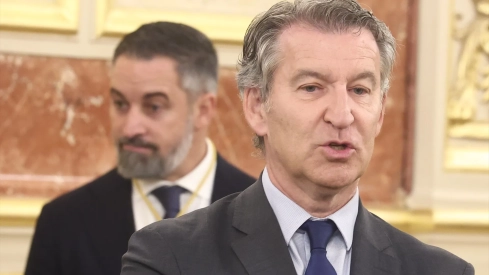
Listening this Friday to Alberto Núñez Feijóo, national leader of the Popular Party and PP candidate for President of the Government in the general elections on November 29, during his interview with Aimar Bretos on Cadena SER, a question arose for me.
If Feijóo proposes to toughen access to abortion and reopens that debate; if he also wants to toughen access to another right such as euthanasia; if the Popular Party has toughened its discourse on immigration, linking it with insecurity; if he also toughens his position regarding access to nationality through what the PP calls the Grandchildren's Law, linked to the Democratic Memory Law; if Feijóo declares himself a feminist because, as he explained this very Friday, he grew up in a house with more women than men, but at the same time announces that he will eliminate the Ministry of Equality, then one must ask where the Popular Party is heading.
To all this is added a way of doing opposition increasingly based on hyperboles and verbal aggressiveness that, on numerous occasions, brings the PP closer to the language used by Vox. Feijóo has even hinted at the idea that Pedro Sánchez acts like a dictator and the official accounts of the Popular Party on X and other social networks sometimes display a degree of harshness comparable even to that of the far right.
And we also have Feijóo's decision not to participate in the four-way debate proposed on Radiotelevisión Española. The PP leader has repeatedly shown his rejection of the current RTVE model and now vetoes public television for one of the main debates of the election campaign.
Therefore, if the national Popular Party and its candidate propose all this, the question seems inevitable to me: what difference is there today between the PP and Vox? What differentiates Alberto Núñez Feijóo from Santiago Abascal? And I believe that, unfortunately, the answer is simple: none.
The far right has ended up devouring the center-right in Spain. The conservative and liberal space that the Popular Party tried to represent for decades is vanishing in favor of positions that until not long ago we fundamentally identified with Vox.
That is the conclusion I draw after listening to Feijóo this Friday on Cadena SER. And the problem is not only that the PP competes electorally with Vox. The problem is that, in that competition, it has ended up copying a good part of its arguments.
Unfortunately, it seems that the center-right that historically represented the Popular Party is disappearing in Spain. We are talking about one of the great mass parties of our democracy, a formation that, together with the PSOE, has led the alternation in government for a good part of the democratic period initiated after the Transition.
That conservative and liberal Popular Party seems to have been diluting itself. And the space it leaves is being occupied by a strategy increasingly closer to the positions of the far-right.
Feijóo no longer seems to compete with Abascal from a clearly differentiated political project. He increasingly adopts more elements of his discourse.
And that, in my opinion, is not good news for Spain, nor for our democracy, nor for our Rule of Law, nor for our Welfare State. A democracy needs differentiated political alternatives, also on the right, and it needs its major parties to have their own project instead of letting themselves be dragged by whoever sets the most extreme discourse.
The pre-campaign for the general elections on November 29 is serving precisely for that: to remove masks and check what each party really proposes when the polls arrive.
And, for now, what 29N is making clear is that the differences between Feijóo and Abascal, between the Popular Party and Vox, are increasingly difficult to find.
