David Broncano made a serious mistake. And it should be said clearly, without beating around the bush and without needing to question his entire career. What happened in La Revuelta with Santiago Abascal was not simply a controversial interview. It was an example of what happens when the demands of entertainment conflict with editorial responsibility.
Because not everything is valid for ratings. And much less so on public television.
The interview with the leader of Vox gathered an average of 4,815,000 viewers and reached a 33.6% screen share. A historic record for the program. An undeniable success in television terms which, however, raises an uncomfortable question: what is the point of getting millions of viewers if, to do so, conditions are accepted that compromise the independence of a public space?
It is worth remembering that Broncano is not only the face of La Revuelta. He is also an entrepreneur and producer. He is part, along with Jorge Ponce and Ricardo Castella, of Encofrados Encofrasa, the company that participates in the co-production of the program together with El Terrat, with a production split of 50% for each company.
This data does not prove that the decisions made were due to economic interests. But it does remind us that Broncano has responsibilities that go beyond presenting a program. His role within the project makes it especially relevant to ask about the editorial criteria that guided that broadcast.
And there is another fact that deserves special attention.
In the days leading up to the interview, the idea spread that Santiago Abascal's presence was due to an obligation imposed by the Central Electoral Board. Broncano himself had stated, humorously, that the Electoral Board had spoken.
However, RTVE later confirmed to Público that the Central Electoral Board had not forced the program to interview the Vox leader. The network explained that it had decided to invite the four main candidates for Prime Minister. This is a fundamental difference.
Abascal's presence was, therefore, due to an editorial decision, not a specific imposition by the electoral body. A legitimate decision, but one that had to be assumed with all its consequences and responsibilities.
Because interviewing a political leader is not the problem. The problem arises when that leader is allowed to dictate the rules of the encounter.
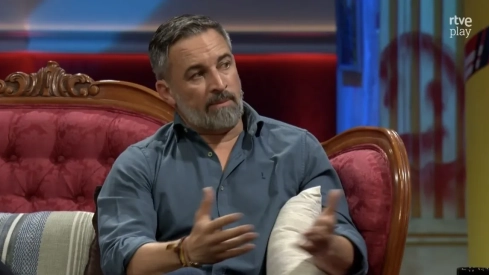
Abascal's team requested to manage the attending audience and La Revuelta accepted. People who had confirmed their entry received a cancellation and the program ended up being held before an auditorium managed at the guest's request.
Broncano explained that he had accepted to prevent possible boos from hindering the conversation. He even ended up acknowledging his reservations about the image of unanimous support conveyed by the audience.
But that rectification does not erase the initial decision.
Editorial independence does not only consist of deciding what questions are asked. It also consists of preventing the interviewee from determining the conditions of their own scrutiny.
Public television cannot function as a tailor-made stage for those who appear on it. And applause, however numerous, does not turn a statement into truth.
There is also an issue that transcends what happened that night.
The far-right knows the mechanisms of contemporary communication. Provocation generates headlines, confrontation multiplies dissemination, and a television intervention can become dozens of fragments that circulate on social networks without context or contradiction.
That is why it is so important to distinguish between offering a space to express oneself and giving up critically examining what is expressed.
Giving a voice does not mean whitewashing. Listening does not mean legitimizing. And defending plurality does not oblige one to present all statements as equally well-founded.
When talking about immigration, gender violence, LGTBI rights, or climate change, we are not dealing with simple ideas to fuel a talk show. These are issues that affect coexistence, hard-won rights, and realities that require data, context, and rigor.
A generalization against a group does not cease to be questionable because it provokes a dictated ovation. A false statement does not become true by being uttered before millions of viewers. And humor cannot be used as a substitute for necessary questions.
RTVE has a particularly demanding responsibility. It is not a private channel whose programming can be evaluated exclusively by its profitability or its audience figures. It is a public service that must guarantee pluralism, independence, and informational rigor.
That does not mean demanding that Broncano do more interviews with politicians. It means recognizing that, when an entertainment program decides to incorporate electoral interviews, it must also assume the demands that accompany that format and its audience. Imagine Pedro Sánchez demanding that Pablo Motos impose his own.
Freedom of expression does not oblige one to offer a loudspeaker without contradiction.
Defending it means allowing ideas to be exposed, but also that they can be discussed, contrasted, and questioned, and Broncano was not up to the task. Democracy does not need selected audiences to applaud.
Broncano achieved a historic audience. That is a fact. It is also a fact that he agreed to modify the usual management of the audience at the request of a political leader and that he subsequently expressed doubts about the consequences of that decision.
Both realities deserve to be part of the analysis.
Because when spectacle replaces journalism, the problem is not only who receives the applause, but also the loudspeaker.
Contact
We are listening. Get in touch.
