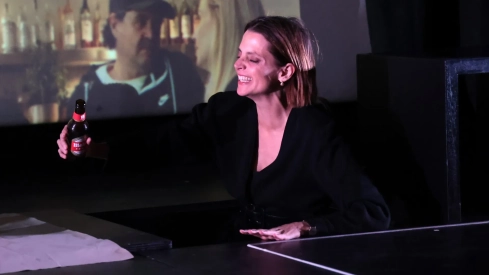
Fernando Tejero has come out against Macarena Gómez and has reignited the controversy after her statements denying that actresses suffer more demands than their male counterparts, with a brief but emphatic "very strong".
The actor, who has coincided with Gómez for several seasons in La que se avecina, reacted to a video circulated on social media that collects the words of the 48-year-old Cordovan actress, at the premiere in Madrid of Fiesta pagana, the film about the trajectory of the band Mago de Oz, presented at the Cines Capitol.
Gómez defends her career and denies unequal treatment for being a woman
Before Europa Press, Gómez explained that "I have been working a lot" since she started working at the beginning of the 2000s and acknowledged that she considers herself "fortunate," although she admitted that "it is complicated" for everyone to be able to say the same.
The actress, who rose to fame in 2007 when she joined the cast of La que se avecina, also assured that she has not experienced "stigmas" for being a woman and valued that, even at 50 years old, she believes she has worked more now than in other stages.
When asked if, for being a woman, she feels that the industry demands more, Gómez replied: "No. That they demand more from me when working than from a man? Not at all," and added that "one works until death," defending that she puts "the same emphasis and the same energy" into each project.
Tejero, Jiménez, and Vázquez respond; the controversy remains open
Gómez's words did not quell the debate and, on the contrary, provoked public responses in the professional environment. The first came from Tejero, who left the comment "It's very strong" in a post by Antonio González, a content creator who replicated the statements.
To that reply was added Agustín Jiménez, who worked with Gómez in ¿Me entiendes o te lo explico?, with the phrase: "If it doesn't happen to her, it doesn't happen," a message that pointed to the contrast between interpretations of the reality of the sector.
María Vázquez, 47, who coincided with Gómez in La vida de Rita and La dama boba, also responded. Vázquez maintained that her colleague "knows perfectly the situation of the sector" and accused Gómez of not having wanted to clarify her position and of trying to "take the conversation" to a political ground to minimize what, she said, happens in the audiovisual industry.
For now, the controversy remains open: after the public responses, the conflict is installed in the media debate without a new definitive clarification having been offered to close the discussion.
Contact