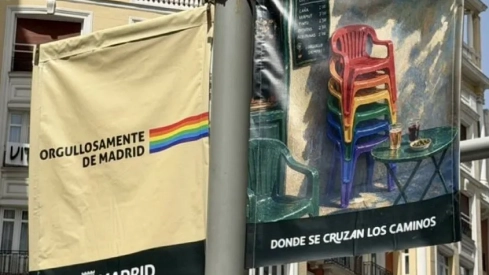
José Luis Martínez-Almeida has once again placed Madrid Pride in an uncomfortable position with an institutional campaign that replaces LGTBIQ+ people or their demands with traditional objects and symbols generated with artificial intelligence. Beyond the design, the use of AI, or the immediate controversy, what is brought to the table is a fundamental question: what does it mean to represent Pride from a public institution.
The choice of posters featuring terraces, chairs, balconies, or decorative elements with a minimal presence of the rainbow flag has been interpreted by collectives and the opposition as a displacement of the main subject of Pride. That is, the shift from people and their demands to aesthetics; from political narrative to a friendly image.
Almeida lo ha vuelto a hacer.
— Reyes Maroto (@MarotoReyes) June 22, 2026
Ha conseguido que el protagonismo del Orgullo no sean las personas LGTBIQ+
Un año más, la campaña del Ayuntamiento para el Orgullo no está a la altura. Demuestra que sigue sin entender las reivindicaciones, los derechos y la lucha histórica del… pic.twitter.com/XQmnIcNAlW
From this perspective, the criticism is not limited to a visual issue. Organizations like Arcópoli and PSOE representatives in the City Council have pointed out that this type of campaign can contribute to diluting the protest character of June 28, a date that was born as a response to discrimination and has historically centered LGTBIQ+ people.
The debate that opens is whether the institutionalization of Pride has led to a more neutral narrative, where social conflict and the memory of the collective are relegated in favor of a more aseptic celebration, intended by some to fit into an image of a festive and “proudly” local city. In this sense, the controversy is not only about a specific campaign, but about a broader trend: the transformation of Pride into an institutional communication product, where aesthetics can end up occupying the space that previously belonged to political demands, and where it seems that the city of Madrid is being celebrated, rather than the political cause that should prevail.
The Madrid City Council (@MADRID) insults LGTBI+ memory and distorts 28J
— Arcópoli (@arcopoli) June 22, 2026
From Arcópoli we express our absolute indignation at the institutional campaign of the Madrid City Council for this June 28. Posters that not only completely distort the… pic.twitter.com/CqevWnGGDP
The City Council defends the initiative as a way to maintain the visibility of Pride in the city, but the underlying discussion remains open: whether a celebration that was born to give visibility to a collective can continue to fulfill its function when 'subtly' it seems to stop being shown in the focus of the message.
Add ElConstitucional.es as a preferred Google source for free.
Stay informed about all the latest breaking news with the best information. Against disinformation, for democracy and social rights.