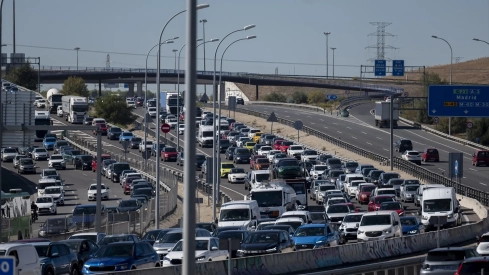
The General Directorate of Traffic (DGT) foresees 5,340,000 long-distance road trips due to the All Saints' Day holiday, to which numerous short trips will be added, especially those linked to traditional visits to cemeteries in different towns in Spain.
To cope with this increase in traffic, the DGT will launch a special operation that will begin at 3:00 p.m. this Friday and end at 12:00 a.m. on Sunday, November 1, in the communities where Monday is a working day. In Andalusia, Aragon, Asturias, Canary Islands, Castilla-La Mancha, Castilla y León, Extremadura and the Community of Madrid, where Monday will be a holiday, the operation will be extended until midnight on November 2.
Reinforcement of human and technical resources
The DGT will maintain maximum availability of its human and technical resources to ensure road safety throughout the operation. The operation will mobilize agents from the Traffic Group of the Civil Guard, personnel from the Air Means Unit, the eight traffic management centers, equipment maintenance operators and emergency services.
The available technical means will also be active, including fixed and mobile radars to control speed, helicopters, drones and cameras to monitor the use of mobile phones and seat belts.
Measures to facilitate mobility
With the aim of promoting fluidity on the roads, Traffic will implement regulation, ordering and surveillance actions, such as the enabling of additional and reversible lanes through signaling and beaconing in sections and periods of greater traffic intensity, the proposal of alternative routes between large urban centers and destination areas, and the adoption of specific measures in the most problematic points.
In addition, works affecting traffic will be halted and limitations will be applied to sports events and other events that occupy the roadway, along with restrictions on the circulation of general goods trucks and those transporting certain goods in specific sections, dates and times.
The hours of greatest traffic intensity
DGT forecasts indicate that the departure will be concentrated mainly between the afternoon of Friday 30 and the morning of Saturday 31. From early Friday afternoon, significant vehicle movements are expected, with high intensities and traffic jams leaving major urban centers, as well as on the main access roads to coastal tourist areas, second homes, and mountains. The biggest complications are expected between 4:00 PM and 10:00 PM.
On Saturday 31, intense traffic will continue from early morning leaving major urban centers and on roads accessing coastal and mountain areas. By late morning, traffic jams will already be at destination points.
On Sunday, November 1, numerous displacements will occur due to the traditional visit to cemeteries. From early afternoon, in the autonomous communities where Monday is not a holiday—Balearic Islands, Cantabria, Galicia, Region of Murcia, La Rioja, and Valencian Community—the return will begin, with a possible increase in traffic intensities on the main road axes accessing cities where Monday is a working day.
On Monday, November 2, short-distance displacements will continue in the communities where it is a holiday, before the return begins during the afternoon, when the highest intensities are expected on the main communication corridors and at the entrances to large cities.
Special attention to Andalusia and the A-1 in Madrid
The DGT has also indicated that it will remain attentive to the possible intensification of traffic on the main road axes originating and destined for Andalusia, as a consequence of the suspension of railway service to that community after the accident in Urda and the foreseeable transfer of travelers to road transport, both in coaches and private vehicles.
Traffic also reminds that the Ministry of Transport and Sustainable Mobility is carrying out long-term works to repair three viaducts located on the A-1, between kilometers 51 and 59, at the height of Venturada and Cabanillas de la Sierra. These works require closing one lane in the direction of entry to Madrid, so it is likely that significant traffic jams may occur in the area during Monday, the return day.
To minimize these effects, whenever weather conditions and safety requirements allow, Traffic will enable an additional lane for entry to Madrid from kilometer 74, which will be previously signposted.
