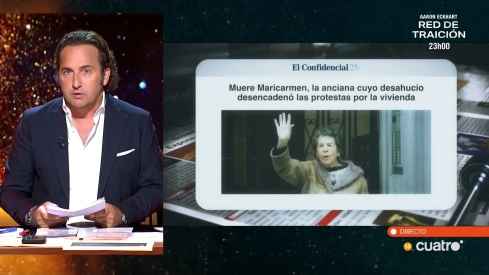
Maricarmen was 87 years old. For weeks, her name appeared on televisions, newspapers, and social media after being evicted from the home where she had lived for decades. Her story provoked mobilizations, political confrontations, and an intense debate about housing. But it also exposed something more uncomfortable: the ease with which a vulnerable person can stop being a person to become a television character.
Maricarmen's case allows us to observe how dehumanization works when it enters the logic of television. She is no longer an 87-year-old woman going through an extreme situation. She is “the Maricarmen case”. A political argument. An element of a talk show. An opportunity to pit some against others. And, at times, even a reason for conflict.
But that transformation did not begin with her death. Maricarmen had already ceased to be merely a woman who was about to lose her home to become the object of a battle between programs, talk shows, and political narratives while she was still alive.
The Maricarmen case was already a television war before her death
One of the most significant episodes occurred between El Intermedio, from laSexta, and Horizonte, from Cuatro. The team of Andrea Ropero managed to access the interior of the home during the eviction and filmed Maricarmen's last hours in what had been her home for more than seven decades from inside. The images allowed showing a part of the eviction that could not be seen from the outside. While hundreds of people gathered in the street, the journalist accompanied Maricarmen inside the home and recorded the moment when the agents accessed the property to execute the eviction.
That coverage, however, ended up becoming the object of attack from Horizonte. Carmen Porter questioned the presence of professional cameras inside the home and suggested that the existence of those images could respond to coverage organized for political purposes. During the talk show, insinuations were even made about Maricarmen herself and about the possibility that she was being used.
The issue went further. In the program, it was even suggested that Maricarmen "had been promised something," while Porter affirmed that the elderly woman had been "used." The focus thus began to shift from what was happening inside that home to a theory about who was behind the coverage and what interests there might be. Andrea Ropero's response was immediate. The journalist defended her team's work and responded by demanding "more empathy and fewer hoaxes." Iñaki López and Jordi Évole also publicly came out in defense of Ropero and questioned the accusations launched from Horizonte. El Intermedio, for its part, responded from the set with its usual satirical tone and vindicated the journalistic value of the images.
Wyoming defended that those cameras had allowed showing a reality that, otherwise, would have remained off television. And he put the focus precisely where, in his opinion, it should be: on what was happening inside that house and not on a supposed conspiracy around the cameras. The problem is that, while an 87-year-old woman was being evicted from the home where she had lived for more than 70 years, television was already turning her story into something else: a war between channels about who was using her and who had the legitimacy to tell it.
The paradox is hard to ignore: Maricarmen was losing her rented home for years while the sets discussed television itself.
Horizonte: from questioning her eviction to continuing to dehumanize her
The controversy did not end there. Horizonte continued to address the case and Maricarmen's name ended up integrated into the dynamics of the talk show itself. In one of the broadcasts, Iker Jiménez even referred to Urbagestión as "the vulture fund that wasn't," while the table included Eduardo Inda and Beatriz Talegón. It was then that Talegón asked a question about the measures being negotiated around the case: "Will the decree be called Maricarmen or not anymore?"
The intervention was followed by a comment from Carmen Porter that would acquire special relevance after the elderly woman's death: "See you later, Maricarmen."
Ese “hasta luego Maricarmen” os perseguirá hasta que os cierren ese chiringuito fascista y negacionista
— sofrito (@soofrito) October 7, 2026
pic.twitter.com/B7tfWKwfqx
In addition, Horizonte even brought one of the businessmen linked to Urbagestión to the set with his face pixelated, presenting him within that narrative of suspicion and confrontation that had surrounded the case. And, more recently, another of the program's commentators even suggested whether Maricarmen "could have been an actress", thus questioning the authenticity of the woman who was at the center of the story. It is difficult to imagine a more evident way of turning a person into a character: it was no longer just about what was happening to her, but whether the person experiencing it was real or playing a role, or being used as a political weapon. Or who knows what other hoax.
When Maricarmen passed away, just a few days later, those images began to circulate again. Talegón herself then appeared on Horizonte talking about the death in a completely different tone from that previously used, holding her hands to her head, as if her past interventions had not minimally inferred what has ended up happening. “It's a sad night”, she stated, to then demand limits and maintain that “not everything goes”. Too late. As always.
Beatriz Talegón: "Que la memoria de Maricarmen sirva para tener límites. No todo vale, ni en las campañas políticas ni en las campañas electorales ni en los movimientos sociales empezando por lo que aquí dijimos desde el primer día" @BeatrizTalegon #Horizonte pic.twitter.com/xHQC0wr1Bm
— Horizonte (@HorizonteCuatro) October 7, 2026
But that was precisely what many viewers reproached him for. That they had not forgotten how Maricarmen had been spoken of when she was still alive, when she was being evicted, and when she was hospitalized.
The contradiction is eloquent: the woman who had been turned into an object of jokes and political confrontation returned to the set, after her death, transformed into a motive for reflection and solemnity.
And it wasn't just Horizonte.
Nacho Abad and the "Morocarmen": when eviction becomes political ammunition
In En boca de todos, also on Cuatro, Nacho Abad gave space to another of the episodes that are now circulating again. Shortly after the eviction, the presenter read live a message published by Vox that stated: "All of Spain knows that if instead of Maricarmen it were Morocarmen, she would have a house."
The phrase used the situation of an 87-year-old woman who had just been evicted from her home to introduce the migratory debate. And here the same problem reappears: Maricarmen ceases to be Maricarmen. She is no longer a specific woman with a specific story. She becomes a resource to talk about immigration, housing, government, politics, or any other issue that can be placed above her own life.
That process is precisely dehumanization.
There is no need to deny the existence of legitimate political debates around housing or immigration. What is problematic is using a vulnerable person as a vehicle for these debates to the point of making the person who originated them disappear.
Mediaset and the conversion of Maricarmen into a television character
It is here that Mediaset's responsibility acquires a particularly clear dimension.
For weeks, different Cuatro programs contributed to building a narrative around Maricarmen that went far beyond reporting on her eviction. The coverage of El Intermedio was questioned, it was insinuated that there could be instrumentalization, political debates about her case were introduced, and phrases were uttered that later, after her death, acquired a much more serious dimension.
The problem is not that a channel has a certain political position or that its commentators disagree with those who defend Maricarmen. The problem is that an 87-year-old woman ended up becoming talk show material.
First it was the eviction. Then, the cameras. Then, the accusations of instrumentalization. Then, the jokes. Then, the death.
And then solemnity arrived.
That is also dehumanizing.
Because when a person becomes a character, it becomes much easier to talk about them without wondering what they feel, what they fear, or what they are experiencing. And it doesn't stop there.
Telemadrid: the owners as protagonists a few hours after her death
And if Mediaset offers an example of how a vulnerable person can become a television character, Telemadrid offers another even more revealing one: what happens when that person dies and the narrative is placed back on those who were on the other side of the conflict.
Maricarmen passed away this Wednesday around 8:30 PM. Barely two hours later, around 10:10 PM, Antonio Naranjo interviewed Fernando Alonso, owner of Urbagestión, the company that owned the home from which Maricarmen had been evicted, on Telemadrid.
The interview did not come at just any time. It came when the death of the story's protagonist had just been announced.
Hablamos con el propietario de Urbagestión, la empresa que compró la casa de Maricarmen@AntonioRNaranjo
— El análisis: Diario de la Noche (@analisisDN) October 7, 2026
✖️@telemadrid#programa327#Elecciones29N
🔊 https://t.co/VHYMhGT6O8 pic.twitter.com/uCb9Szclrh
And Naranjo did not limit himself to giving the floor to the property. Before the interview, he presented Urbagestión from a clearly favorable position, defending that the company had finally accepted an agreement for Maricarmen to return to the home and emphasizing that it had been years since they had given up income. “They have been many years giving up income that they could have had,” Naranjo stated when introducing Fernando Alonso.
Then came an even more significant question due to its focus: “Do you have a certain fear, seeing how things are unhinged, agitated, and demagogic, or has that fear already left you?”
That is to say: a few hours after Maricarmen's death, the television focus was placed on the owner's fear of not receiving more income than he already received. The owning company appeared as a subject to be listened to, understood, and asked how it was doing. Meanwhile, the 87-year-old woman who had just died was, once again, turned into the object around which the conversation should revolve.
Naranjo also ended up criticizing those who, according to him, could politically use Maricarmen's death and spoke of an alleged “avalanche of political demagoguery.” The program closed with a “good night and long live Spain.”
The interview can be understood as a legitimate journalistic decision to give a voice to the property. But the problem is once again in the framing: when a woman has just died after being evicted, why does the television conversation end up focusing on the fear, economic losses, and the position of those who defended her eviction?
There Maricarmen disappears again.
Dehumanizing does not always mean insulting
That is probably the most worrying aspect of the case. Dehumanizing is not just about insulting someone. It also consists of reducing them to a label by trying to control the narrative until we stop perceiving everything that is behind it.
Maricarmen was an 87-year-old woman. She had a story, a house, memories, bonds, and fear. But in certain television spaces, she ended up becoming a name around which debates and confrontations were organized. First, she was news. Then, a symbol. Then, a character. And finally, even her death became content.
And television has a special responsibility because what is broadcast does not disappear when the program ends. It remains on networks, is clipped, shared, distorted, manipulated, and recirculated. A phrase uttered as a joke can later become the memory of how someone was treated when they were going through their worst moment.
That is precisely what has happened now with Maricarmen. Her death has made many viewers look back and retrieve images that perhaps, when she was alive, had been buried between the next controversy and the next program.
Mediaset and Telemadrid contributed to dehumanizing Maricarmen. They took her from the place she should occupy —that of an 87-year-old woman facing an extreme situation— to turn her into a character to opine about, confront political positions, generate controversy, and build an audience.
It stopped mattering solely what was happening to Maricarmen and began to matter what Maricarmen could generate on television or the profit they could get from it.
And it wasn't only the sets that ended up shifting the focus from what was truly important. During those days, articles also proliferated that reconstructed Maricarmen's life through secondary or anecdotal aspects: interviews with neighbors, her bingo afternoons, details of her routine, or even information focused on the properties she owned and issues related to alleged non-payments.
All these elements could be part of journalistic coverage, but, accumulated, they contributed to building a portrait of Maricarmen as a character, as a sum of anecdotes, circumstances, and controversies, instead of keeping the focus on the essential: an 87-year-old woman who was going through an eviction and whose situation had acquired an enormous public dimension. The same problem also appears there: when the life of a vulnerable person becomes narrative material, the person runs the risk of disappearing behind the story.
There lies the gravity. It was not necessary to insult her directly to dehumanize her. It was enough to stop seeing her as a person and to contribute to a certain audience being able to think that way.
It was enough to turn her name into a label, her eviction into a political battle, her suffering into a talk show, her intimacy into television material and, finally, her death into just another piece of content. And that is what certain Mediaset and Telemadrid spaces did with her story: contribute to turning a vulnerable woman into a television character rather than a person.
When people say “they killed Maricarmen,” they are not claiming that a television channel physically caused her death. They are pointing to something else: the construction of a narrative in which Maricarmen's dignity too often fell behind the spectacle or the defense of certain political ideas.
Television and the media did not carry out the eviction. But they could decide from what angle to tell the story of the person who suffered it. They could decide whether an 87-year-old woman appeared as a person or as a character. They could decide whether her privacy was respected or turned into content. They could decide whether a tragedy served to understand a social problem or to fuel a war between talk show guests and opposing opinions.
And in Maricarmen's case, too often some television channels and media chose the second option.
The question Maricarmen leaves behind
It was not necessary to turn Maricarmen into a heroine to treat her with dignity. Nor was it necessary to share the demands of those who came out to defend her. It was enough to remember that she was a person.
A person who was 87 years old. A person who had lived in that house for decades. A person who faced an eviction. A person whose situation caused a social mobilization. A person who ended up in a hospital. A person who died before being able to return to that place she had called home for decades.
That is why the Maricarmen case should also serve to look at television itself.
At Mediaset, for the words, jokes, insinuations, and approaches that are now circulating again and that show to what extent her story could become talk show material.
At Telemadrid, for the way of approaching the case and for the choice of who to focus on just hours after her death.
And also to television itself as a whole, because the war between Horizonte and El Intermedio showed to what extent the case had ceased to be solely a story about a woman and had become a battle between television narratives or specific political ideas.
Not because a network is responsible for her death. But because the media also participate in the construction of the social climate in which certain people are treated as subjects of rights or as objects of debate.
And that difference matters. Because when a person stops being seen as a person, it becomes much easier to laugh at them, question them, use them, point them out, or turn their suffering into entertainment.
Perhaps that is the true lesson Maricarmen leaves: that the first step for some people to stop suffering is to prevent (in time) them from being seen as human beings.