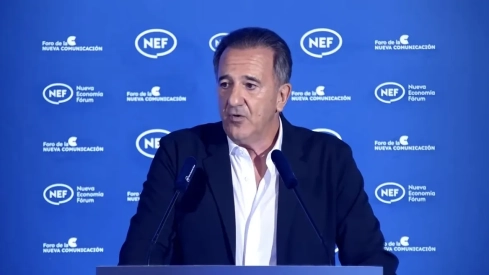
José Miguel Contreras has presented La Séptima at the New Economy Forum, where he explained the reasons that led him to launch the new television project, the model he intends to develop, and the difficulties he is encountering in getting it started.
The event brought together prominent representatives from politics and communication, including Félix Bolaños, Irene Montero, and Mónica García, as well as several of the main faces of La Séptima, such as Javier Ruiz, editorial director of the project; Sarah Santaolalla, Luján Argüelles, Rocío Delgado and other team members.
During his speech, the journalist and executive defended the need to incorporate "other voices" into the Spanish television landscape and assured that the project began to take shape after his departures from Atresmedia and Prisa. "This channel is a product of unemployment," Contreras explained when asked about the origin of La Séptima. According to him, in 2019 he left the Antena 3 Media group and subsequently Prisa, in both cases "against my will," although he defended that these situations are part of any professional career.
After even considering the possibility of retiring after 50 years in the profession, Contreras assures that he decided to continue because he believes that "Spain needs other voices." "I believe that due to the easily explainable circumstances of what has been the conformation of the Spanish television model, we have ended up in a somewhat strange system in which there are only two groups that legitimately and also with a very high level of professional quality have occupied all the space," he pointed out.
In this sense, he acknowledged that the current offering of Spanish private television does not represent, in his opinion, all audiences. "I believe, or at least I thought, that what is currently offered on private television in Spain did not represent me. I believe there are more citizens," he stated.
From La Sexta to La Séptima
The presentation also had a symbolic component for Contreras. Twenty years ago, he participated in the presentation of La Sexta, and now he returns to the same stage to present La Séptima.
"Here we were twenty years ago, curiously presenting La Sexta, and twenty years have passed, and we are in the same place presenting La Séptima," he recalled. He even joked about the possibility of a new presentation in another twenty years: "Let's all meet in twenty years for the eighth, if that sounds good to you."
Contreras has explained that the current context is radically different from that of 2006 and has defended that La Séptima is born precisely to adapt to a television marked by new technologies, social networks, and audience fragmentation.
A television based on live broadcasting
One of the main pillars of the project will be live broadcasting. Contreras believes that streaming platforms have transformed the audiovisual market and that traditional television must seek out those territories where it can still offer something different.
"These giants cannot reach everything," he explained. "If they do deferred, recorded productions for you to consume whenever you want, the only place they don't reach is opening the window of each house. That is, for you to open the window and see what is happening on your street."
Based on this idea, La Séptima aims to bet on a television based on "absolute live broadcasting," immediacy, and permanent connection with current events. "What there isn't is a channel that has a particular stamp, a distinctive stamp that somehow tries to occupy that space," he defended. According to Contreras, this model has been developed in other countries and now intends to be transferred to Spain.
"Television is a concept, it is no longer a medium"
Another key to his intervention has been the transformation of the very concept of television. "Television is a concept, it is no longer a medium," assured Contreras, who believes that the audiovisual content consumed by young people through mobile phones, YouTube or TikTok is equally part of that new television ecosystem.
"When a 16-year-old kid is sending 12 videos to each other and connected on YouTube and downloading TikTok videos, that is television," he defended. For this reason, La Séptima does not intend to limit itself to being a traditional DTT channel, but to become an audiovisual brand present on different devices and platforms.
"The idea is to see how we can transform, which in Spain no one has yet done seriously, the creation of a brand, which in the end is what we are looking for, a stamp," he explained. His intention is for La Séptima to be "something more than a channel" and to be identifiable with a certain way of understanding the world. "May La Séptima be something more than a channel, may it be a stamp with which people identify," he pointed out.
A project that wants to launch on November 5
Contreras has also spoken about the deadlines the project is handling. The intention is to start broadcasts on November 5, a date that, as he explained, is conditioned by the retuning linked to the arrival of ultra-high definition technology. "You cannot imagine what it is like to aspire to go live on November 5, which we have to do out of obligation," he stated.
The head of La Séptima has acknowledged that launching a television channel in just six months is a considerable challenge. "We will go live, I'm going to say it clearly, however we can," he joked. "It won't be the best television channel you've seen in your life, but well, it will be the second or third best in history."
Not competing with Netflix in series and movies (for now)
The commitment to live broadcasting also implies initially giving up competing with large platforms in certain genres. "It makes no sense for us to aspire to compete with Netflix," Contreras stated. "We have to look for territories where we can become strong."
For this reason, the project does not consider series or movies as its main focus. "Therefore, that's why we don't make series, we don't make movies," he explained.
Its objective is to take advantage of a different space within the audiovisual market and turn it into the identity of the new channel. Contreras has defined La Séptima as "the first channel of the new era of generalist television," in reference to the changes produced in the sector since the appearance of La Sexta and Cuatro.
A commitment to plurality
One of the most relevant aspects of his intervention has been his analysis of the ideological offer of private television. Contreras has argued that, in his opinion, there is a space that is not sufficiently covered. "We firmly believe that there is a very important percentage of the Spanish population underserved today in the offer of private television channels," he assured.
The promoter of La Séptima has considered that private television presents, according to his interpretation, "a very powerful ideological bias linked to conservative ideas." And he added: "In the realm of the progressive world that would range from the center-right to the extreme left, if it exists, there is an absolute and total void right now."
"The success of this project is that we come to exist"
Beyond audience figures, Contreras has assured that his main objective is to get the new channel up and running. "For me, the success of this project is that we come to exist," he stated. In that vein, he defended an independent private television, with transparent financing and professionals who can express their opinions.
"Just knowing that in that territory we have defined there is an absolutely independent, private voice, of transparent people, who show their faces, who know where the money came from, who know where every euro comes from, where it goes," he explained. And he summarized his approach with another of the central phrases of his speech: "Simply defending that there is a space where you can express your ideas."
An estimated cost of about 30 million per year
Contreras also put figures to the project. As he explained, La Séptima's model contemplates an approximate expenditure of 30 million euros per year and around 100 million during the first three fiscal years.
"To be profitable we have to earn 101," he pointed out. The project manager acknowledged that it is still impossible to know the audience the channel will have before it begins broadcasting.
"Measuring the audience of something that doesn't exist is impossible. We don't know what audience we are going to have," he admitted. As a reference, he recalled the premiere of La Sexta: "La Sexta had 0.1% audience on its first day of broadcasting."
From there, he launched his particular commitment: "I commit that we are going to surpass it. We are going to do more than 0.1 and see how far we get."
Regarding future forecasts, he explained that the current business plan contemplates placing the audience around 2.2% in 2027. "If we are around 2, you will see us calm; if we are at 2.5, you will see us smile; if we are at 3, well, we'll invite you to whatever you want," he joked.
Advertising, one of the big challenges
Another issue addressed during the meeting was advertising financing. Contreras explained that La Séptima will have to resort to one of the companies that currently manage television advertising in Spain and cited Atresmedia, Mediaset, and Pulsa.
Regarding Atresmedia and Mediaset, he has acknowledged their position in the market and highlighted the work done by both groups. "They are the kings, they have earned it, they have invested, they have made, I believe, magnificent products in these years, they know how to manage it and no one has given them anything for free," he stated.
The decision on which company will finally manage La Séptima's advertising is not yet closed, he explained. At this point, Contreras also publicly highlighted the relationship maintained with Mediaset and, in particular, with its CEO, Alessandro Salem. "Alessandro Salem's behavior has been exemplary, magnificent," he assured.
Contreras denounces obstacles for the project
During the meeting, the promoter of La Séptima also stated that the project has encountered significant obstacles. "Practically never have I encountered a project where so many people are working so hard to prevent it from succeeding," he declared.
He then attributed these difficulties to three types of factors: business and competition interests, political interests, and personal conflicts. "There is a part, therefore, of business economic interests," he explained. "There are also reasonable political interests."
He also spoke of the personal conflicts accumulated during his five decades of professional career. "I have been working for 50 years. I believe I have made many friends," he pointed out, although he acknowledged that he has also had confrontations with some people.
"There are people who don't see it that way and they have names and surnames," he added. According to his account, all these factors would have combined to hinder the launch of La Séptima.
Vox's appeal and the battle for the license
The legal situation surrounding the license also featured prominently in the meeting. Asked about the appeal filed by Vox, Contreras offered his own interpretation of the procedure.
"I believe that Vox basically seeks to reaffirm the legality of the process and corroborate that Spain is not a dictatorship at all, but on the contrary, the system works and the license has been obtained with the maximum legality and transparency imaginable," he stated.
Contreras then made an extensive review of the history of television licenses in Spain and compared the current process with previous tenders. During his speech, he also mentioned other procedures related to the granting of the license.
"We have, as far as I know, I think there is another one from OK Diario and I think Atresmedia has appeared as an observer of the process," he explained, although he admitted not being certain about all the details of these procedures.
In his opinion, the current controversy precisely demonstrates the need to expand television plurality. "I think it is so evident, it is so clear, that all it does is demonstrate the absolute need for true plurality, for other voices to exist, and we are going to try to move forward." And he closed with a statement that summarizes his position on the project: "I don't know how we will end up, but we are going to try."

This breaking news is being updated. The editorial team of ElConstitucional.es is working to expand the news and offer you the best information.