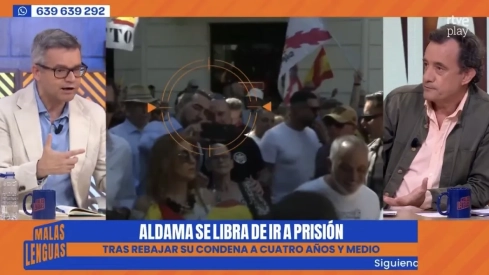
Businessman Víctor de Aldama made an intervention on May 5, 2026, in which he sent a direct message to the Spanish right-wing political class: “Spain is going to hell, there are no colors, and I can't do it alone. Okay? I don't know how I have to say it. I don't know if I have to say it louder, shout, or what. Mr. Feijóo, Mrs. Abascal, I can't do it alone”.
His words were analyzed on the program Malas Lenguas, where presenter Jesús Cintora contextualized the debate surrounding his judicial situation and the public interpretation of the case. “Aldama does not go to jail, and here it is being said that he has spoken, that there is a unanimous judicial decision. There is also a debate about justice today in this country, a debate that can be raised”, he pointed out, referring to the underlying discussion about the judicial system.
In that context, journalist Manuel Rico focused his intervention on the application of mitigating circumstances and the scope of judicial resolutions. “It can be applied in one way or another… and that was part of the debate”, he explained, before questioning that in this case “the court went further than what the PP and the Anti-Corruption Prosecutor's Office requested”.
The journalist also questioned the proportionality of some resolutions and their impact on corruption cases, pointing out that in this matter “the court had options” and criticizing that, in his view, the convicted person “gets off completely” and “does not have to return the money”, something he described as “absolutely scandalous in a corruption case”.
But Rico's analysis went beyond the specific case and delved into a structural reflection on corruption. With a critical tone, he maintained that “here, the corruptors get away with it, but it's not the first time”, alluding to other episodes of political corruption in Spain.
In his intervention, journalist Manuel Rico focused on the treatment of corruption cases in Spain and the consequences that, in his opinion, previous processes have had. “In everything related to Gürtel, illegal financing, or those who paid, they got away with it absolutely free”, he affirmed, before opening a broader debate on the need to revise the Penal Code on corruption. Javier Gallego interrupted to suggest that “that is another debate, because we have the penal code we have”.
Rico defended that the discussion should not be limited solely to the figure of the person who collaborates with justice, but also to those who participate from the other side of the crime. “Mr. Aldama has two roles in this trial: one is the one you highlight, that he collaborates with justice; let's accept that he collaborates… and the other is that he is a corruptor,” he maintained, emphasizing that, in his opinion, both aspects should be analyzed jointly. Gallego pointed out that he had not accepted it as an individual, but that “the Court has accepted it unanimously. I am not going to turn him into a hero.”
In that context, Rico insisted that, in his judgment —shared with his colleague Gloria—, the true debate “for any sensible person” lies in the role of the corruptor. Although he acknowledged that collaboration with justice can be valued, he questioned the final consequences of this type of decision: “That he doesn't go to jail and that they forgive him the money seems like too much of a reward to me.”
Finally, he maintained that the underlying problem lies in the lack of consequences for those who induce corruption: “Here, being a corruptor is free,” lamenting that, in many cases, “the corruptors are big businessmen and not one has gone to jail with a sentence similar to what we have seen.”
👉 Aldama pide ayuda a Abascal y Feijóo: "España se va a la mierda y yo solo no puedo"
— Malas Lenguas (@MalasLenguas_Tv) June 22, 2026
🔴 "Aquí, ser corruptor, sale gratis", opina Manuel Rico en #MalasLenguas pic.twitter.com/zQw7BnG0Gz
Add ElConstitucional.es as a preferred Google source for free.
Stay informed about all the latest breaking news with the best information. Against disinformation, for democracy and social rights.