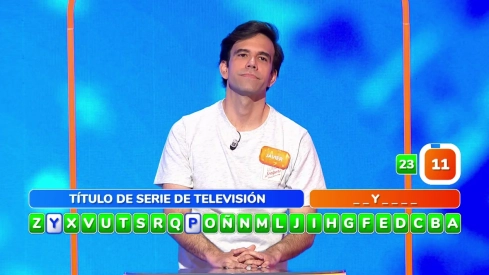
The legal war against Pasapalabra adds a new episode and, once again, the one who runs the risk of being harmed is the viewer. After Atresmedia complied with the Supreme Court ruling by withdrawing El Rosco and opted for a new test with its own license, MC&F and Mediaset are preparing a new lawsuit to try to also take AlaZ off the air, an offensive that once again questions the continuity of the leading television contest despite the fact that the change has been supported by the audience since its premiere.
The legal battle between networks and production company around Pasapalabra and Antena 3, in this way, is far from over. Just a few weeks after Antena 3 replaced El Rosco with the new AlaZ test to comply with the Supreme Court ruling, MC&F, owner of the rights to El Rosco, and Mediaset are preparing a new lawsuit against Atresmedia in which they will even request the precautionary cessation of the broadcasts of the final test of the contest.
The offensive comes when AlaZ has already proven to have the support of the audience. Since its premiere on June 19, the contest has maintained its figures and has even improved some of the results it registered with El Rosco, showing that viewers have naturally accepted the change introduced by Antena 3.
After the Supreme Court's resolution, Atresmedia immediately eliminated El Rosco and acquired the rights to AlaZ, a test belonging to a format from a Swiss television that was later adapted to become the outcome of Pasapalabra. Among the changes introduced, all the circular symbolism of the historic rosco disappeared, the mechanics were modified, the available time was extended, and differences were incorporated regarding the original format to integrate it into the structure of the contest.
However, MC&F now argues that this adaptation retains elements that the ruling considers protected and understands that the new game is still based on the essence of El Rosco. To support this thesis, it compares the version broadcast by Antena 3 with the description made by the Provincial Court of Barcelona —later ratified by the Supreme Court—, arguing that there are similarities in aspects such as the confrontation between two contestants, the alphabetical order of the questions, the existence of an accumulated jackpot, or the construction of the program's final climax.
The strategy represents a new chapter in a legal dispute that has accumulated years of lawsuits between the different companies involved and that once again places the viewer as the main victim, because in the end it is they who directly suffer the consequences. After Antena 3 found an alternative to guarantee the continuity of the contest after losing El Rosco, the new lawsuit threatens to reopen uncertainty about the outcome of one of the most successful formats on Spanish television.
While justice must decide whether AlaZ constitutes a sufficiently different game or if, on the contrary, it reproduces protected elements of El Rosco, the reality is that Pasapalabra has managed to keep public favor intact even respecting the law and embracing the change in mechanics. Precisely that success now turns the new test into the target of a judicial offensive with which MC&F and Mediaset intend to once again remove the final test of the Antena 3 contest from the screen.