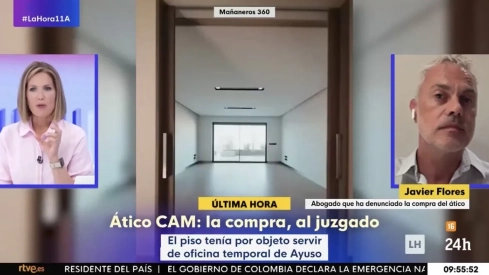
The purchase of the property linked to the Community of Madrid has once again come under the spotlight after lawyer Javier Flores, who has denounced the operation, explained on La Hora de La 1 the differences between acquiring the property directly from the Administration or doing so through the public company Planifica Madrid. In conversation with Silvia Intxaurrondo, Flores emphasized the administrative controls that, he maintains, would have been applied through the ordinary channel.
The lawyer pointed out that, if the acquisition had been made through the General Directorate of Heritage, it would have been necessary to open an administrative file and documentarily justify the need to have that space. It would also have had to be explained why that specific property was chosen over other alternatives and the operation would have had to be budgeted for.
Flores also highlighted the amount of the purchase, which exceeds three million euros, and assured that, through the ordinary channel, the operation would have had to pass through the Governing Council and the Assembly of Madrid. This would involve, according to his explanation, prior controls aimed at scrutinizing the operation before it occurred, and not subsequent checks.
Javier Flores denuncia la compra de un ático por parte de la CAM: "De haberse adquirido por la vía ordinaria, que es la Dirección General de Patrimonio, habría habido un expediente administrativo (…) Es decir, habría habido una serie de controles previos, no posteriores" pic.twitter.com/nEfiKES86k
— La Hora de La 1 (@LaHoraTVE) August 11, 2026
The difference, according to the lawyer, lies in the legal regime of Planifica Madrid, which is mostly subject to civil and commercial law and not to the same administrative obligations. Flores also questioned whether the operation fits with the usual activity of this public company, mainly dedicated to regional investments such as senior centers, fire stations, or municipal facilities. "It is not a real estate company, to put it clearly," he stated, although he acknowledged that among its functions is the purchase and sale of properties.
Furthermore, according to Flores, the file includes the acquisition of a home by a public company of the Community of Madrid. The initial explanation, as he recounted, was that the property would be temporarily used as office space while works were carried out at the headquarters of the Casa de Correos de la Puerta del Sol. However, the lawyer maintains that when the purchase was formalized, in April, those works were not yet documented.
“The works file was initiated practically seven weeks later,” Flores pointed out. To this circumstance, he added another issue he considers relevant: according to his explanation, the property does not allow for the installation of an office due to its urbanistic use. The lawyer thus questioned whether the home could legally fulfill the function for which, according to the justification offered, it would have been acquired.
Flores also pointed to the Dirección General de Patrimonio, dependent on the Ministry of Finance, as the body responsible for determining the needs for workspace for civil servants of the Community of Madrid. According to him, there is no record or no "commission" or "necessity report" from this body that accredited that at that time it was necessary to temporarily have offices with those characteristics. A series of circumstances that, in his opinion, raises questions about the operation and the justification used to acquire the property.