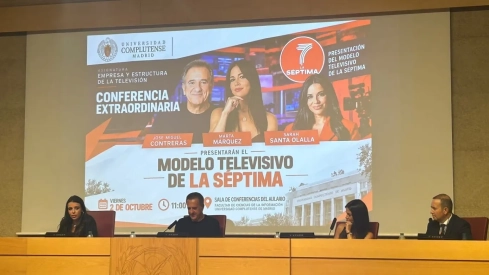
José Miguel Contreras was this morning at the Complutense University of Madrid to talk about television and, incidentally, about a professional career that began precisely during his university years. His parents allowed him to dedicate himself completely to his studies when he had just started his Journalism degree, and it was then that he discovered a medium that ended up becoming the center of his professional life. "It drove me crazy and I didn't really know what I wanted to do, and in the end I've done everything," he recalled.
The promoter of La Séptima also emphasized the importance of insisting to make one's way: "They won't call you, you have to be going around." A philosophy that, he explained, he applied from his early years with his colleagues and that he summarizes as preparing for what one wants to do, working, getting closer to that world, and persevering. "I've had all the luck in the world," he acknowledged. Although he has already retired from the university, he made it clear, with a laugh, that he does not contemplate doing the same with his profession: "I don't plan to retire from the profession until they kick me out, which they have tried several times, but I resist."
La Séptima seeks the gap that platforms cannot occupy
Contreras then arrived at the birth of La Séptima, a project that he admits may seem "a bit crazy" after twenty years without new television channels. "Suddenly, 20 years without television channels, a group of people decide to do something that seems outdated, that already belongs to the Anthropocene. A television channel," he stated. However, he defended that the concept of television has not disappeared, but has evolved: "If people don't watch television. You won't watch television, but you consume video through mobile phones and through screens and through everything. That is television, it's exactly the same." The project that now occupies Contreras starts from a paradox: launching a new television channel when the very concept of television has radically changed. After twenty years without new channels, La Séptima breaks into a fragmented market, with audiences that have migrated to the digital environment and with platforms such as Netflix, Movistar Plus, Prime Video or HBO Max having become direct competitors of conventional television.
The promoter of La Séptima thus claimed a much broader conception of the medium than the traditional screen. "Television has made all the changes it could have and we have always called it the same way, although in reality it has nothing to do with it, because today it is a connected whole, with the possibility of having access to all kinds of signals, second screens". For Contreras, despite this transformation, there is an element that remains: "We continue to call it television because deep down there is a common element, which is people's interest in audiovisual content and this is what we are dedicated to". La Séptima wants to build on that transformation. "Our DTT channel aims to be the first channel of the new era of television", he affirmed, distancing himself from the television he himself helped create with La Sexta more than twenty years ago.
Contreras does not deny the difficulties. On the contrary, he acknowledges that "many people think it's crazy and they are possibly right", but assures that the project will go ahead. His argument is based on understanding that television no longer solely means sitting in front of a device: audiovisual consumption has multiplied among mobiles, screens and second screens, although the interest in content remains the same. "Television remained like a man. When life returned, I said it again, but TV was a tough guy", he affirmed in reference to the evolution of the medium.
The network wants to position itself precisely in this new scenario. Contreras recalled that when he participated in the creation of La Sexta, more than twenty years ago, the network literally occupied the sixth position; now La Séptima arrives at a market with "almost 30 national channels, adding public and private ones". To the fragmentation of the offer is added the pressure from platforms, which concentrate large international productions, series, formats, and increasingly sports rights. La Séptima's response will not be, as he explained, to try to reproduce that model, but to seek what a global platform cannot offer. "What they won't be able to do is, in each country around the world, open a window and show what is happening in the streets of your country," he pointed out. That "little window" is precisely the space La Séptima wants to occupy: to be there when something happens and tell it at that very moment. To do this, it bets on faces like Marta Márquez and Sarah Santaolalla, far from the classic news model and with a way of communicating that, according to Contreras, allows "speaking clearly, speaking sharply" and "getting involved".
A television that wants to discuss without turning the viewer or those who think differently into an enemy
Contreras's second big bet has to do with the type of conversation he intends to build around this new screen. In a context he defines as "very polarized", he defends La Séptima as a space "without fear and without any kind of complex", capable of bringing different positions into contact without the exchange ending up as a permanent confrontation. Contreras openly defines himself as a left-wing person and assures that he has been "all his life", but introduces a condition he considers essential for any debate: being convinced of one's own ideas does not imply believing that one is right about everything. "I am absolutely convinced of my ideas. I am also convinced that I am not right about everything, that is impossible," he stated. From this premise, he advocates recovering a possibility that, in his opinion, is being lost: listening to the other, contrasting opinions, and maintaining a conversation without aggressiveness or threats.
His approach also stems from personal experience. Contreras explained that in his family, left-wing and right-wing people coexist, and that this coexistence has accustomed him to dealing with very different political positions without that preventing the maintenance of personal ties. This is the experience he wants to transfer to La Séptima. "What I would most like is for conservative people to come and see us," he assured, so they can learn how a channel with a progressive outlook interprets the world "and that when they do, they don't feel offended, don't feel insulted, don't feel excluded." Contreras admitted that he himself sometimes has this feeling when he approaches programs of a different ideology and perceives that certain positions appear as "proscribed interveners." The aspiration of La Séptima, as he explained, is precisely the opposite: that those who think differently can stay and listen, and that those who share their ideas can also encounter other voices. "I like to know what people who don't have the same idea think too," he summarized. That is, he concluded, "the spirit with which we are born and which Marta and Sarah represent."
From La Sexta's 300 million to La Séptima's little more than 30
Contreras also put figures to the radical change that the television business has experienced in the last twenty years. When La Sexta was born, he explained, the project managed around 300 million euros annually and competed in an advertising market that reached 3,500 million. "If you had around 10% of the audience, you would get 350 million," he recalled. The channel then had the football League, Formula 1, and five prime-time programs, but the crisis caused by Lehman Brothers caused television advertising investment to plummet from 3,500 to 1,800 million in just a few months. "Those of us who earned 300 million or 320 in advertising went on to earn 150. And the expenses you had were 300," he explained, in a situation that ended up leading to the absorption of La Sexta by Atresmedia.
Now, according to the figures Contreras handled, the market is around 1,600 million and there are about 30 national channels compared to the six back then. La Séptima, furthermore, starts with a much lower budget: "We are going to spend around more or less above 30 million euros, from 300 to 30." In this new scenario, reaching a certain audience share does not guarantee receiving the same proportion of advertising investment, since, as he explained, small channels are at a disadvantage compared to large operators: "The bigger you are, the more you get, and the poorer you are, the smaller you are, the less you get."
His forecast is that La Séptima can start to be profitable with an audience located "around 2.5 and 3%", adding traditional advertising to digital, commercial, and event revenues. The launch of La Séptima will also take place in a particularly intense political context. The channel plans to begin its broadcasts on November 5, in the midst of political news and with the possible early general elections on the table. In recent hours, November 29 has even been considered as a possible date for the elections, although for the moment there is no official call. Contreras believes that this scenario can give added exposure to the launch: "Without a doubt, we will have impacts, it will cause a stir and we will be able to meet our audience perspective."