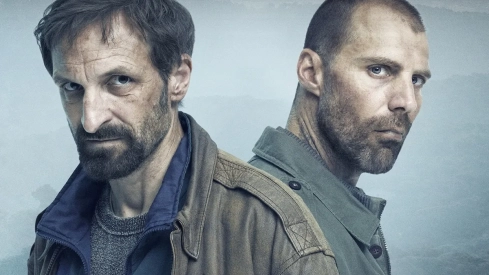
Luis Corpas for 'ElConstitucional.es' exclusively interviews José Manuel Poga and Julián Villagrán about 33 days, the first fiction series by journalist Carles Porta, which arrives next June 7 on Atresplayer, in which they analyze the challenge of bringing to life a story inspired by real events and its impact as true crime in current television fiction.
Question, Luis Corpas, ElConstitucional.es: What was the first thing that captivated you about 33 days when the project reached you?
Answer, José Manuel Poga: The truth is that it captivated me, I saw the episode on Crims. I already watch true crimes, well I used to watch true crimes —not anymore, because I think I've seen them all,— And I was very interested in the story of, firstly a prison escape, which I already find interesting, and then the escape and surviving in Collserola very close to Barcelona, you know? That everything stays like in the neighborhood, right? And surviving with wild animals for about 33 days. I found the adventure fascinating.
Answer, Julián Villagrán: What caught my attention the most is getting to understand why my character does what he does, you know? A guy who has committed a minor crime, who has... who already has permission to leave, who has AIDS and knows that there is a medicine, in 2001, that if he leaves he cannot have access to the medicine that keeps him alive and that he has very little sentence left and how he throws everything overboard to save a companion and somehow compensate, which is a bit, I think, the reason he had for his family for having defrauded them, trying to get out of jail to rob a drug trafficker, get the money and give it to them. That is the intention for which the project called me the most.
Q. Did it make you dizzy to work with material inspired by real events so well-known in Catalonia?
R. J.M.P. Yes, for me particularly it made me feel hesitant, because it was a character that you build, that you can handle, you can... So it was delving into a psychologically quite perverse character and trying to understand and defend and well, put yourself in their shoes, right? Put your body there and your head and your time into such a dark character. And that exists... and well with a certain hesitation and certain respect, to try to understand him, because if you don't understand him, you can't defend him or act him. It's entering into that psychology and seeing where all this comes from to justify it.
R. J.V. In my case I wasn't so aware at the beginning because as it's a version, in the end it's a fiction with changed names: we have invented things about the relationships and other things that happen with respect to the real case, that is, it's a fiction based on real events. But it is true that, once the characters leave prison, they go to the Collserola mountain range which is near Barcelona and commit atrocious acts, which coincide with what the real people actually did... Hostia, there I became aware of: hostia, where I was getting myself into with this role, which I hadn't realized before.
Q. And so that the public understands it, is 33 days more thriller, more human drama, more psychological study?
R. J.M.P. Well, we intend it to be a bit of everything, right? I think so, because it's a journey you take hand in hand with the protagonists and it has a bit of all that, yes.
R. J.V. Yes, I believe that the intention of Anaïs Pareto, the director, what caught her attention about this project, was above all... well, that, to tell the relationship and the journey that these characters undertake at a psychological level right? and the relationship... it is always framed within a thriller because it is still a thriller, based on a true crime, but what interested us were above all the relationships and the internal journeys that the characters made.
Q. And did the level of emotional intimacy that the relationship between the characters reaches surprise you?
R. J.M.P. Yes, yes, it seems fascinating, right? how a good person, as is the case of Calatrava, you see if he would be alone in this world, the poor guy, who finds the bond, finds a brotherhood with Prieto, who is totally different, is a totally opposite pole, and how between the two of them they form a family.
R. J.V. Yes, that is brutal, because truly that, I mean, he (Prieto) is a murderer who is a brute beast, in prison everyone fears him and my character (Calatrava) is someone sensitive, cultured, in a way, reads, paints, starts some degrees, two degrees in prison: Physics and Law... and how they connect so much with each other, you know?
Q. Being so different, of course.
R. J.V. In my case I justify it, because, well, he is a junkie, he feels rejected by his family and feels like a black sheep and as if he has never had a figure or validation in his paternal life and here he finds it, right? A companion, a brother, a father, a... I don't know, like a partner almost who gives him his place and teaches him martial arts and pulls him out of the depression with which he arrived at prison...
Q. And how protective has Carles Porta been with the real material? I mean, is his gaze noticeable, even if this time it's fiction?
R. J.M.P. Yes, I think so. Well... He has a lot of documentation, he knows the case very well and well, and... when it comes to editing, right? When you see that he has the true crime in there, right? and it's in his code, which works. So, yes, yes, he is passionate about this and of course, that is noticeable there.
R. J.V. Yes, I think that is very noticeable in the final result, that. The essence of what he has created.
Q. And do you think we are now living in Spain a golden age of thriller associated with true crime?
R. J.M.P. Well... I don't know, let's see if it's true that true crimes appeared in our lives relatively recently and yes it is true that they are maintained, quite a lot of production is being made, that...
R. J.V. I think they are doing very well, right? Which ones have there been? The Body in Flames was one of the first, right?
R. J.M.P. Now, well, they continue to be filmed, there are documentaries... The Asunta Case, right? Of Marta del Castillo is being made now. Other cases, right? So, it's something that, well, like horror movies. Well, there's something there... there's something that calls you to want to understand a bit, through fiction, and to go hand in hand with the characters: murderers and victims —well, I think that everyone is a victim, but well, victims and executioners— and through fiction and the point of view of a script then give answers to questions you ask yourself when you watch a documentary: that you can understand more about the topic of psychology.
Q. Of course, what do you consider 33 days has that differentiates it from other true crimes?
R. J.M.P. Yes, I think that the very strong connection that the characters have with each other.
R. J.V. I think so. Their journey, the arc they have in the relationship from when they meet until they reach the end of their adventure, so to speak, "the height", that evolution so disparate, right? and so marked that they have, I think it could be.
Q. And finally, if you had to define the series in three words, what would they be?
R. J.M.P. Toxic animal relationship.
R. J.V. A journey to survival, I would say.
Q. Well, thank you very much.
R. J.M.P. and J.V. To you Luis, a pleasure.