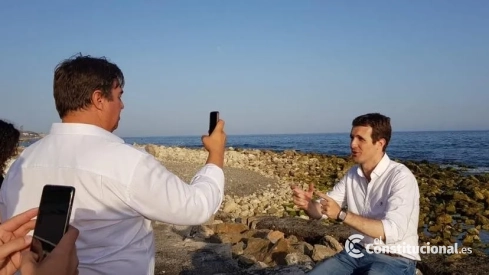
“If you don't appear on the Deputy Minister's TikTok, you don't exist for the PIR”. According to sources from the Popular Party of Madrid exclusively to ElConstitucional.es, this maxim has been installed on the Presidency floor of the Royal House of the Post Office. What began as an anecdote about a high-ranking official with influencer aspirations has been revealed as a control network that uses the 1,000 million euros from the Regional Investment Plan (PIR) as currency for political submission.
The war between Isabel Díaz Ayuso and Pablo Casado not only changed the leadership of the Popular Party. It also reordered the Madrid apparatus and elevated profiles that, far from being trapped in the collapse of Genoa, emerged strengthened from the new internal distribution. One of them was José Antonio Sánchez Serrano, today deputy minister of Presidency and Local Administration of the Community of Madrid and, at the same time, territorial deputy secretary of the PP of Madrid. His name appears at the exact point where three sensitive planes intersect: institutional power over the city councils, organic command over the party's municipal map, and a media and political network that multiplies his visibility.
A man of the apparatus, not of neutral management
Sánchez Serrano's own public biography leaves little room for ambiguity: his career has been built within the party, in political communication, municipalism, and the institutional environment of the PP. The Transparency Portal of the Community of Madrid defines him as career military and records his time at the General Directorate of Local Administration, the Deputy Ministry of Local Administration and Digitalization, and the current Deputy Ministry of Presidency and Local Administration. His personal website adds the other relevant political fact: he began collaborating with the PP of Madrid and in 2015 he moved to the digital communication team of the national PP. We are not dealing with a profile that came to politics from outside, but rather with a party apparatus figure who grew within it.
That detail also matters for another reason. In his official biography, a classic university academic career does not appear, but rather industrial technical studies, military career, teaching, and subsequent leadership and communication courses; in parallel, the public record itself places a good part of his professional evolution within the institutional, organic, and media ecosystem of the PP. The political reading of that itinerary is clear: Sánchez Serrano does not land in territorial power from management, but from the party machinery.
From the fall of Casado to the new Ayusista order
The rise of Sánchez Serrano cannot be understood outside of the PP's internal war. In the autumn of 2021, the offensive by the PP of Madrid was already underway to break the siege of Génova and accelerate the regional congress. In February 2022, that rupture finally materialized with the fall of Casado and Ayuso's total victory over the national apparatus. The central element of that episode was not only the confrontation between two leaderships, but the organized mobilization of the Madrid party —in the streets, in the territory, and digitally— to turn internal pressure into a show of force.
And there appears the political relevance of Sánchez Serrano. He came from the core where messages are designed, internal propaganda is mobilized, and politics is made through network, structure, and loyalty. After Casado's fall, he did not disappear, he was not sidelined, and he did not remain as a residue of the old national organizational chart. On the contrary: he emerged strengthened. First as an important piece of the regional Government and then, in September 2023, as Territorial Deputy Secretary of the PP of Madrid, formalizing his entry into one of the party's most decisive engine rooms.
The real power: controlling city councils from the Government and from the party
Sánchez Serrano's current weight is not explained by the title of the position, but by the double lever he concentrates. From the Community of Madrid, he directs a key vice-ministry in the relationship with municipalities. From the PP of Madrid, he directs the party's territorial area. That coincidence places him in a particularly sensitive position: the same leader who deals with city councils from the administration also steps onto the municipal board from the political apparatus. And that intersection is what fuels internal concern in the Madrid PP.
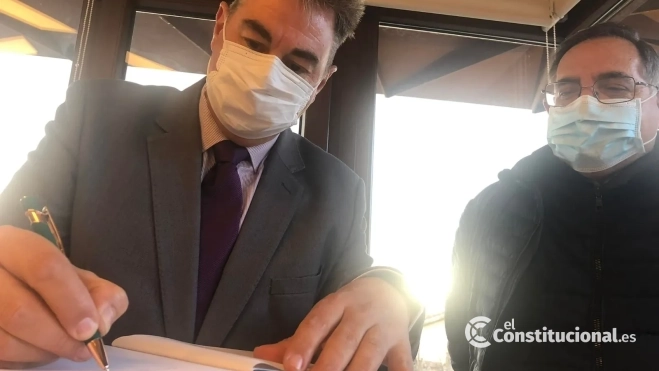
That style of hierarchical relationship with the municipal world had already generated comments during his time as director general of Local Administration. According to sources from the PP of Madrid, Sánchez Serrano went so far as to ask mayors to hand him the book of signatures of their town halls to leave his signature in it during institutional visits. This is an unusual gesture in municipal protocol, since these books are usually reserved for highest-ranking authorities —such as the King, the president of the Government, the president of the autonomous community or, on occasion, councillors— and not for intermediate-level positions within the autonomous administration.
The material dimension of that power is better understood if one looks at the Regional Investment Program 2022-2026, endowed by the Community of Madrid with 1,000 million euros. The autonomous documentation itself presents the PIR as the great instrument of municipal investment of the legislature. Whoever sits in Local Administration not only handles files: they handle times, interlocution, priorities and political relationship with mayors and councilors. In that context, the accumulation of institutional and organic command makes any territorial decision politically much heavier.
Lucía Paniagua, the piece that links Sol, party and municipality
In that architecture appears Lucía Paniagua Conesa as a second key figure. The official website of the Villanueva de la Cañada City Council identifies her as 1st deputy mayor, spokesperson for the municipal group, and Councillor for Coordination and Universities. The PP of Madrid, for its part, places her as secretary of Municipalities within the territorial area directed by José Antonio Sánchez Serrano. The link between the two is not an interpretation: it is formally inscribed in the political structure of the party and in the institutional reality of Madrid.
There is, furthermore, a particularly sensitive element: Paniagua's footprint in the Deputy Ministry. The public agenda of the Community of Madrid mentions her in December 2021 as “advisor to the Deputy Minister of Local Administration and Digitalization” and in an official activity in 2022 as “support technician for the Deputy Ministry of Local Administration and Digitalization”. That is to say, before her current organic role in the PP of Madrid, she already appeared incorporated into Sánchez Serrano's direct institutional environment.
The position that does not appear in the structure
This is where one of the most delicate questions arises. The organic structure of the Ministry of the Presidency, Justice and Local Administration and the official organizational chart of 2023 include the Vice-Ministry of the Presidency and Local Administration and the general directorates that depend on it, but do not reflect a dedicated cabinet attached to that Vice-Ministry. The cabinets and their temporary staff appear referred to the ministry level, and in June 2023 the BOCM published the appointment of a deputy chief of staff of the Ministry, not of the Vice-Ministry. In that context, that the Community's public agenda places Lucía Paniagua as “advisor to the vice-minister” and then as “support technician for the Vice-Ministry” fuels political doubt about the exact fit of that function and about the true power structure surrounding Sánchez Serrano.
It is not a minor detail. Because today Paniagua is not a secondary figure: she is the head of Municipalities in the PP of Madrid and one of the most visible links between the party's territorial structure and local power. The complete sequence —support in the Vice-Ministry, organic ascent, deputy mayoralty— draws a political continuity that explains why her name has become one of the keys to internal control of the Madrid municipal world.
The Resurgence of Madrid: a political showcase with public sponsorship
The influence network does not end in the administration and the party. It also goes through the media. El Resurgir de Madrid presents itself as “the digital newspaper of the 179 municipalities of Madrid” and in its format Tertulia El Cocido makes José Antonio Sánchez Serrano a fixed presence. In the program's own description, it is stated that the vice-counselor accompanies the talk show “in each appointment” and that the first season had sponsorship from the Community of Madrid. The fact is relevant in itself: a high-ranking official with territorial power establishing constant presence in a municipal promotion format with institutional backing.
That format does not work in a vacuum. In successive episodes, mayors and municipal officials parade while the deputy minister gains focus as a regular figure of the program. The political message that the format projects is clear: territorial proximity, institutional closeness, and personal visibility of the position in the same showcase. And that showcase was not alien to regional public sponsorship, at least in its first season.
Public money and local advertising circuit
To that visibility is added the documentary trail of public procurement. In Villaviciosa de Odón, minor contracts include payments to El Resurgir Media, S.L. and to Grupo Babel Media, S.L. for institutional campaigns. In the fourth quarter of 2022, a contract with El Resurgir for 484 euros is recorded. In the fourth quarter of 2023, another one appears with El Resurgir for 423,50 euros and another with Grupo Babel Media for 592,90 euros. In the first quarter of 2024, Grupo Babel Media appears again for 592,90 euros. And in the fourth quarter of 2024, 350 euros appear again for El Resurgir and 510 euros for Grupo Babel Media, this time for institutional advertising in Sierra Madrileña.
These amounts are not, by themselves, those of a large campaign. But that is not the point. The point is the pattern: media where Sánchez Serrano gains presence or where he publishes his texts repeatedly appear within the institutional advertising circuit of Madrid city councils. The journalistic relevance is not in scandalizing each invoice, but in showing the intersection between political promotion, media proximity, and public money.
Group Babel Media and Sierra Madrid: the other loudspeaker
It is advisable to clearly separate the roles. Grupo Babel Media, S.L. is not the support for La Tertulia del Cocido, but the publisher of the newspaper Sierra Madrid, where José Antonio Sánchez Serrano maintains a recognizable opinion column. His own blog republishes or links articles that appeared in Sierra Madrid with explicit formulas such as “Article published in the Newspaper Sierra Madrid”, and the newspaper's site includes him in its list of columnists in the TRIBUNA section. It is not, therefore, a sporadic appearance, but a continued presence as a columnist.
That data adds a second layer to the picture: a regional media outlet that serves as an opinion platform for the deputy minister and that, at the same time, receives institutional advertising contracts from city councils like Villaviciosa de Odón. It is a less showy relationship than that of El Cocido, but politically just as revealing: discourse projection, editorial closeness, and presence in the local advertising spending circuit.
The family cape: DKD and The Immense Majority
There is one last layer that finishes completing the picture around José Antonio Sánchez Serrano: the family one. In his own public biography, he claims his connection with Grupo DKD, the family company for metal furniture, and emphasizes that today it remains in the hands of his family. The surname reappears outside the administration and the party on another platform: the podcast La Inmensa Mayoría, hosted by Jesús Sánchez Serrano, as listed on Spotify. The connection is not anecdotal, because in the program's own presentation, DKD Mobiliario is also promoted, so that family business, family surname, and interview platform are inserted into a same ecosystem of visibility and narrative.
That channel does not function precisely as a neutral space or one alien to politics. Through its episodes, profiles directly linked to the Madrid PP or its institutional environment have passed, such as Sonia Cea, councilor of the Madrid City Council; Ismael López, deputy of the Madrid Assembly and online communication director of the Popular Party of Madrid; Alberto Escribano, mayor of Arganda del Rey; or Javier Carazo, presented in the program as general director of the Community of Madrid. The pattern is sufficiently clear: it is not only about conversations open to pluralism, but a succession of guests closely connected with positions, structures, and messages of the conservative political ecosystem of Madrid.
Furthermore, in the provided transcript of the interview with Isabel Vega, deputy of the Madrid Assembly, the guest herself proposes José Antonio Sánchez Serrano as the next interviewee, and the host responds with a particularly revealing phrase: “it would be the first time in history that my brother would have to sit in something and couldn't order me around because I'm the one who gives the orders”. Beyond the relaxed tone of the conversation, the scene portrays quite clearly to what extent kinship, political trust, and public promotion coexist naturally within the same format.
Viewed as a whole, The Immense Majority does not appear as a simple personal or family adventure, but as one more piece of the projection circuit that surrounds Sánchez Serrano: administration, party, family business, own media, and a showcase for positions and protégés from the Madrid political environment. There is no need to exaggerate to understand the background. The surname Sánchez Serrano is not limited here to an institutional biography: it extends over a network where power, affinity, and visibility mutually reinforce each other.
The logic of the new order: apparatus, territory and narrative
Seen as a whole, the political problem that José Antonio Sánchez Serrano projects is not that of a brilliant manager nor that of a neutral technician. It is another: that of a total operator of the apparatus. His trajectory links digital communication of the PP, territorial apparatus, vice-ministry with command over the city councils, a key leader like Lucía Paniagua situated between municipality and party, a format sponsored by the Community where he gains fixed visibility, a continuous column in a regional newspaper and a family network that combines business and audiovisual platform.
That is the core of the tension surrounding her figure today within the PP of Madrid. It is not just about an internal rivalry or a disputed name. It is about the perception that too many levers —Government, party, municipalities, and narrative— have ended up grouped on the same axis. And when a regional party concentrates territorial command, political visibility, and promotion circuits in a single network, what grows is not trust. It is suspicion.
The fall of Casado not only had visible victors. It also had structural beneficiaries. José Antonio Sánchez Serrano is one of them. Not because he inherited a fleeting spotlight, but because he occupied the space where the levers that truly matter in Madrid politics intersect: municipalities, party, media, and apparatus. His trajectory does not draw that of a manager who administers; it draws that of a man of the system who has gone from moving messages to moving territory. And in the PP of Madrid, today, that weighs more than any position printed on an organizational chart.
Add ElConstitucional.es as a preferred Google source for free.
Stay informed about all the latest breaking news with the best information. Against disinformation, for democracy and social rights.
