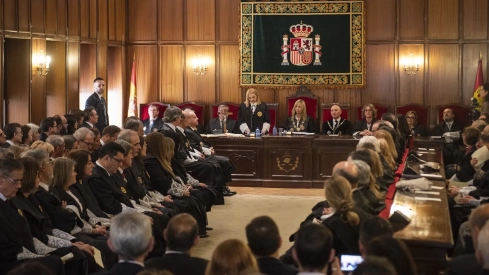
Tomás Olivo, who recently closed the most striking real estate operation of the year with the purchase of the legendary Telefónica building for 200 million, and whose fortune is valued at more than 6,000 million, is one of the great businessmen most affected by the so-called Togas Case, reactivated in 2026 by his ex-son-in-law and father of his first granddaughter, also businessman José Manuel Martínez Pomares, plaintiff against 21 judges and the deputy prosecutor of the Supreme Court, including the president of the CGPJ, María Isabel Perelló.
The Murcian businessman, third shareholder of Unicaja Banco, was accused of bribery and money laundering in the so-called Malaya Case for allegedly having paid 2.4 million euros to Juan Antonio Roca, mastermind of the plot, an accusation that was proven false, for which he was finally acquitted, and behind which an attempt to undermine his reputation would be hidden.
The origin of the campaign against the successful businessman lies with up to four people linked to the Togas Case (a notary, a lawyer, a businessman, and a regional director of RuralCaja), who would have agreed, according to Martínez Pomares, to pay a commission to the mayor's office of Jesús Gil to obtain the municipal license after buying a 300 million plot in Marbella. As they did not make it effective after obtaining the license, the then mayor, Jesús Gil, called Olivo and ordered him to paralyze them.
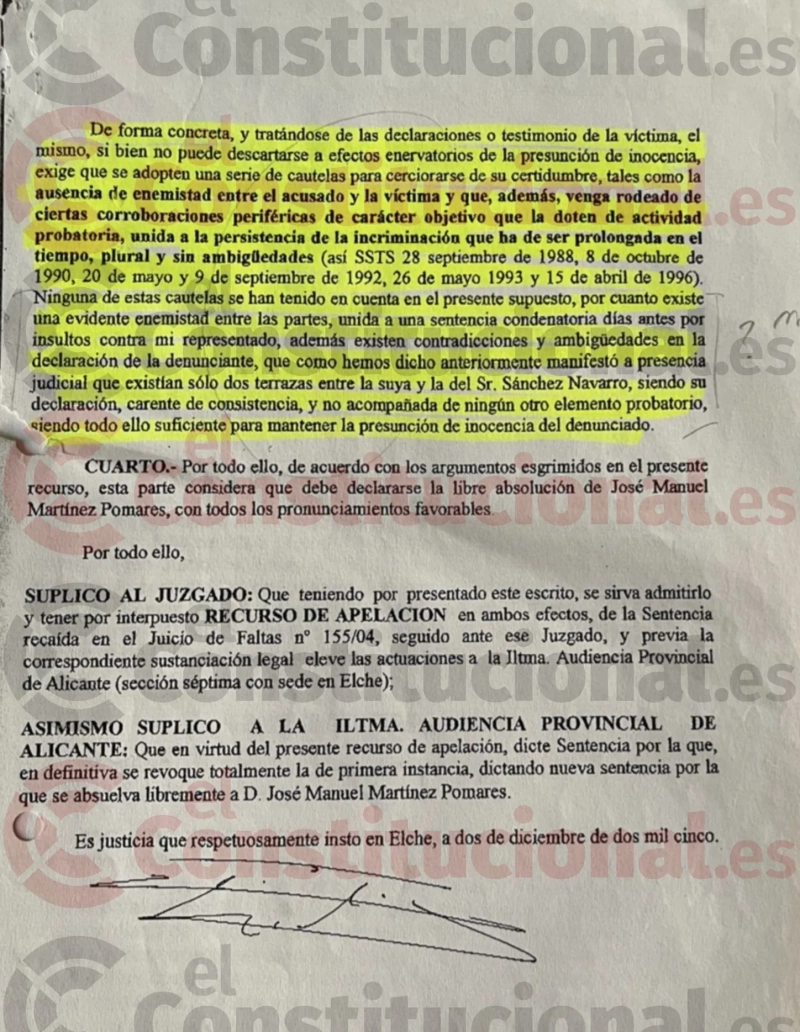
As a first reprisal, one of them, the lawyer and socialist councilor in Elche, Antonio Martínez Camacho, from Altamira Asesores, whom Martínez Pomares approached, entrusted him with legal assistance to lawyer Tomás Saura in the case of the alleged hit-and-run that, according to Martínez Pomares, originated in a false complaint against him, since the victim had been admitted to the hospital one day before it occurred (November 21, 2003), as attested by the emergency report.
After losing the trial and the subsequent appeal, also represented by Saura, Martínez Pomares sued his lawyer in civil court for disloyalty, for not having used in the complaint and appeal the procedural fraud he knew about (as Saura himself admitted in court), for not having demanded to check the date of the injuries with the hospital, and for presenting an appeal brief that included a copy-paste from another procedure.
In his lawsuit against Saura, the lawyer was represented by Martínez Camacho himself, which led to the request for recusal of Martínez Pomares, as Martínez Camacho is Tomás Saura's boss. Judge Marchena himself points out in his ruling on the case in the Supreme Court the lack of rectification by the lawyers as the reason for the ruling, but he did not revoke the previous ruling against Martínez Pomares, considering the matter as res judicata and disregarding the alleged procedural fraud.
Tomás Olivo, Eroski and the Elche-Marbella Shopping Center
Tomás Olivo used to build shopping centers for Eroski (prospective study, construction, and sale to the shopping center), and at a certain point, he decided to start operating them himself, and Eroski realized, according to Martínez Pomares, that he was becoming competition and could go public, as the Cartagena businessman finally did in 2017 with the SOCIMI General de Galerías Comerciales, listing on the Alternative Stock Market (MAB).
Grupo Lar (Eroski) then contacted Martínez Pomares through José Rafael Martínez Sánchez, Eroski's regional director, who first moved into one of his apartments as a tenant, and later, upon learning of his family relationship with Olivo, promised him the subcontract for cleaning the five regional centers he managed, also promising him the integral construction of all new centers that Eroski would build in Spain, which Tomás Olivo had previously built for them, something Olivo agreed to.
The business for Martínez Pomares would have amounted to 50 million pesetas per cleaned center in profit, so Martínez Sánchez demanded half, 25 million, as a commission, according to Martínez Pomares's version, as well as that he sell him the apartment where he was staying as a tenant, valued between 240 and 270,000 euros (approximate market value) for 78,131.57 euros, to which Martínez Pomares agreed given the commitment for the subcontract of the centers.
The persecution denounced by the businessmen and the increasing tension between Olivo and Grupo Lar paralyzed the concession of the five shopping centers to Martínez Pomares, so Olivo undertook the ambitious project of building the largest shopping center in Europe in Elche, La Cañada Shopping, which he intended to transfer to his ex-son-in-law and father of his granddaughter and daughter. After buying the plot, Olivo agreed with the socialist mayor of Elche, Manuel Rodríguez Maciá (mayor who had Martínez Camacho, the lawyer whose works Olivo paralyzed, as a councilor from 1987 to 1991), to advance the license in exchange for investing 25 million in parks and gardens. But at the time of signing, the mayor backed down and asked for double for the parks, 50 million, so Olivo finally decided to build it in Marbella.
It was precisely because of the reclassification and construction of La Cañada Shopping in Marbella that he was unjustly accused of bribery and money laundering within the framework of the Malaya Case, although he was finally acquitted. In parallel, the Junta de Andalucía paralyzed Olivo's works in the Nevada Shopping Center in Granada, which kept the works paralyzed for seven years and for which the Supreme Court forced the Junta to pay 165 million to the businessman for lost profits.
The persecution suffered by the businessmen, and in which financial entities such as Deutsche Bank and Cajamar would also allegedly be involved, is attributed directly to the corruption of the Togas Case derived from the interest against national competition represented by Olivo from the American vulture funds that are part of the shareholding of Grupo Lar (Eroski), among which are Helios Re, BlackRook Capital or Morgan Stanley Real Estate, as we will be detailing in 'ElConstitucional.es' in the near future.
Add ElConstitucional.es as a preferred Google source for free.
Stay informed about all the latest breaking news with the best information. Against disinformation, for democracy and social rights.