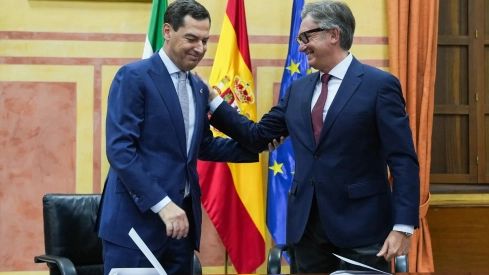
Juanma Moreno was invested this Thursday as president of the Junta de Andalucía with the votes of the PP and the far-right Vox. The popular candidate surpassed the second vote with 68 supports, 53 from his group and 15 from Santiago Abascal's far-right party, against the 41 votes against from PSOE-A, Adelante Andalucía and Por Andalucía.
The investiture comes after an agreement closed almost at the last minute and signed barely half an hour before the vote in the Andalusian Parliament. The pact is not limited to the investiture. PP and Vox have presented it as a "Government and Stability Agreement for Andalusia", with a commitment for the entire legislature, approval of the four budgets and a package of 150 measures.
The most important political consequence is the entry of the far-right into the Andalusian Executive. Manuel Gavira, Vox spokesperson in Andalusia, will be vice president of the Junta and will assume the Ministry of Tourism, Deregulation, Justice and Local Administration. Vox will also have a vice-presidency in the Parliament's Bureau and one of the senators by autonomous designation that corresponded to the PP after the elections on May 17.
Moreno, who for weeks defended his intention to govern alone, has justified the pact by the need for stability. The Popular Party was two seats short of an absolute majority and had no other way to get the investiture through without repeating elections. The Andalusian president has defined the agreement as “serene”, “sensible”, “fair” and “legal”, and has insisted that PP and Vox are different parties, but with the capacity to find common ground.
Vox manages to enter San Telmo
Vox had made it clear from the beginning that it did not want to repeat the 2019 scheme, when it supported Moreno's first government with Ciudadanos from outside. This time it demanded to enter the Governing Council and obtain an agreement similar to that closed in Extremadura, Aragon and Castilla y León, the other communities where PP and Vox govern together.
The final distribution leaves the far-right with only one ministry, although with the rank of vice-presidency and with competencies of political weight. Gavira will assume Justice and Local Administration, in addition to Tourism, one of the key economic areas in Andalusia. The area of Deregulation, a common flag of Vox in its regional pacts, also remains within its department.
The PP maintains other sensitive portfolios that Vox had coveted in previous negotiations in other communities, such as Agriculture or Culture. Even so, Abascal's party achieves what it sought. It sits for the first time in the Andalusian Government and turns Andalusia into the fourth regional coalition pact with the PP in recent months.
The agreement also forces institutional pieces to be readjusted. The far-right will have a presence on the Board of the Andalusian Parliament, where until now the PP had assumed control of most positions, and will receive a regional senator. This concession reinforces the state dimension of the pact at a time when Feijóo and Abascal have normalized their territorial agreements as a rehearsal for future understandings.
The 'national priority' enters the agreement
The most delicate point of the pact is the so-called 'national priority', the formula of the far-right Vox to give preference to Spaniards over foreigners in access to aid, subsidies, housing and public benefits. Moreno had even described it during the campaign as a "slogan" difficult to fit legally, but he has finally accepted it within the agreement.
The PP tries to reduce the scope of the concept by linking it to roots. Moreno has defended that the 'national priority' will be applied through criteria of real, durable and verifiable residence in Andalusia, something that already exists in some areas of social legislation. According to the approach conveyed by the popular party, it would not be about discriminating by nationality, but about reinforcing registration requirements and connection with the territory.
Vox, however, has sold the inclusion of the term as its own political victory. The 'national priority' was one of its main demands in the negotiation and already appears in other regional pacts signed with the PP. In Andalusia, the agreement incorporates it in access to public resources and connects it with housing, aid and services.
The European Commission has already warned in recent hours that it will monitor respect for the principle of non-discrimination on grounds of nationality in the agreements between PP and Vox. Brussels does not evaluate political pacts, but recalls that any regulatory development must respect Union Law, free movement, European citizenship and the Charter of Fundamental Rights.
The left denounces darkness and “fraud”
The opposition has criticized the way the pact was closed. The agreement was known just minutes before the vote, and the left-wing groups unsuccessfully asked Moreno to explain the content of the document to the Plenary before submitting it again to the confidence of the Chamber. The Parliament's Bureau rejected that request and kept the session limited to the roll-call vote.
The general secretary of the Andalusian PSOE, María Jesús Montero, has described it as “shameful” that the investiture was voted on without sufficient time to know the fine print of the pact. She also spoke of “absolute investiture fraud” because, in her opinion, Moreno presented a solo government project on Monday and this Thursday he was invested with an agreement that incorporates the far-right into the Executive.
Montero insisted that the pact allows “for the first time the far-right to enter a government in Andalusia after the dictatorship”. The PSOE maintains that Parliament has voted on an investiture without being able to debate the document that will truly mark the legislature.
The spokesperson for Adelante Andalucía, José Ignacio García, has followed the same line and spoken of “democratic theft”. He reproached Moreno for not explaining the pact to the Chamber and asked “what does he have to hide” the Andalusian president for not submitting the agreement to debate before the vote.
From Por Andalucía, Antonio Maíllo has called the agreement “infamous” and declared the so-called Andalusian way over, the political brand with which Moreno has tried for years to present himself as a more moderate leader than other PP barons. Maíllo has placed the pact within a broader political operation between Alberto Núñez Feijóo and Santiago Abascal.
A pact that changes the Andalusian map
Moreno's investiture comes 46 days after the regional elections on May 17. The PP won clearly, but lost the absolute majority it enjoyed during the previous legislature. With 53 seats in a Parliament of 109, it needed two more supports to govern. Vox, with 15 deputies, became the essential partner.
The first vote, held on Tuesday, failed. Moreno only obtained the votes of the PP and received the rejection of Vox and the entire left. From that moment, negotiations accelerated. Feijóo acknowledged this Thursday morning that the programmatic agreement was practically closed and that the distribution of responsibilities in the Government remained to be specified.
The Andalusian pact also has national value. The PP already governs with Vox in Aragon, Extremadura and Castilla y León. Andalusia was the great exception due to Moreno's own profile, who came from an absolute majority and had tried to keep Vox out of the Executive. That exception is now broken with an agreement that incorporates the far-right into San Telmo, albeit with a more limited presence than in other regional governments.
Moreno will announce the full composition of his new Government presumably next week. For now, only the name of Manuel Gavira as vice president and minister is confirmed. The readjustment of the Parliament's Bureau and the designation of the regional senator that the PP will cede to Vox under the agreement signed this Thursday also remain pending.
