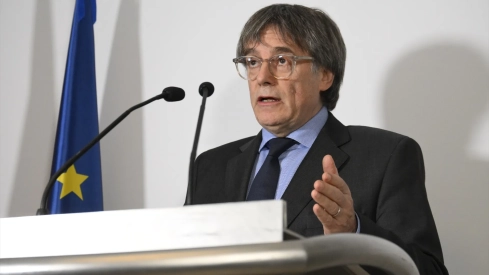
The former president of the Generalitat and leader of Junts, Carles Puigdemont, can return to Spain without risk of being arrested and without judicial charges for the 1-O referendum, after the magistrate of the Supreme Court, Pablo Llarena, lifted the national arrest warrant barely an hour after the Constitutional Court (TC) declared the crime of embezzlement amnestied. After almost nine years abroad, the pro-independence leader is beginning to glimpse his return, in a scenario still conditioned by new judicial procedures.
From Waterloo, Carles Puigdemont celebrated the resolution as a “defeat of the strategy of public powers that have delayed its application for strictly political reasons,” and added: “Aznar's order of 'whoever can do it, do it' has come this far. It can't go any further.” In his speech, he also criticized “the improper use of judicial powers over a conflict that belongs to politics.”
Carles Puigdemont comparece desde Waterloo tras la amnistía que permitirá su regreso a España: "Lo que se ha acordado hoy obliga a cerrar la etapa de represión política que venimos sufriendo desde hace más de nueve años"#Canal24horas pic.twitter.com/wPN0tkXkE4
— RTVE Noticias (@rtvenoticias) October 6, 2026
The leader of Junts insisted that the amnesty does not resolve the conflict between Catalonia and the State and stressed that "it is not a solution in itself," although he did interpret it as "the implicit recognition that this was not the way to attempt the civil death of the independentistas," a situation he described as "typical of authoritarian regimes and unacceptable for a European democracy." In another subsequent assessment, Puigdemont maintained that the decision of the Constitutional Court puts an end to a stage he defined as one of "political repression" initiated after the 2017 independence process. According to him, the nine years of exile have had "personal, family, social, and political" consequences, and during that period, he added, his party faced electoral processes under conditions he considered of "grave abnormality."
A return without a date and with legal prudence
Even so, Carles Puigdemont has not wanted to specify when he will return. His own lawyer, Gonzalo Boye, has recommended caution and has explained that he will not do so until the Supreme Court applies the amnesty "in full," because he understands that the file must now be elevated from the investigation phase to the Chamber for it to confirm the application. The former president's statement also comes at a time when the TC has upheld the appeal for protection filed by former minister Dolors Bassa and has endorsed that the amnesty can be applied to embezzlement linked to the procés, a decision that sets a relevant criterion for other independence leaders in a similar situation.
Carles Puigdemont: "Decidimos ir al exilio a hacer política y no hemos parado hasta asegurar que el regreso también tenga un sentido político"#Canal24horas pic.twitter.com/0PjExNITI7
— RTVE Noticias (@rtvenoticias) October 6, 2026
Puigdemont plans to tour Catalonia to learn firsthand about the current situation of the community, aware that the Catalonia of 2017 is not the same as that of 2026, neither politically nor socioeconomically. The leader himself has proposed to "immerse himself" in the autonomous community to reconnect with Catalan reality.
This plan, however, now crosses paths with the election campaign, after the President of the Government, Pedro Sánchez, decided on Monday to bring forward the elections to November 29. Before starting this tour, Puigdemont will be received with honors by the President of the Parliament, Josep Rull, and it is expected that the President of the Generalitat, Salvador Illa, will receive him at the Palau de la Generalitat "like the rest of the former presidents," according to sources from the Catalan Executive. He does not contemplate a meeting with Pedro Sánchez.
The scenarios opening up in Junts and in the independence movement
Once this tour of Catalonia concludes, Carles Puigdemont will have to clarify his political future. The first unknown is whether he wants to serve as leader of the opposition, a responsibility that the Junts bench has always reserved for him and for which he holds a deputy's seat. The second involves defining what role he wants to assume within the party, at a delicate moment for the formation, where there are voices that advocate for recovering the spirit of the old Convergència and addressing ideological debates to respond to the rise of the far-right Aliança Catalana.
The third decision affects the type of former president he intends to be, whether he wants to maintain a strictly institutional profile, whether he chooses to try to mobilize the independence movement again as a social leader, or whether his goal is to regain control of the Generalitat in Catalan elections scheduled for 2028. The polls, according to the scenario described by his political circle, do not facilitate that path.
In contrast to the message of the President of the Government, Pedro Sánchez, who has argued that the application of the law contributes to coexistence and allows Catalan society to "look forward," Carles Puigdemont has maintained that the judicial resolution does not solve the political conflict between Catalonia and Spain. "In terms of the Catalonia-Spain relationship, nothing is solved today," he stated.
