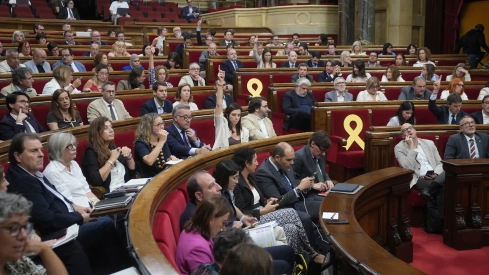
The Parliament has demanded this Thursday from the Supreme Court the “total and immediate” application of the Amnesty Law and has condemned the attitude of the courts that prevent or delay its compliance. The resolution, presented by ERC in the General Policy Debate, has gathered the votes of PSC-Units, Junts, ERC, Comuns, CUP and Aliança Catalana. Only PP and the far-right Vox have voted against it.
The Catalan Chamber has denounced the "anti-democratic blocking attitude of the courts that deny or delay its application". The pronouncement comes on the ninth anniversary of the referendum of October 1, 2017, and a few days before the Constitutional Court examines the appeals that can unblock the amnesty for embezzlement for the leaders of the 'procés'.
The plenary session has also approved a proposal from the Comuns that demands the application of the norm "in a comprehensive, immediate and without restrictive interpretations manner". The text expressly includes political officials, activists and anonymous citizens prosecuted, so that the demand for compliance reaches all those affected.
Conde-Pumpido recalls that the doctrine is binding
The vote has coincided with a message from the president of the Constitutional Court, Cándido Conde-Pumpido, about the obligations of judicial bodies. During an informative breakfast in Madrid, he recalled that the doctrine of the court of guarantees is "binding" for all judges and courts, also when it resolves appeals for protection.
Next October 6, the plenary session is expected to examine the appeals of former ministers Jordi Turull and Dolors Bassa against the Supreme Court's refusal to amnesty embezzlement. The reports propose to uphold their demands, although the decision still needs to be submitted to deliberation and voting. The result may determine the application of the norm to other pro-independence leaders.
Conde-Pumpido has explained that, if the appeals are upheld, the Constitutional Court will establish a "clear, precise and forceful" doctrine and will quickly communicate the ruling to the Supreme Court. He has also pointed out that resolutions that restore fundamental rights must be executed preferentially and urgently. He has avoided, however, anticipating how long it would take the Supreme Court to do so, because that decision corresponds to the court itself.
The pending controversy affects a decisive point for Carles Puigdemont and other leaders of the 'procés'. The Constitutional Court has already endorsed the law, but the Supreme Court maintains its refusal to apply it to certain embezzlement cases. A favorable doctrine in the appeals of Turull and Bassa would open the door to reviewing that situation; its execution would then have to be specified in the corresponding judicial resolutions.
From the Parliament, its president, Josep Rull, also demanded this Thursday that the delay end. In a statement for the anniversary of 1-O, he called for an end to the "legal stratagems" and "judicial filibustering" that, he denounces, delay the amnesty. He demanded that Puigdemont and Lluís Puig be able to occupy their seats and that Oriol Junqueras and Jordi Turull cease to be disqualified.
Agreement for dialogue and rejection of the unilateral path
The support for the amnesty has been accompanied by another agreement on the resolution of the political conflict between Catalonia and the State. The plenary session has approved an ERC initiative to promote a country understanding with the participation of political forces, social agents and civil society. PSC, Junts, ERC, Comuns and CUP have supported it; PP and Vox have rejected it and Aliança Catalana has abstained.
The proposal includes the terms of the investiture pact between PSC and ERC, places democratic dialogue as a principle and proposes presenting conclusions in one year. It also defends that citizens peacefully and freely decide the political future of Catalonia and that the solution to the conflict be endorsed by Catalans. The approved text does not specify the formula for that consultation.
That agreement has coexisted with the rejection of broader independence proposals. The Junts text that set independence as an objective and defended that only a referendum agreed with the State could replace the mandate attributed to 1-O has fallen. Nor has the CUP's request to act beyond constitutional and statutory limits prospered.
The plenary session has also rejected that the Government undertake legal actions against those responsible for not applying the amnesty for the alleged prevarication denounced by the CUP. It has also overturned the proposal of the far-right Vox that demanded to repeal the law.
