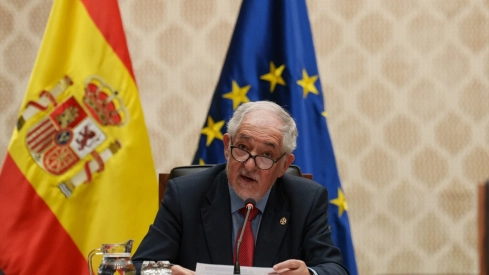
The president of the Constitutional Court, Cándido Conde-Pumpido, has defended this Monday the application of the amnesty law to the embezzlement of the 'procés' and has launched a harsh legal challenge against the criteria followed by the Supreme Court. His report proposes granting protection to former Catalan minister Dolors Bassa and ordering the Criminal Chamber to issue a new resolution declaring the crime for which she was convicted to be amnestied.
Conde-Pumpido argues that the exclusion agreed by the Supreme Court responds to an expansive reading of the exceptions provided by the legislator and ends up leaving out some of the behaviors that constituted the core of the norm. The favorable conclusion for Bassa would be, according to the draft, "the only one reconcilable with the rules of logic and common sense", in addition to being the most consistent with the origin and purpose of the law.
The president of the court of guarantees accuses the Supreme Court of having carried out a "teleological reduction" that drastically restricts the application of the amnesty. The Chamber would have justified its decision by considering what, in its opinion, the law should have established, moving away from its wording and the will expressed by the Cortes Generales. The report considers that this reasoning "turns the exception into a rule".
The law separates the 'procés' from personal corruption
The Organic Amnesty Law includes acts of embezzlement intended to finance, cover, or facilitate the referendum of October 1, 2017, provided that those responsible did not seek personal enrichment. The text itself specifies that using public funds for those purposes does not constitute enrichment when there is no intention of obtaining a particular patrimonial benefit.
The Supreme Court interpreted, however, that the pro-independence leaders obtained a benefit by avoiding paying out of their own pockets the expenses associated with the referendum. That saving, according to the Criminal Chamber, allowed the exclusion of embezzlement from the amnesty. The consequence was to maintain the disqualifications of Oriol Junqueras, Raül Romeva, Jordi Turull, and Dolors Bassa, in addition to the national arrest warrants against Carles Puigdemont, Toni Comín, and Lluís Puig.
Conde-Pumpido rejects that one of the elements inherent to the crime can be used to automatically exclude from the norm behaviors that the legislator decided to include. The report recalls that the law distinguishes funds destined for the independence process from those used for personal corruption purposes and reproaches the Supreme Court for having reduced that difference to the point of making it irrelevant.
The draft concludes that the refusal to grant amnesty to Bassa has violated her right to effective judicial protection, related to her rights of political participation and access to public office. The former minister remains subject to a disqualification penalty that prevents her from exercising institutional responsibilities. The Constitutional Court considers the interpretation used to maintain that conviction unpredictable and internally contradictory.
The report also recovers the purpose declared by the Cortes when they approved the norm. The amnesty sought to improve coexistence, strengthen social cohesion, and integrate different political sensibilities after years of institutional conflict in Catalonia. For Conde-Pumpido, the Supreme Court showed itself "absolutely indifferent" to that objective and broke the necessary coherence between the decision adopted, the content of the law, and the constitutional purpose that justified it.
The contradiction regarding European interests
The second argument used by the Supreme Court to exclude embezzlement was the possible impact on the financial interests of the European Union. The magistrates understood that an eventual independence of Catalonia would have reduced the Spanish contribution to the community budget and generated economic harm to the Union.
Conde-Pumpido confronts this thesis with the 'procés' ruling itself, which described independence as a "daydream" with no real possibilities of materializing. The report finds a contradiction difficult to sustain between considering secession unviable when dictating the convictions and then presenting that same project as an effective threat to European finances.
The Court of Justice of the European Union (CJEU) already ruled out last July that a hypothetical reduction of the Spanish contribution could be interpreted in those terms. The ruling explained that the budgetary variation would be an ordinary consequence of a territory ceasing to be subject to European treaties. Conde-Pumpido considers that this interpretation of Community Law prevails over that put forward by the Supreme Court.
The Plenary Session of the Constitutional Court will study on October 6 the report on Dolors Bassa and the new proposal by conservative magistrate José María Macías to resolve Jordi Turull's appeal. Macías has had to redo his first draft, favorable to the Supreme Court's criterion, after being in the minority against a majority in favor of granting protection.
The future doctrine will affect the four leaders convicted of embezzlement and will serve as a reference for the proceedings of Puigdemont, Comín, and Lluís Puig. Its approval would allow the lifting of national arrest warrants that still prevent the former Catalan president from returning to Spain without being arrested. Investigating judge Pablo Llarena must apply the constitutional criterion when he receives the sentences.
Conde-Pumpido proposes that the Supreme Court issue a new resolution declaring Dolors Bassa's embezzlement amnestied. The draft concludes by recalling that the law itself obliges these requests to be resolved "preferentially and urgently".
Add ElConstitucional.es as a preferred Google source for free.
Stay informed about all the latest breaking news with the best information. Against disinformation, for democracy and social rights.
