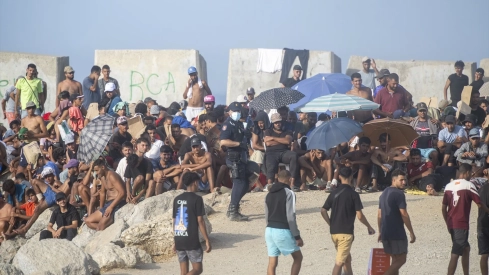
The National Court judge María Tardón has admitted this Tuesday Ceuta's appearance as a private prosecution in the investigation into the massive entry of migrants recorded on July 30 and 31. The magistrate considers its status as an injured party to be proven by events that directly affected the city and its inhabitants.
"The condition of injured party undoubtedly concurs", Tardón states in her order. The instructing judge considers that Ceuta and its population were "direct and immediate victims" of events that affected their freedom, the exercise of their rights, and the integrity of people and their property.
The resolution responds to the request submitted by the city's legal services after the Government of Juan Jesús Vivas approved the appearance in an extraordinary meeting. The Ceuta Executive alleged that the crisis had seriously harmed the functioning of essential public services, public safety, and the protection system for unaccompanied migrant minors.
Ceuta will now be able to actively intervene in the procedure, request new proceedings, appeal resolutions, and claim possible criminal and civil liabilities arising from the damages. The local government explained when announcing its decision that its purpose was to defend the rights of the victims, represented in this case by the entire people of Ceuta.
A separate prosecution within the case
The status of private prosecution allows Ceuta to maintain its own position, different from the popular prosecutions admitted by the National Court. Among them are Iustitia Europa, the Popular Party, the far-right Vox, Ahora España, Hazte Oír, Zeolandia, and Libertad y Justicia, which must act under a unified representation.
The judge rejected, however, the intervention of Se Acabó La Fiesta (SALF), the party of the ultra agitator and MEP Luis 'Alvise' Pérez. Tardón considered that his complaint for crimes against humanity against the King of Morocco and several security officials lacked justification and constituted a "political instrumentalization" of the criminal process.
The admission of Ceuta constitutes one of the first movements of the magistrate since she decided to keep the investigation in the Audiencia Nacional. Tardón appreciates indications of possible crimes against the peace or independence of the State, against the rights of foreign citizens, reckless homicide for at least 83 deaths accredited in Spanish waters, and criminal organization.
The investigating judge considers that the events could have constituted a serious attack against the territorial integrity of Spain and points to a "clear and undeniable facilitating management" from Morocco. The order alludes to the behavior of the Moroccan security forces on the beaches of Fnideq and in the surroundings of Castillejos, documented through photographs and videos.
This judicial conclusion contrasts with the caution maintained until now by the Government, which maintains that there are still no conclusive proofs to attribute the organization of the massive entry to the Moroccan Executive. The Public Prosecutor's Office supported the Audiencia Nacional taking over the investigation, considering that its main effects occurred in Spanish territory.
The Government also prepares its appearance
The General State Administration will also request to enter the procedure as an injured party. The single command deployed in the face of the crisis has agreed to ask the State Attorney's Office to process the appearance, according to sources from Moncloa.
The central Government and Ceuta will thus share the status of affected administrations, although each one will be able to defend its own interests and the damages suffered. The incorporation of both institutions will give greater public weight to a case that must clarify who promoted or facilitated the entries, how they occurred, and what responsibilities may arise from the deaths.
Vivas coincided this Tuesday with the resolution during his trip to Brussels, although he has not expressly commented on the order. The president of Ceuta has described the city as a "pressure cooker" and has demanded permanent involvement from the European Union through Frontex and the European Asylum Agency.
The popular leader has also requested a specific European status for Ceuta and Melilla, more funding for the border, and a response adapted to their condition as the only land borders of the European Union in Africa. The European Commission is studying emergency aid and preparing to send a technical mission to Ceuta to analyze the city's needs on the ground.
