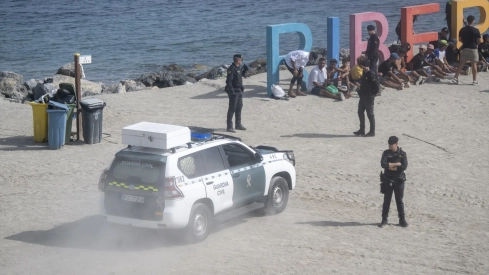
Judge María Tardón now has on her desk the second police report she had requested to clarify what happened in Ceuta on July 30 and 31. The Information Service Headquarters of the Civil Guard delivered this Friday an official letter that confirms the existence of previous communications about possible arrivals, although none allowed to anticipate a mobilization of tens of thousands of people nor the subsequent collapse of the border.
The five-page document answers the specific questions posed by the head of Central Investigating Court number 3 of the Audiencia Nacional. Tardón had asked to know the information available before the crisis, the deployed device, the rescue operations, and the data gathered on the deceased and survivors.
Its content is especially relevant in the midst of a political dispute about what the State knew. The document forces a distinction between general signals about possible swimming entries, relatively common at certain times of the year, and an alert capable of anticipating the extraordinary dimension that the events reached.
Previous warnings incapable of anticipating the collapse
The Civil Guard explains that in the previous days information obtained on social networks circulated through the usual channels of cooperation with other Spanish and foreign bodies, agencies, and information services. These communications pointed to a possible influx of people towards the border, but their content and scope were far from reflecting what ended up happening.
The official letter does not expressly identify the organizations that participated in these exchanges. Sources familiar with the investigation cited by various media place the National Intelligence Center among them, although the document generically refers to agencies and information services. The precision matters given the versions that present any prior warning as proof that the Government knew the magnitude of the crisis beforehand.
The National Police report already included two communications issued by the National Immigration and Borders Center on July 28 and 29. Both warned of a "high" probability of swimming entries into Ceuta and Melilla after detecting movement on social networks, although they also pointed out that it was impossible to ensure that they would materialize.
The new document thus places the debate on a more precise ground. Margarita Robles was right to state that there was prior information, while the position defended by Pedro Sánchez and Fernando Grande-Marlaska finds support in another essential aspect: no communication described a scenario close to the simultaneous crossing of tens of thousands of people.
The Civil Guard has also provided information on its deployment and the work carried out at sea. The armed institution estimates the number of confirmed deaths during those days at 82, mainly due to drowning and crushing. The link with the massive entry of other bodies recovered later remains pending confirmation.
Two different reports on the same crisis
The Civil Guard's report has a different purpose than the 55-page document presented by the National Police. Tardón tasked the CENIF agents with analyzing whether the entry could have been a concerted action, identifying its possible organizers, and studying the available graphic material. This work led to indications of planning and the alleged "active guidance" of people by Moroccan forces.
The Civil Guard was asked for operational information on the warnings, the border device, rescues, and victims. The absence of references to Morocco's role responds to the scope of the judicial order, so the brevity of the report also does not allow its importance to be measured against the police report. Each body has answered different questions within the same proceedings.
The delivery has coincided with the Prosecutor's Office's support for the Audiencia Nacional to investigate the events. The chief prosecutor, Jesús Alonso, sees indications of aiding irregular immigration, homicide and injuries due to gross negligence, and criminal organization. He also places part of the possible planning, mobilization, and logistical coordination in Moroccan territory.
The Government will bring the possible declassification of documents related to Ceuta to next Tuesday's Council of Ministers. The objective announced by Sánchez is to publish the available police and intelligence information before and after the crisis, preserving data that could harm the CNI or cooperation with foreign services. The report sent by the Civil Guard will be part of that dossier.
With the reports from the National Police, the Civil Guard, and the Prosecutor's Office already incorporated into the proceedings, Tardón must decide whether the Audiencia Nacional definitively assumes the investigation, admits the complaint that originated the procedure, and decrees the partial secrecy requested by the Public Ministry.
