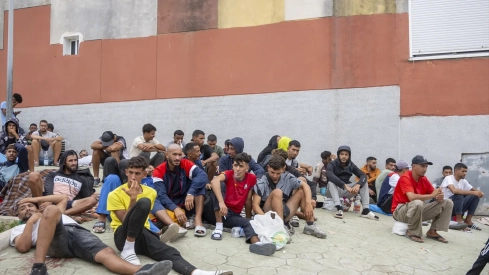
The migratory crisis in Ceuta took a decisive step towards the courts this Friday. The Prosecutor's Office of the Audiencia Nacional has supported that this body investigate the massive entry registered on July 30 and 31 and has located a part of its possible planning, mobilization, and coordination in Moroccan territory.
The report was signed by the chief prosecutor, Jesús Alonso, who personally took on the matter due to its relevance. The Public Prosecutor's Office sees indications of favoring irregular immigration, homicide and injuries due to serious negligence, and criminal organization or group. It has also requested that a part of the proceedings remain secret due to the special circumstances of the case.
The position of the Prosecutor's Office is still provisional. Magistrate María Tardón must decide whether the Audiencia Nacional is competent and what steps she orders to clarify what happened. The identification of those responsible, including any eventual participation of Moroccan state structures, remains in the hands of the investigation.
A possible planning in Moroccan territory
The document states that a relevant part of the preparation could have taken place on the other side of the border. There, according to the evidence gathered so far, the mobilization of people, logistical coordination, the dissemination of messages on social networks, and an eventual strategic direction would have occurred. The execution and the most serious consequences fell on Ceuta, Spanish territory, which allows Spanish jurisdiction to investigate the entire set of facts.
This approach is especially supported by the 55-page report prepared by the National Immigration and Borders Center. The agents described a planned movement and pointed to the alleged participation of Moroccan personnel in the "active guiding" of people towards different crossing points. The document also highlighted the permissiveness observed for several hours at the border, although it left pending to determine who gave the instructions and from what level.
The Prosecutor's Office considers that the Audiencia Nacional has the necessary means to face a cross-border and potentially organized investigation. In addition to the crimes initially identified, the investigation must verify whether the investigated behaviors could have affected public order or collective assets such as the peace or independence of the State.
Tardón also now has the report requested from the Civil Guard. The document includes the communications maintained before the massive arrival, the deployed personnel, the rescue operations, and the known deaths. According to sources close to the investigation, there were prior warnings and contacts with state agencies, although none anticipated the dimension the crisis would reach.
Tardón will decide after the clash with Interior
The Public Prosecutor's Office's statement comes after the confrontation between the Minister of the Interior, Fernando Grande-Marlaska, and the magistrate. The minister conveyed to the General Council of the Judiciary his concern that the police officers in charge of the report had to maintain confidentiality and were prohibited from communicating their conclusions to their political superiors.
The Government Chamber of the National Court has unanimously supported Tardón's actions and has reminded that the Judicial Police functionally depends on judges and prosecutors when carrying out a criminal investigation. The president of the General Council of the Judiciary, Isabel Perelló, also called for respect for the independence of the magistrate.
Pedro Sánchez defended before Congress on Thursday that so far there is a lack of conclusive evidence to attribute the organization of the massive entry to the Moroccan Government. The Public Prosecutor's Office's criterion starts from a different level: the existence of sufficient evidence to investigate. The document places part of the possible preparation in Morocco, while reserving the attribution of responsibilities for the proceedings that the judge may agree upon.
The Government of Ceuta, chaired by Juan Vivas, has agreed to appear as a private prosecution to claim damages caused to public services, citizen security, and the child protection system. Tardón must now decide whether to keep the case in the National Court, decree the requested partial secrecy, and order the first actions to identify those who may have organized and directed the crossing.
