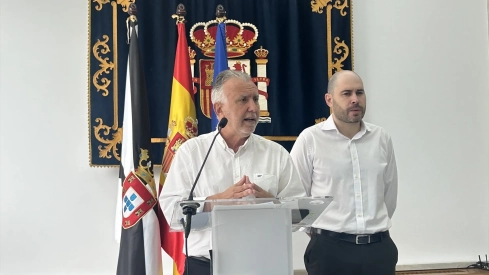
The Government has accelerated its response to the migratory crisis in Ceuta this Thursday. The Minister of Territorial Policy and Democratic Memory, Ángel Víctor Torres, has updated the balance of returns, announced the opening of new temporary spaces, and has set the goal of recovering the beaches before mid-October.
Torres conveyed this commitment to five residents of the city with whom he met for about half an hour at the Government Delegation. The women had come to Plaza de los Reyes to personally request a meeting and explain the situation of El Trampolín and Benítez, where about 3,500 migrants are still settled.
The minister has assured that he will do "everything possible" to clear the beaches within that period. He also explained the legal and operational difficulties of an action that requires opening reception places, identifying each person, and individually resolving their situation. Mid-October remains the Government's goal, although the calendar will depend on the pace of transfers and the processing of files.
Currently, about 6,000 people are housed in resources enabled by the State. Last Friday, about 1,700 were transferred from the beaches to the port plots, but the settlements still occupy a large part of El Trampolín and Benítez. Torres announced that new spaces will be opened this week and next so that no one has to sleep in the streets or on the coast.
More than 7,000 returns and new reception spaces
The balance offered by the head of the single command reflects 7,099 returns to Morocco since August 10. To these are added 364 expulsions, corresponding to people who had arrived before the massive entry at the end of July. The files opened after that crisis are still being processed, as they can take up to twelve weeks to resolve.
The rate of return is currently between 150 and 200 people per day. The Government has carried out 2,742 adult triages, interviews in which each migrant is identified, their situation is studied, and it is checked whether they wish to request international protection. On Monday, 26 of the one hundred people interviewed decided not to request asylum and received information about the start of their return procedure.
Torres has defended that temporary reception is essential to accelerate this work. When a person enters one of the resources, they can be identified, receive attention, and learn about the real possibilities of remaining in Spain. The minister maintains that the progress of the triages explains the increase in voluntary returns registered in recent days.
The Executive is studying enabling an additional space if the planned places prove insufficient. The land located near the Fuerte Mendizábal prison remains among the possibilities, despite the objections raised by the Independent and Civil Servants Trade Union (CSIF). Torres has offered to explain the conditions of the device and the security measures before making a decision.
The Government has indeed ruled out other places it considered suitable, such as the Military Hospital, the old Fiscer, several sports pavilions, or the flour factory. The decision responds to the requests of the Autonomous City and the residents to move the camps away from the most populated areas. All resources will be provisional and will be removed when the emergency ends.
"Ceuta is not going to be a giant Temporary Immigrant Stay Center," Torres guaranteed. The minister insisted that the tents allow procedures to be completed and departures to be expedited. "When they leave, we will dismantle the tents," he stated.
Minors will be reunited on a case-by-case basis
The situation of minors continues to occupy a central part of the operation. The Government has identified 2,383 children and adolescents who arrived without family accompaniment and maintains reunification as the first option, both with relatives residing in the Peninsula and in Morocco.
So far, 54 minors who arrived after July 30 have been reunited with their families in the Peninsula. Another 118 who were already in Ceuta before that date have been transferred to different autonomous communities through the mechanism provided for territories subject to a migratory contingency. Nearly 300 more files are in preparation.
Around 90 minors have already gone through interviews accompanied by their legal representatives. Another 400 remain in resources enabled by the State while the Autonomous City prepares specific places to host them. Torres has assured that none will return to the streets or remain permanently in facilities shared with adults.
The minister has asked for "rigor" from parties that promise to immediately return all minors. Each file must analyze family circumstances, listen to the child or adolescent, and verify that any reunification protects their best interest. If returning with their family is unfeasible, legal options include remaining in Ceuta or being transferred to another autonomous community.
"Not all minors can be returned," Torres warned before demanding that no one "deceive or lie" about a procedure subject to legal guarantees. Morocco has expressed its willingness to collaborate, but Spanish authorities must verify who will receive each minor and under what conditions.
The Government's response also includes measures to revive Ceuta's economic and social activity. A total of 1,137 self-employed individuals and small and medium-sized enterprises have applied for direct aid from the 309 million euro package approved in early September. Torres explained this Wednesday in Congress that the first payments will arrive starting October 6. Self-employed individuals can receive 5,000 euros and companies, between 10,000 and 150,000 euros depending on their business volume.
The minister also highlighted that attendance at educational centers is already close to 90%. This data comes after a start to the school year marked by family concerns and union protests demanding more security, cleanliness, and action protocols in schools and institutes.
The Government has also sent official communications to request that Ceuta and Melilla be part of the European Committee of the Regions. It has also requested to extend the presence of the European Border and Coast Guard Agency (Frontex) and advance in the incorporation of both cities into the Customs Union. Torres has presented these steps as part of a response that seeks to address the immediate emergency and strengthen Ceuta's position within the European Union.
Add ElConstitucional.es as a preferred Google source for free.
Stay informed about all the latest breaking news with the best information. Against disinformation, for democracy and social rights.
