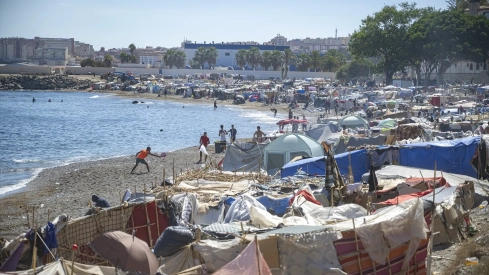
The Government confirmed this Wednesday one of the first important advances in the care of minors who arrived alone in Ceuta during the massive entry at the end of July. A total of 54 boys and girls have been able to reunite with relatives who already lived in the Peninsula through an urgent procedure and there are more than 300 similar cases under study.
The transfers have begun after verifying the kinship and the conditions of the environment that will receive each minor. Adults must travel to Ceuta, prove the family bond, and personally pick up the child. The National Police authorizes the departure and the Autonomous City subsequently informs the Prosecutor's Office and the social services of the destination community.
The Minister of Youth and Children, Sira Rego, has defended that family reunification should be the first option when it responds to the best interest of the minor and there is a core capable of guaranteeing their protection. "If the family is in the Peninsula or in Spain, it is much simpler, we save a lot of time, it is much more agile and equally guaranteeing," she explained on 'RNE'.
The existence of another 300 open cases does not yet imply that all transfers will be approved. Each case requires individualized interviews, proof of kinship, and an assessment of the family situation. The process is longer when relatives are in Morocco or another country because it requires the participation of foreign authorities.
More than 2,300 minors have already been identified
The latest government data raises the number of minors identified in Ceuta to 2,321. Identification allows knowing their age, family situation, possible protection needs, and willingness to request asylum or return to their family. The Government estimates that between 500 and 700 could remain outside the enabled resources.
The Ministry of Youth and Children is supporting the Autonomous City in interviews, detecting vulnerabilities, and processing cases. Guardianship legally corresponds to Ceuta, a distribution of powers that has once again caused a political clash between both administrations.
Rego has accused Juan Jesús Vivas's Executive of "lying" about the state proposal to transfer around 500 particularly vulnerable girls to the Peninsula. The minister maintains that the files can be processed from anywhere in Spain and considers it "impossible" for Ceuta to handle the current volume of minors alone.
The reform of article 35 of the Immigration Law has already allowed the transfer of some 700 minors from the autonomous city during the last year. The Government now advocates applying the same principle of territorial solidarity to relieve protection services that remain well above their ordinary capacity.
A new camp to get hundreds of people off the streets
The Executive has also begun to set up a new reception facility on the so-called Cuesta de Caballería, within the Playa de Benítez neighborhood. The enclosure will have the capacity to temporarily house between 500 and 700 people and is less than half a kilometer from the settlements built in El Trampolín and its surroundings.
Workers are preparing the esplanade with gravel before installing the tents. The site is part of the plots included in the decree that declared Ceuta a zone of interest for national security. The Government is also studying enabling spaces in El Guano, next to El Trampolín beach, and in the old military installation Batería K-8, near the Beliones border.
The State estimates more than 6,000 temporary places created since July and maintains the goal of reaching 10,000. Between 3,000 and 3,500 people still remain without stable accommodation, while the Autonomous City demands more information about the new locations and proposes using land near Piniers and the prison.
The Minister of Territorial Policy and head of the single command, Ángel Víctor Torres, has argued that these spaces allow adults to be identified, their situation to be individually studied, and returns to be completed more quickly. The latest official data show 6,791 voluntary returns to Morocco and 318 expulsions executed since the massive entry.
"All people will be returned according to the law," Torres said in Congress, where he recalled that each file must respect the right to asylum, situations of vulnerability, and the guarantees provided for minors. The minister also accused the Ceuta government of putting "spokes in the wheel" during the transfer of migrants to the facilities set up in the port.
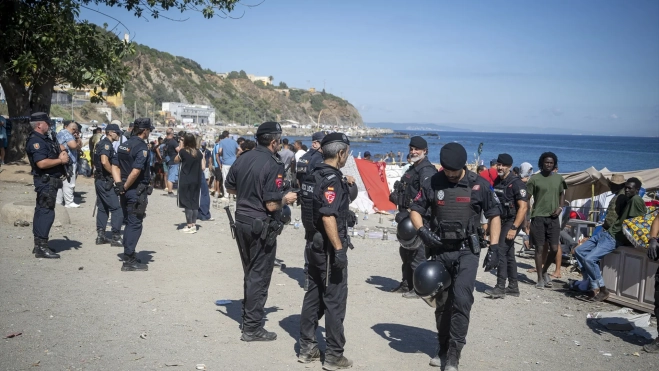
The National Police and the Local Police intervened this Wednesday on Trampolín beach to remove an unauthorized street market that had been reinstalled after the first operation on Tuesday. The action included the cleaning and conditioning of the settlement, where hundreds of people still survive in improvised structures.
The security device remains reinforced after the General Council of the Judiciary counted 37 preliminary proceedings for sexual assaults opened in Ceuta since the end of July. The Minister of Equality, Ana Redondo, has assured that the State is dedicating "all efforts" to restoring security and normality. The proceedings are in an initial phase and their opening does not yet determine authorship or criminal responsibility.
23-S passes calmly and the Government increases pressure on Morocco
The Tarajal border remained calm until late in the afternoon despite calls disseminated on social media to promote a new massive entry during Morocco's legislative elections. No significant attempts were registered in Melilla either.
Spain has reinforced the presence of the Civil Guard and the National Police, while Morocco has deployed agents, vehicles, and controls on the roads leading to Ceuta. Rabat had conveyed to the Spanish Government its commitment to do "everything necessary" to prevent a situation like that of July 30 from recurring.
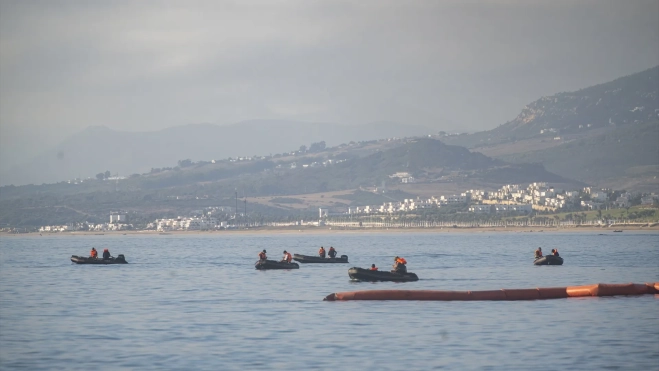
During the day, Maritime Rescue worked on repairing several modules of the Tarajal pneumatic barrier that had again lost pressure. The Interior Ministry has already initiated procedures to extend the border breakwater and replace the current provisional structure with a stable buoy system.
The calm of 23-S coincides with a significant change in the discourse of the President of the Government, Pedro Sánchez, regarding Moroccan responsibility. In an interview with Christiane Amanpour on 'CNN', Sánchez has acknowledged that Morocco's border control "failed" during the massive entry and has assured that Spain has asked for "actions and responses" from Rabat.
The president has at the same time maintained the commitment to a strategic relationship with the neighboring country and has defended that returns be carried out with guarantees. "In Spain, migrants are not livestock, they are human beings," he stressed before asserting that security, order, and dignity can be part of the same response.
The Minister of Defense, Margarita Robles, has "fully" supported these words and believes that Sánchez has spoken with "knowledge of the facts". She has also guaranteed the Government's collaboration with Judge María Tardón, who is investigating in the Audiencia Nacional what happened during the massive entry and the possible international ramifications of the operation.
Sira Rego has gone further by considering it "unlikely" that Morocco was unaware of the movement of tens of thousands of people towards the border. The minister has also called for a review of European migration policy and has warned of the consequences of handing over external control to third countries.
The Minister of Foreign Affairs, José Manuel Albares, maintains that the Government seeks to be "effective" in its relationship with Morocco and keeps contacts open to accelerate returns and prevent new entries. In parallel, Foreign Affairs is preparing the formal request to incorporate Ceuta and Melilla into the Customs Union, a process that could last between one year and a year and a half.
The roadmap also includes a permanent seat for the two cities in the European Committee of the Regions, a stable presence of the European Border and Coast Guard Agency (Frontex) and the visit of Kings Felipe VI and Letizia before the end of the year. The Spanish Federation of Municipalities and Provinces must now decide which position of its representation it will cede so that Ceuta and Melilla can occupy it, at the latest, in the European plenary session in December.
Add ElConstitucional.es as a preferred Google source for free.
Stay informed about all the latest breaking news with the best information. Against disinformation, for democracy and social rights.
