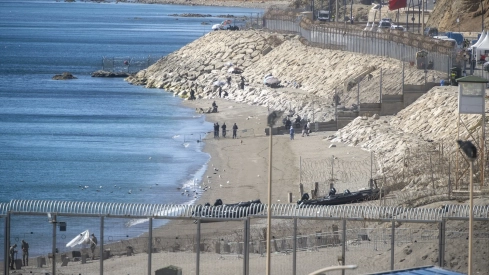
Ceuta faces this Wednesday a day marked for weeks on the calendar of the Spanish and Moroccan authorities. The calls disseminated on social media to attempt a new entry coincide with Morocco's legislative elections, a circumstance that its promoters present as an opportunity to take advantage of the police deployment for the elections. The border awakens reinforced on both sides and subjected to permanent surveillance.
For the moment, the call has not caused a significant concentration of people around the perimeter. Another similar call disseminated for last Sunday also did not prosper. The Government has decided to maintain the planned deployment given the risk that movements may occur rapidly, as happened during the massive entry on July 30 and 31.
The operation incorporates nearly 150 additional national police officers and civil guards in Ceuta, three platoons from the Civil Guard's Reserve and Security Groups, two groups from the Police Intervention Unit and a reinforcement of aerial assets. Helicopters and drones will monitor the vicinity of the fence and the maritime strip of El Tarajal day and night.
The response comes accompanied by increasing political pressure on Rabat. The President of the Government, Pedro Sánchez, stated on Tuesday in an interview with the American network 'CNN' that "it is clear that Morocco's border control failed" during the July crisis. Spain, he added, has asked for "actions and responses" from the neighboring country while continuing to investigate how an entry of that magnitude could have occurred.
Reinforcements throughout the night on both sides of the border
The Civil Guard has suspended rest periods and reorganized shifts to increase its presence during the hours considered most sensitive. The GRS platoons joined the deployment during the night and will remain deployed, in principle, until the afternoon. Interior plans to increase the number of personnel again if intelligence services detect significant movements in Morocco.
The National Police has added two UIP groups. One of them was supposed to relieve the agents who had been stationed in the city for several days, but the Ministry of Interior decided to temporarily keep both to have greater intervention capacity. The reinforcement is concentrated in Ceuta, although Melilla also has additional units, aerial surveillance, and maritime resources.
Morocco has intensified its police and military presence in Fnideq, the border town known in Spain as Castillejos, and on the roads leading to the Bab Sebta crossing. Estimates released in recent hours place around 3,000 personnel mobilized in the area, including agents, gendarmes, and military personnel. Barriers have also been installed near the beach and controls at the accesses usually used by those attempting to approach the border.
The Minister of Foreign Affairs, José Manuel Albares, assured on Tuesday that his Moroccan counterpart, Naser Burita, had guaranteed him that Rabat “will do everything necessary” to prevent another massive entry. Both maintain daily contact since the beginning of the crisis and plan to meet in New York during the United Nations General Assembly.
This is the sixth alert activated since the end of July. The most serious occurred on August 15, when hundreds of people approached the perimeter and were intercepted by Moroccan forces. The warnings on August 8, 9, and 12, in addition to the one issued for September 20, ended without significant movements.
Coordination with Morocco also includes a campaign against false messages circulating on social media and messaging applications. The Spanish Embassy in Rabat has warned that entering Ceuta or Melilla irregularly does not grant the right to pass to the Peninsula, remain in Spain, or circulate within the European Union. The Ministry of Foreign Affairs has asked Moroccan media to disseminate this information to curb the messages used by networks dedicated to human trafficking.
Sánchez's statements introduced a degree of public pressure on Morocco that the Government had avoided during the first weeks of the crisis. The president maintained the need to preserve a stable relationship with Rabat, which he defined as a strategic partner, although he made it clear that Spain expects concrete measures after the July ruling.
Sánchez also rejected that the reports declassified by the Executive demonstrated that the authorities clearly knew the magnitude of the entry. As he explained, those documents collected general risks, but “there was no clear evidence that something like that was going to happen”. The open investigation will have to determine if the Moroccan device was overwhelmed or if there were other circumstances that facilitated the crossing.
The Interior Ministry has added to the immediate response a project to permanently reinforce the maritime border of El Tarajal. The action contemplates extending the breakwater in a first phase by 15 meters and, subsequently, raising another 100 meters of dike further out to sea. The estimated budget amounts to seven million euros, to which another two million will be added to install a beacon system and a suspended containment net to the bottom.
The works still need reports from the Autonomous City and other organizations. The new breakwater is not part of this Wednesday's operation, which depends on the agents deployed, aerial surveillance, and effective cooperation with the Moroccan authorities.
Torres maintains unified command with reception still under pressure
The 23-S alert finds Ceuta trying to recover normality almost two months after the entry of more than 72,000 people. Most returned to Morocco during the first hours and days, but thousands remained in the city and overwhelmed its reception resources.
The Minister of Territorial Policy, Ángel Víctor Torres, responsible for the functional authority known as unified command, reported the latest balance of the crisis to the Council of Ministers on Tuesday. The structure he directs coordinates the departments involved, the Government Delegation, intelligence services, and the Ceuta administration since the situation was declared of interest for national security.
According to the data presented by Torres, more than 6,000 adults are housed in facilities enabled by the State. The Council of Ministers approved another 88 million euros to expand available resources and prevent beaches from becoming improvised resting areas again. The recent transfer of 1,700 people to the plots conditioned in the port allowed part of the saturated spaces to be freed.
The teams in charge of identifications had conducted 2,546 initial interviews. Since August 10, 6,791 people voluntarily returned to Morocco and another 318 were expelled. In the last week alone, 1,309 voluntary returns were recorded, a figure that the Executive relates to the streamlining of procedures and the information provided to each affected person.
The situation of minors continues to be the main bottleneck. The Government has identified 2,321 and estimates that between 500 and 700 are still outside reception resources. Nearly 2,000 receive care in public or concerted facilities. The legal priority is to locate their families and study a reunification with guarantees. For those who must remain in Spain, the Executive proposes transfers to other communities.
Torres on Tuesday urged the regional governments of the PP to collaborate in this reception and reproached the president of Ceuta, Juan Jesús Vivas, for his rejection of several proposals. “What we ask of the Popular Party, more than a demonstration, is that they put some solution on the table,” he said after the popular announced their attendance with Vox at a protest against the management of the crisis.
The Council of Ministers also approved an institutional declaration to reinforce attention to women and girls exposed to trafficking, sexual exploitation and other forms of violence. Of the minors attended in the facilities, 730 are girls. The different services must prioritize their protection and offer resources adapted to their age.
Sánchez also called for a European response. He recalled that Ceuta constitutes an external border of the Union and reproached several governments for their lack of solidarity, despite the support provided by Spain during the Lampedusa crisis or in the face of Donald Trump's threats regarding Greenland. Regarding the people who must return to Morocco, the president set the criterion that, he defended, should guide all actions. “We will do this work with dignity. Migrants are not livestock, they are human beings.”
Add ElConstitucional.es as a preferred Google source for free.
Stay informed about all the latest breaking news with the best information. Against disinformation, for democracy and social rights.
