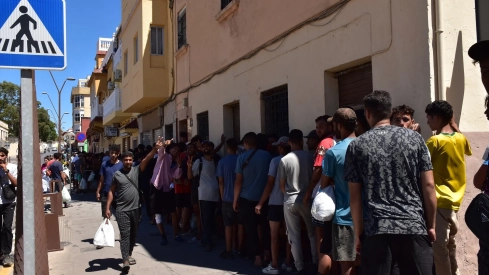
The Príncipe neighborhood has stopped counting. In just two days, the neighborhood association has gathered the names, ages, and phone numbers of 4,860 people who have identified themselves as unaccompanied migrant minors. The constant arrival of more young people at their small headquarters has also overwhelmed a registry set up with sheets of paper, volunteers, and very few resources.
The list lacks official status and does not, by itself, verify the age of all registered individuals. Its dimension, however, offers a very different picture from what administrations have conveyed so far. The Government Delegation estimates that about 2,500 migrant people remain in Ceuta, a figure referring to the total number of adults and minors that is even below the count carried out solely in this neighborhood.
The Príncipe Alfonso Neighborhood Association decided to open the registry after verifying that the numbers offered by the authorities did not match what they saw every day in their streets. "We wanted to know the real number of people who remain in the neighborhood," explained its president, Ahmed Enfed-Dal.
On the first day, they recorded 2,672 names. During the second, they added another 2,188. Then they closed the folder. "We had to stop because this is chaos. They keep coming to the association asking to sign up," Enfed-Dal admitted. The entity now intends to hand over the documentation to the administrations to facilitate identification and demand emergency resources.
Most of those registered claim to be between 15 and 17 years old. The association has also located numerous children between 11 and 13 years old, some lost among streets, squares, and mountain areas after crossing the border. Other young people have just reached adulthood or lack documentation to prove when they were born.
Girls and adolescents face an especially delicate situation. Several have come to the association to ask for sanitary pads and other intimate hygiene products. Enfed-Dal recounted the case of a young girl who had just had her first menstruation and arrived looking for a bathroom and help to clean herself.
A precarious neighborhood sustains the emergency
The neighborhood headquarters has become this week an improvised point of humanitarian assistance. Residents bring food, water, clothes, and toiletries that are then distributed among those who continue to sleep outdoors or spend the day in the neighborhood.
El Príncipe is one of the neighborhoods with the highest rates of poverty and unemployment in Spain, but some of its residents have opened patios, rooms, and homes to offer temporary refuge. Some families have taken in several siblings, and others prepare food for children they find in front of their houses.
The association received 150 bags of food this Wednesday, delivered by the Minors area of the Autonomous City. The quantity barely sufficed for a portion of the people gathered, so the volunteers decided to distribute them among the youngest. They had to do so discreetly to prevent other young people from seeing the food run out before reaching them.
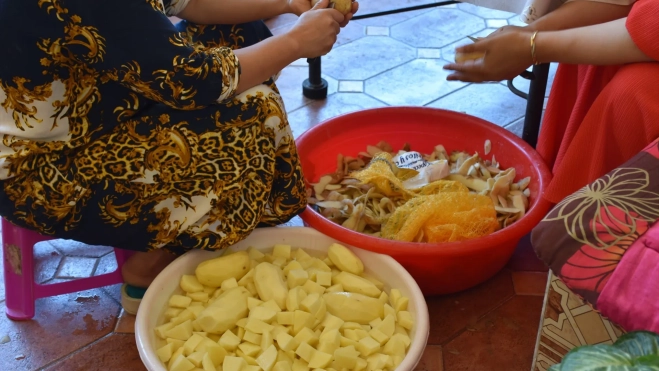
Enfed-Dal admits that the neighborhood is starting to feel the fatigue. Solidarity continues, but the homes and pantries of a humble neighborhood have a limit. "Maybe you have ten people at your door and you can only feed two. What do you do? Well, we prioritize the youngest," he explained.
The demand addressed to the institutions is immediate. The association asks to enable sports centers, schools, pavilions, barracks, or any facility that has showers, bathrooms, and enough space for minors to stop sleeping on the street. "The resources are already late. They could have been enabled on the first day," lamented its president.
The Autonomous City has begun to open new facilities. The Reina Sofía school has hosted around a hundred girls during its first night, and there are plans to also use the CEIP Príncipe Alfonso. The response is still far from covering the needs described by residents and organizations working on the ground.
The figures vary because they measure different moments and situations. The National Police had identified 528 minors who arrived during the massive entry and were placed at the disposal of protection services as of this Wednesday. The Ceuta government claimed to be assisting 1,017, and Juan Jesús Vivas raised the total to about 1,200 this Thursday. The city's ordinary system has about thirty places.
The Prince's registry also cannot be directly compared with that data until authorities verify identities, ages, and possible duplications. The file does confirm that thousands of people are still seeking help outside the official circuit, including many who have not yet gone through a police station or a reception facility.
Protection against ultra noise
Legislation requires that any person who may be a minor be placed at the disposal of protection services and that their circumstances be individually studied. Age, family situation, health status, and possible risks of return must be verified before a decision is made. Collective or automatic returns of children and adolescents are outside these guarantees.
Since 2025, Spain has had a mechanism to transfer minors from the most saturated border territories to other autonomous communities. The rule places the best interest of the minor ahead of political conflict and requires coordination of guardianship, documentation, and reception at the destination.
The Popular Party confirmed this Thursday that its regional governments will comply with the law and will receive the minors who are transferred from Ceuta. This position clashes with the agreements signed with Vox in several communities, where the ultra party had imposed the rejection of new receptions as a political condition.
The far-right Vox has responded to the crisis by recovering its most aggressive language. Santiago Abascal traveled to Ceuta to define the entry as an "invasion" and an "act of war," while leaders of his party demand expulsions and oppose the distribution of minors. Deputy José María Figaredo has even spoken of "hunting" and "fishing" those who remain in the city, expressions that dehumanize people, among whom are children as young as 11 years old.
In the streets of El Príncipe, reality has little to do with that rhetoric. There are minors who do not remember their parents' phone numbers, siblings who fear being separated, and girls who fled homes marked by abuse. Many prefer to sleep in Ceuta rather than return to the same circumstances they escaped from.
The association will transfer its file to the Government Delegation and the Minors area so that the unofficial census can be converted into real identifications and reception places. Enfed-Dal summarizes the priority without getting into acronyms or territorial disputes. "I don't care if it's a school, a pavilion, or a barracks. The important thing is that these children are protected."
Add ElConstitucional.es as a preferred Google source for free.
Stay informed about all the latest breaking news with the best information. Against disinformation, for democracy and social rights.
