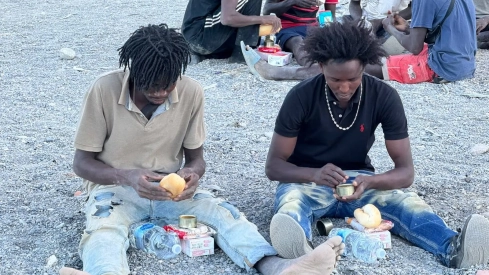
Five days after the massive entry across the border, the humanitarian emergency continues on the beaches, around the CETI, and other points in Ceuta. There are people sleeping outdoors, minors still unidentified, and migrants who depend on distributions organized by neighbors and social entities to get water or some food.
No Name Kitchen and Asociación Elín, two organizations working on the ground, denounced this Tuesday "inhumane" treatment, lack of basic assistance, and forced returns to Morocco. Their testimonies describe exhausted people who end up accepting the return after several days exposed to hunger, thirst, and unsanitary conditions.
"There are people who still haven't eaten anything since Thursday," Francesca Fusaro, coordinator of No Name Kitchen, told 'EFE'. The distributions made during these days have been too small to cover all needs. Some people are "on the verge of fainting" and end up returning to Morocco due to pure physical exhaustion, according to her account.
"It's a very ugly way of doing things," Fusaro lamented. The organization maintains that returns are occurring while Army and security forces search for migrants at different points in the city, put them into vans, and transport them to the border. It also denounces actions based on racial profiling.
The Government estimates that 72,000 people entered Ceuta and 70,000 have already returned to Morocco. Authorities have highlighted cooperation with Rabat and the speed of returns, but NGOs question whether all these decisions can be considered fully voluntary when those who remain in the city lack water, food, rest, or information about their rights.
Asociación Elín, present in Ceuta since 1999, speaks of "systematic neglect" that especially affects migrants from countries like Sudan and Chad. Many of these people have traveled for months on routes marked by war, persecution, and violence and could meet the necessary conditions to apply for international protection in Spain.
"Taking a person to the limit of their physical and psychological endurance is a cruelty with irreversible consequences for their health and integrity," the entity warned. Elín demands real humanitarian care protocols and reception centers where people can rest, receive medical assistance, and learn about available legal options.
The lack of water was especially visible on Trampolín beach. The association reported on Monday that the only potable water supply point in the area had been cut off while numerous migrants remained there. The service was reestablished this Tuesday.
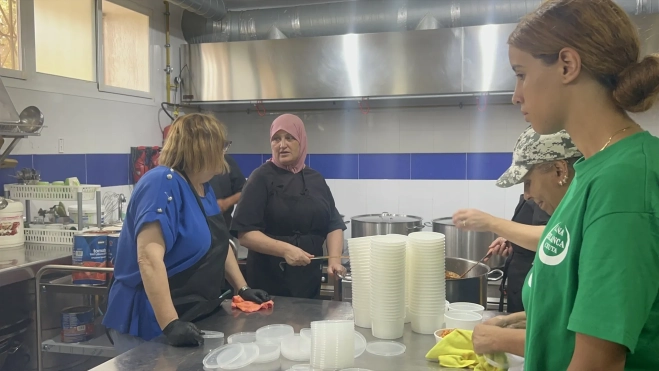
Much of the immediate response is falling on local organizations. Luna Blanca has managed to prepare and distribute 2,000 breakfasts in two hours with a dozen workers and several volunteers. Its president, Mustafa Abdelcader, estimates that the entity has assisted some 4,000 people since Thursday.
"A child has just arrived suffering from heatstroke and is lying on the ground. We cannot let him starve to death. We are not politicians. We are human beings," Halima Ahmed, social educator and spokesperson for Luna Blanca, explained to 'Euronews'.
Unidentified minors and returns under suspicion
The situation of children now concentrates much of the concern. Ceuta assists 862 migrant minors in ordinary centers and emergency-enabled resources, although its structural capacity was prepared for barely 29. The city calculates an over-occupation of 2,872% and takes for granted that the figure will end up exceeding a thousand.
Other children remain on the street, hidden in the mountains, on Trampolín beach, or in improvised settlements. Some hide for fear of being returned. Unicef has found children aged ten and twelve who only ask for a phone to tell their mothers that they are still alive.
Save the Children has sent a letter to the Government after receiving testimonies and images about possible minors transferred to the Moroccan border. The organization assures that very young people appear in some operations and that it has learned of specific cases of children who would have been accompanied to El Tarajal.
"Before any return, it is essential to identify each child and individually assess their situation, always guaranteeing their best interest," warned Jennifer Zuppiroli, migration specialist at Save the Children. The age, family circumstances, and risks the minor would face in Morocco must be checked before making a decision.
ActionAid has received even more concerning information from its partner organizations in Morocco. The entity assures that hundreds of people, many of them minors, have been transferred to remote areas in the south of the country without transport, accommodation, or means to return to their homes.
Some children lost their phones during their entry into Ceuta and are still unable to contact their families. Among those returned, there would also be young Algerians, Tunisians, and sub-Saharans who lack residence or family networks in Morocco.
The recent Supreme Court ruling prevents the application of immediate returns, foreseen for the land border, to people intercepted at sea when trying to access by swimming. The court established that this figure requires crossing a physical containment element and that the sea, cameras, or surveillance systems lack that consideration.
The resolution allows for a return to be processed through ordinary channels, with identification, legal assistance, and the possibility of requesting international protection. In the case of minors, any return also requires an individual assessment and guarantees that they will be handed over to their family or an appropriate protection service.
EAPN-ES has called for an independent investigation to reconstruct what happened and determine possible responsibilities. The entity demands respect for the right to asylum, the principle of non-refoulement, and the prohibition of collective expulsions, especially when minors or people from countries in conflict are involved.
25 million for an overwhelmed reception
The Government has announced an extraordinary allocation of 25 million euros to assist unaccompanied migrant minors in Ceuta. The resources are in addition to the 5.5 million distributed in July and will serve to reinforce facilities, staff, and specialized care.
Youth and Childhood also works on the transfer of minors to other autonomous communities. The reform of the Immigration Law allows for the activation of a mandatory distribution when a territory far exceeds its capacity. Save the Children calls for accelerating these transfers to relieve centers that are already operating far beyond their capabilities.
The minors are distributed among the La Esperanza center, the Tarajal Nueva Esperanza warehouse, and the two spaces set up in Piniers. Education has also ceded two school centers to specifically care for girls, one of the groups most exposed to violence, exploitation, and abuse during these displacements.
The Ceuta government maintains that the response continues to be insufficient and asks the State for more agents, resources, and reception capacity. The Autonomous City estimates that between 3,000 and 5,000 migrants still remain, while the central government's figures reduce that estimate to about 2,000 people. The absence of a complete registry prevents knowing how many are still on the street or remain hidden.
The official toll has already reached 75 deaths on the Spanish side of the border. Most drowned while trying to go around the breakwater or were crushed during the stampede. The bodies are being transferred to the old Military Hospital for autopsies and to advance their identification.
At least 44 people, mainly young people and minors, remain missing. Their families are searching for them from Morocco through calls, photographs disseminated on social media, and requests for help from humanitarian organizations.
The Civil Guard has opened a special office in the customs facilities of El Tarajal to receive complaints between 8:00 and 21:00. Relatives can provide physical descriptions, scars, tattoos, medical operations, or personal objects that facilitate identification.
The email ce-cmd-ceuta-pjlaboratorio-identificacion@guardiacivil.org has also been enabled. Every piece of data received will be incorporated into the search for missing persons and the identification process of bodies recovered at sea.
Add ElConstitucional.es as a preferred Google source for free.
Stay informed about all the latest breaking news with the best information. Against disinformation, for democracy and social rights.
