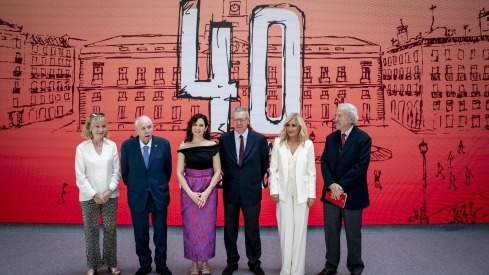
Isabel Díaz Ayuso has brought three of her predecessors back to the institutional heart of the Community of Madrid. Esperanza Aguirre, Alberto Ruiz-Gallardón and Cristina Cifuentes will be members of the Legal Advisory Commission, the body responsible for issuing opinions on matters of special legal relevance that come from the regional government and other Madrid administrations.
The appointments were approved this Wednesday by the Governing Council in application of the Statute of Former Presidents that Ayuso's own Executive promoted in 2025. The three will participate in the plenary sessions as experts, with the capacity to intervene in deliberations, although their positions will have a voice and lack a vote.
From Puerta del Sol, they argue that their experience will allow them to provide "legal certainty and technical rigor". The decision brings together in the same body three leaders who governed Madrid for almost two decades and who represent very different stages of the regional PP, from Gallardón's institutional profile to Aguirre's neoliberalism and Cifuentes' eventful presidency.
Six years on the Legal Commission
The decree approved last year recognizes this right to those who have presided over the Community for at least two years and have acceded to the position at the beginning of a legislature. Gallardón, Aguirre and Cifuentes meet these requirements and requested their incorporation, so the Governing Council had to formalize their appointments.
The ordinary term will be six years. In the case of former presidents who remained in office for more than four years, the Executive can extend it for a reasoned period up to a maximum of twelve. This possibility applies to Gallardón, who governed between 1995 and 2003, and to Aguirre, president from 2003 until her resignation in 2012. Cifuentes held the Presidency between 2015 and 2018. Her term ended in the midst of the crisis over the irregularities of her master's degree and after an old video related to the alleged theft of two creams in a supermarket appeared.
The three may receive compensation for each plenary session they attend, although they will not have a fixed remuneration for being part of the Commission. The amount of the allowances corresponds to the Ministry of Finance and will be incompatible with certain public compensations.
Joaquín Leguina also meets the required conditions, but remains out while he continues as president of the Madrid Court of Accounts. His current public responsibility is incompatible with receiving the indemnities provided for elective members. Ignacio González, Ángel Garrido, and Pedro Rollán also do not accede. The three assumed the Presidency during an already initiated legislature, replacing those who had headed the respective electoral candidacies, and are excluded by the criteria introduced in Ayuso's statute.
Ayuso looks back at her political past
The incorporation of Aguirre and Cifuentes connects directly with the first years of the current president's political career. Ayuso worked in the communication area of the Madrid PP during Aguirre's time and entered the Assembly in 2011. Afterwards, she renewed her seat with Cifuentes, who appointed her Deputy Minister of Presidency and Justice in 2017.
Aguirre was for years one of her main political references and also one of the first party leaders to publicly support her leadership. Both share a form of communication based on confrontation with the left, tax cuts, and the vindication of Madrid as a counterweight to the central government.
Cifuentes has progressively recovered her public relationship with the Madrid PP after several years away from the front line. Ayuso has coincided with her in different institutional events and now grants her a position from which she can intervene in the legal debates of the advisory body.
The relationship with Gallardón responds to another tradition within the same party. His presidency was marked by a more moderate profile and an intense infrastructure policy, before moving on to the Madrid City Council and subsequently to the Ministry of Justice. He left Mariano Rajoy's Government in 2014 after the Executive withdrew its restrictive reform of the abortion law.
The appointment thus brings together figures who maintained political confrontations among themselves. Gallardón and Aguirre disputed control of the Madrid PP for years and represented different models within the right, a rivalry that reached its toughest moments during the period when both governed the Community and the City Council.
From power to the controversies of the Madrid PP
The long presidency of Esperanza Aguirre was later crossed by corruption investigations that affected some of her closest collaborators. Former leaders of her governments and of the PP of Madrid ended up implicated in cases such as 'Púnica', 'Gürtel' and 'Lezo', although Aguirre has never been convicted and has always denied knowing about the criminal activities carried out in her environment.
In 2016, she resigned as president of the Madrid PP after the regional headquarters were searched as part of the 'Púnica' investigation. A year later, she also left the Madrid City Council after the arrest of Ignacio González, her successor at the head of the regional government.
Cifuentes arrived precisely with the promise of opening a different stage, but her mandate ended before completing the legislature. The scandal over her master's degree at Rey Juan Carlos University wore down her position until the dissemination of the supermarket video precipitated her departure in April 2018. Ayuso would end up occupying the regional PP spokesperson position months later and a year later would reach the Presidency.
Gallardón left Madrid without comparable personal scandals, although his management left high-cost projects and decisions that have still caused litigation for the regional coffers. Among them is the so-called 'sanitary cent', promoted during his time and subsequently declared contrary to European law.
Now the three will share a seat in a body that the regional government presents as independent and technical. The Advisory Legal Commission intervenes in ex officio reviews, patrimonial claims, public contracts and regulatory projects, although its conclusions are consultative and the final decision remains in the hands of the corresponding Administration.
The appointments will have an initial duration of six years. Gallardón and Aguirre may aspire to an extension up to twelve, while Cifuentes will exhaust her presence at the end of the first period provided for by the Statute of Former Presidents.
Add ElConstitucional.es as a preferred Google source for free.
Stay informed about all the latest breaking news with the best information. Against disinformation, for democracy and social rights.
