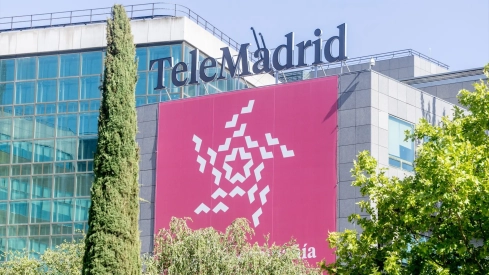
The public television of Isabel Díaz Ayuso's Government acknowledges before the courts that it does not have the capacity to pay the more than 60 million euros that Hacienda is claiming from it. Radio Televisión Madrid considers this amount unmanageable and has managed to provisionally suspend one of the value-added tax (VAT) settlements, as 'verTele' exclusively revealed.
The accumulated claim amounts to 60,029,924.56 euros for the fiscal years 2012 to 2022. The different files are appealed separately and, in the procedure now known, the Audiencia Nacional has halted a settlement of just over one million euros while resolving the appeal. The judges have taken into account the impact that demanding the payments would entail and the risk of irreparable consequences for the entity.
To justify its request, the channel presented its accounts and stated that it faces several similar procedures for an "amount unmanageable for the appellant". It also alleged that "in no case would it have treasury surpluses" to meet that volume of debt. The suspension grants a financial respite to Telemadrid while the dispute over tax deductions continues.
The conflict spans a decade of PP governments, including Ayuso's first years at the head of the Community of Madrid, whose presidency she assumed in 2019. The Audiencia Nacional already confirmed a claim of 17 million corresponding to 2012, 2013, and 2014, considering that public television had incorrectly calculated the VAT it could deduct.
From boasting about efficiency to admitting a lack of money for Hacienda
The dimension of the problem is reflected in the regional budgets themselves. The budget law of the Community of Madrid sets 98,824,000 euros for Radio Televisión Madrid in 2026. The accumulated tax claims are equivalent to 60.7% of that annual budget, a comparison that allows measuring its magnitude, although they correspond to several fiscal years and are discussed in different procedures.
The recognition of a cash flow shortage comes after the network had made its economic management a flagship. On March 18, it presented the closing of 2025 with a positive accounting result of 59,576 euros and a budgetary surplus of 846,585 euros. In that official communication, it proclaimed itself "the most efficient regional television in Spain" and highlighted that it had received 81.5 million from the Community. The defense of that efficiency now coexists with tax obligations that the entity itself admits it cannot face.
The dispute also affects other regional television networks, with claims totaling around 400 million euros. Hacienda distinguishes between the public service and the commercial activity of the networks, such as advertising or content sales. According to its criteria, entities can only deduct VAT on purchases of goods and services to the extent that they are used for activities that generate that right, instead of applying a full deduction to all their activity.
Part of the controversy is pending before the Court of Justice of the European Union, to which the Audiencia Nacional has referred questions about a dispute involving Aragón Televisión. In parallel, the central government is preparing a regulatory reform so that certain non-deductible taxes of RTVE are computed as public service costs and can receive compensation. This modification is aimed at the state corporation and does not by itself resolve the claims of Telemadrid and the other regional networks.
Ayuso brought back the director who was already in charge during the first claimed fiscal years
The continuity in the management adds a political element to Telemadrid's history. José Antonio Sánchez, brought back by Ayuso in 2021, had already directed the network between 2011 and 2014, the period that includes the three fiscal years for which the Audiencia Nacional confirmed the payment of 17 million. Under that management, the 2013 employment regulation file was also executed, which left out 861 workers and which the Supreme Court declared unfair in 2014, forcing an increase in indemnities.
Ayuso named him provisional administrator after promoting the reform of the Telemadrid law in 2021. PP and Vox ratified his designation in the Assembly, after a legal modification that had gone ahead with the popular votes and the abstention of the far-right. The provisional appointment lasted almost three years, until Sánchez was designated general director in June 2024, after passing the suitability process with the support of the PP. The shareholders' meeting that formalized his election is made up of the regional government.
The processing of that reform also ended up in court. In its ruling of March 11, 2026, the Constitutional Court concluded that the Assembly violated the right to political participation of socialist deputies by using a single reading procedure that prevented them from presenting amendments without the circumstances that justified it being present. The court annulled the parliamentary agreements that allowed that processing and specified that the ruling did not rule on the constitutionality of the law itself.
