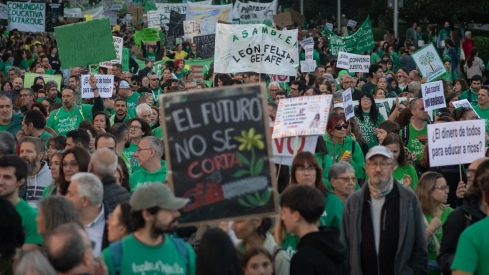
The public universities of Madrid will go on strike on November 4 and 5 and will bring the financing agreement signed by the Government of Isabel Díaz Ayuso to the center of the conflict. The Coordinator in defense of Public University, which brings together most unions and numerous student associations, calls for a halt in the six campuses of the public network against what it defines as an underfunding that pushes towards privatization.
The call affects teachers, researchers, administration and services staff, and students. The call comes after several months of clashes between rectors, unions, and the Community of Madrid, and in the midst of the pre-campaign for the early elections.
The protest once again measures the scope of the pact that the Government sold as “historic”
The Coordinator maintains that the budget allocated to the public university of Madrid remains at 0.4% of GDP, well below the 1% set by the LOSU, and also below the national average of 0.75%, and the European average of 0.92%. In its statement, read this Thursday at a press conference at the Autonomous University, the March 2026 agreement is described as a “scam.”
The Community of Madrid allocates 1,441 euros less per student to public education than the national average, according to 2023 data from the Ministry of Education. Madrid’s investment stands at 6,502 euros per student, compared to 7,943 euros for Spain as a whole, which represents a difference of approximately 18.1% below the state average. These figures place the budgets of Ayuso’s Community of Madrid as the lowest in the entire country. The capital has been at the bottom of Spain for years in university funding per student. The scarce growth of funds allocated to public universities during the analyzed period highlights the discourse of the Government of Isabel Díaz Ayuso, which claims to defend its commitment to the university system.
This pact, which the regional Executive presented as “historic” and as a “milestone,” foresees an investment of 14.8 billion euros in public campuses between this year and 2031. But the university’s own complaint highlights its limit: part of the figure includes what families pay and another part is conditioned on the fulfillment of objectives by the universities.
The Ministry of Education rejects this interpretation and denies that there is a lack of funding. In response to questions from this newspaper, it defends that the multi-year model signed with the rectors, chosen as representatives of public universities, leaves these 14.8 billion in the hands of the six centers to “continue growing” and consolidate Madrid as the largest university hub in southern Europe.
The pulse comes after two previous strikes and with new appointments on the street
The November mobilization resumes an escalation that already had a first episode on April 28, 2025, when the blackout that left Spain in the dark marred the initial strike. Even so, the protest had a notable following in the Complutense, the university that the organizers consider most suffocated, and less in the Autónoma, Alcalá, Politécnica, Carlos III, and Rey Juan Carlos.
The next strike, on November 26 and 27, did achieve broad support on the campuses, with the exception of the Politécnica and Alcalá, which receives funds from Castilla-La Mancha. Since then, tension with the Community of Madrid has continued to grow.
To warm up the call, the Coordinator has announced a concentration on October 28 before the Ministry of Education, with the aim of “demanding a quality university free of repression.” In the week of the strikes, Uni en la calle (University on the street) days will also be held, a form of protest that was already used in 2012, during the mobilizations against the increase in fees and the reduction of scholarships promoted by José Ignacio Wert.
The conflict thus once again brings to the table another piece of data that the organizers consider decisive: Madrid, despite being the richest community, has so far been the one that contributes the least funding per university student in all of Spain, according to the annual report of the Knowledge and Development Foundation. With 220,000 university students enrolled in the public network, the margin for improvement remains open and the new edition of the analysis is still pending.