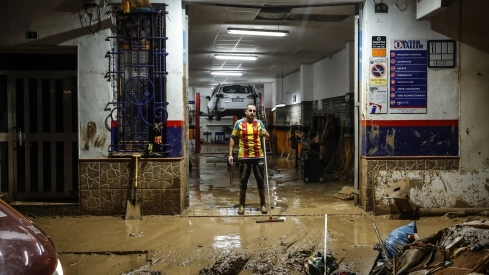
Paiporta continues in reconstruction almost two years after the DANA that destroyed a good part of the municipality, and its mayor, Vicent Ciscar, now places the next step in an urban redesign intended to better withstand extreme rains and heat waves.
In an interview with EFE, Ciscar maintains that the Valencian municipality is "much better" than in the months after the flood of October 29, 2024, although he admits that the population remains tense when new rainfall arrives. "People get very nervous," he summarizes, in an area that remains marked by the memory of the overflow.
Works underway, but with a long and difficult calendar
The mayor explains that Paiporta has "fully" entered into the reconstruction of its municipal infrastructures and details that work has already been carried out in the Poyo ravine, with the consolidation of the slopes in the urban section and the repair of two destroyed bridges.
Now, he adds, work is being done on the third bridge, demolished to build a new one, "more modern" and with "more hydraulic capacity". Ciscar insists that the general criterion is not only to return the municipality to its previous state, but to incorporate technical measures that make it "more resilient."
The City Council has 45 reconstruction projects underway for a total of 280 million euros. Of that amount, 201 million come from the Ministry of Territorial Policy and 56 million from the Ministry for Ecological Transition and the Demographic Challenge, destined for the integral water cycle.
The mayor acknowledges that there is a feeling that everything is progressing slowly, but attributes it to the technical complexity of works that, he says, must be designed with current regulations. The complete repair of the sewage system will require opening about 25 kilometers of streets to change drains and intervening in 80 kilometers of urban area with asphalt, sidewalks, lighting, gardens and parks.
Rethinking the city for water, heat and fewer cars
Regarding deadlines, Ciscar recalls that the Miteco has set four years to execute the new drains, although he speaks of "seven or eight years" to complete the urban transformation. "The DANA destroyed Paiporta and forces us to rebuild it, but climate change forces us to rethink that reconstruction," he states.
That rethinking, he argues, must serve not only for episodes of rain and flooding, but also for heat waves. That is why he advocates for more vegetation and more shade, with trees as one of the natural elements of adaptation.
He also proposes streets with fewer vehicles, after the DANA demonstrated, he says, that cars were one of the factors that caused the most damage by sweeping away doors, lampposts, and other urban elements. In total, he recalls, 12,000 vehicles were removed as total losses in Paiporta.
To compensate for this reduction of surface space, the City Council plans two large-capacity, elevated parking lots. Ciscar maintains that the horizon of reconstruction must be thought of for 50 or 60 years and that the goal is not to return to the previous situation, but to turn Paiporta into a "modern" and at the same time safer city.
More information, more control, and less uncertainty
The council has created an Emergency Office with expert personnel, will introduce early warning systems, and has installed real-time cameras on the Poyo ravine, accessible via the internet. Ciscar argues that this information helps to reduce neighborhood anxiety, although it does not eliminate nervousness every time it rains.
"People today need information," says the mayor, who emphasizes the importance of that information being "truthful and fast." Meanwhile, the municipality continues to combine the daily life of a population of 30,000 inhabitants with works that, according to his own calculation, will still last for years.
In this scenario, Paiporta keeps several pending tasks open: finishing the new drains, completing road reconstruction, and finishing adapting the urban area to a context that the City Council no longer interprets only as a repair after the DANA, but as a fundamental work for the coming decades.