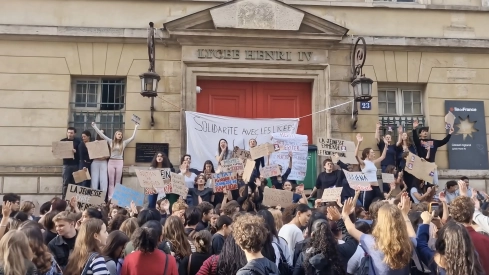
Tens of thousands of high school students took to the streets on Tuesday in Paris and other regions of France, alongside teachers, university students, and trade unionists, to demand more resources for education, on a day marked by the tension of recent days and strong police surveillance. In the marches, slogans against repression abounded, and protesters counted 450,000 people across the country, of whom 100,000 gathered in the capital. Sébastien Lecornu's government lowered those figures to 100,000 for the entire country.
Miles de jóvenes estudiantes franceses toman las calles de París en la huelga educativa en defensa de los servicios públicos. Impresionante. pic.twitter.com/lM5qlWzOXB
— Fonsi Loaiza (@FonsiLoaiza) October 6, 2026
Students denounce the poor conditions of the buildings, overcrowded classrooms, and the lack of teachers, a situation that complicates the coverage of sick leave and absences, especially in working-class neighborhoods. “Generation Z is rising up and wants to be heard,” Lilia, a 19-year-old student who came to protest, told France Presse. The young woman added that she hopes President Emmanuel Macron will address the movement's demands: “Instead of funding wars, he should fund his own country.”
Two weeks of protests with incidents and injuries
The student mobilizations come after two weeks of protests that have been increasing in intensity and extension. The first concentrations were mainly focused on the conditions of educational centers, the lack of teachers and resources, and the impact of cuts on students. As the days passed, the protests have spread to numerous high schools and have led to blockades, clashes with security forces, and several arrests.
One of the most serious episodes occurred in Lens, in northern France, where a 15-year-old student was seriously injured during a police intervention. The minor lost a hand and part of his forearm after being hit by a stun grenade. The incident has raised concerns about the use of riot control material and has opened an investigation to determine the exact circumstances in which the injury occurred.
The tension has also moved to the political arena. The French government defends the need to guarantee order in the face of the violent episodes recorded during some mobilizations, while opposition sectors and student organizations demand that the demands behind the protests be addressed. These include the lack of resources in public education, the conditions of the centers, and aid for young people. The conflict also unfolds a few months before the next presidential elections, scheduled for April 2027. The economic situation, the rising cost of living, and the Executive's decisions to reduce public spending have turned the protests into a new focus of political tension, with the debate on cuts and public services at the center of the discussion.
The Government denies "police repression" while tension grows in the streets
Before the National Assembly, the prime minister condemned the violence recorded on the sidelines of the demonstrations, denied that there was "police repression", an accusation launched from different sectors, and announced the suspension of classes in high schools at the end of the week to organize a "space for internal democracy". In total, a quarter of secondary schools, 891 out of 3,700, saw their classes "suspended, either totally or partially" on Tuesday, according to the Ministry of Education.
In this context, the police officer who fired the grenade launcher that seriously injured 14-year-old Eden in the face last week in Saint-Ouen-l'Aumône (Val-d'Oise), has been charged with violence, according to the Pontoise prosecutor. The officer is accused of "violence committed by a person holding public authority resulting in mutilation or permanent disability", has been placed under judicial supervision and is prohibited from exercising his duties until further notice, the prosecutor's office specified.
📹 Los padres de un chico de 14 años al que la policía francesa disparó un bote de gas lacrimógeno a la cara: "Le han quitado la vida". Mientras, la cólera de los estudiantes toma las calles de Francia en un día de protestas masivas ➡️https://t.co/ggJoWSXITv pic.twitter.com/Wrd9ANKxL4
— EL PAÍS (@el_pais) October 6, 2026
The crisis thus leaves the Executive facing a double front: responding to student demands that have spread throughout the country and, at the same time, containing an escalation of violence that has already left dozens of young people injured and opened a new debate on the actions of security forces. With just over six months until the presidential elections, the protests have ceased to be solely a conflict in high schools and have become one of the main sources of political and social tension in France.
