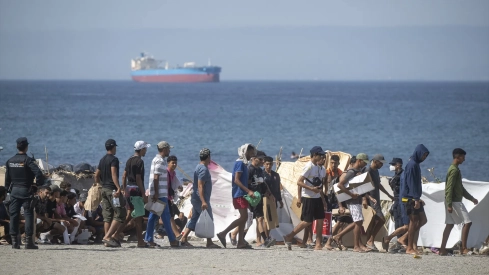
The Moroccan authorities informed the Spanish Government this Thursday that they have opened an investigation into the massive entry of more than 70,000 people into Ceuta on July 30 and 31. The Moroccan Minister of Foreign Affairs, Naser Bourita, conveyed the opening of the investigation to his Spanish counterpart, José Manuel Albares.
Rabat's move comes at a time of greatest political and judicial pressure over what happened at the border. The President of the Government, Pedro Sánchez, assured Congress that Spain will act "with total forcefulness" if solid evidence appears that accredits Morocco's responsibility in the crisis.
Sánchez maintained, at the same time, that no Spanish, European or international institution has provided the Executive with conclusive evidence that the Moroccan authorities planned the operation. Bourita's announcement now opens its own path to clarify what happened from the other side of the border.
The Moroccan Government has not yet detailed which body will lead the investigation, what specific facts it will examine, or when it will share its conclusions with Spain. The communication sent to Albares is limited to confirming that the investigations are already underway.
A report pointing to Moroccan agents
The investigation announced by Rabat coincides with the controversy caused by the document that the National Immigration and Borders Center (CENIF) has delivered to the National Court judge María Tardón. The 55-page report analyzes videos, photographs, messages published on social networks, interviews with migrants, and mobile phone data related to the crossing.
The agents consider what happened incompatible with a spontaneous mobilization and rule out that the known trafficking networks in the area had the capacity to concentrate and displace tens of thousands of people. The document describes an organized operation on the ground and includes images of Moroccan gendarmes giving instructions to overcome obstacles and reach the entry points.
It also points to the presence of plainclothes people who walked against the flow, monitored the progress of the groups, and seemed to give instructions to the uniformed personnel. The investigators speak of a high permissiveness during the decisive hours of the crisis, although the report does not identify who could have ordered the operation nor attributes its authorship to the Government of Morocco.
Tardón requested this analysis to determine if the massive entry was a concerted action or directed by an organization. The magistrate now awaits the report commissioned from the Civil Guard and the criteria of the Prosecutor's Office before deciding whether the Audiencia Nacional has jurisdiction to open an investigation into events that could affect national security.
Sánchez asks for evidence before pointing to Rabat
During his appearance in Congress, Sánchez acknowledged that Moroccan agents allowed passage for about ten hours on July 30, when the most critical moment of the entry occurred. The Government maintains that it still needs to be clarified whether that lack of response was due to a deliberate decision or an inability to contain the crowd.
The president also revealed that the Executive summoned the Moroccan ambassador to Spain on August 21 over statements by two Moroccan ministers about Ceuta and Melilla. Sánchez described those words as "unacceptable" and defended the prudence maintained by the Government to avoid a diplomatic escalation while investigations progress.
Rabat had until now rejected accusations of permissiveness and attributed the mobilization to mafias, calls disseminated on social media, and a false interpretation of a Spanish ruling on hot returns. The Moroccan Minister of Justice, Abdellatif Ouahbi, assured in August that security forces avoided forcibly stopping the crowd to prevent bloodshed.
The Moroccan Ministry of Interior announced days later the arrest of several people accused of promoting new calls for collective crossings towards Ceuta and Melilla. In Spain, the next decision will correspond to Tardón when she receives the pending reports from the Civil Guard and the Prosecutor's Office.
